Associations of depressive symptoms, social engagement and support, and lifestyle behaviors among non-Hispanic black and Hispanic men with chronic conditions in the United States
Jeong-Hui Park, Caroline D. Bergeron, Michael Ness, Ledric D. Sherman, Ashley L. Merianos, Moka Yoo-Jeong, Cynthia L. Cisneros Franco, Aditi Tomar, Ali Boolani, Chung Lin Kew, Oluyomi Oloruntoba, Matthew Lee Smith

TL;DR
This study explores how depressive symptoms, social support, and lifestyle behaviors are linked in non-Hispanic Black and Hispanic men with chronic conditions in the U.S.
Contribution
The study identifies common and unique factors influencing depressive symptoms in non-Hispanic Black and Hispanic men with chronic conditions.
Findings
Hispanic men and those on more medications had higher odds of depressive symptoms.
Social disconnection and healthcare frustrations were strongly linked to depressive symptoms.
Tobacco use and prolonged sitting increased the likelihood of depressive symptoms.
Abstract
Self-management of depressive symptoms is influenced by co-morbidity, social support, and health-related behaviors. Men are less likely to discuss depressive moods and seek healthcare. This study examines factors associated with depressive symptoms among non-Hispanic Black and Hispanic men ages ≥40 years with ≥1 chronic condition in the U. S. Data from 1,907 non-Hispanic Black (n = 1,117) and Hispanic (n = 790) males with chronic conditions were analyzed using logistic regression to assess depressive symptoms, identified as a Patient Health Questionnaire-2 score ≥3. One model was fitted for all men, then separate models were fitted for non-Hispanic Black and Hispanic men, respectively. The models adjusted for sociodemographic, disease characteristics, health status, social engagement and support, and lifestyle behaviors. In the full model, Hispanic men (OR = 1.39, p = 0.017) and those…
Genes, proteins, chemicals, diseases, species, mutations and cell lines named across the full text — each resolved to its canonical identifier and authoritative record.
Click any figure to enlarge with its caption.
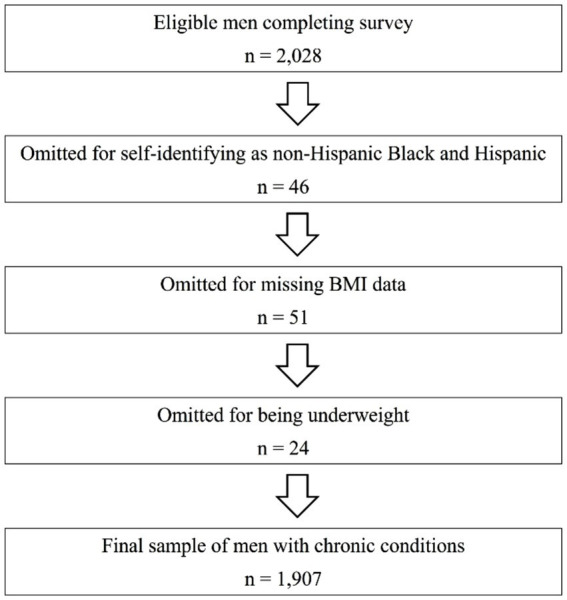 Figure 1
Peer Reviews
No public reviews on file for this paper yet. If you reviewed it on a platform where reviews are public (OpenReview, ICLR, NeurIPS, ICML), you can paste yours below so the community can read it here.
Videos
No videos yet. Explain this paper in a talk, walkthrough, or lecture? Add one.
Taxonomy
TopicsChronic Disease Management Strategies · Diabetes Management and Education · Mental Health Treatment and Access