Hirschsprung's disease prognosis: significance of the length of aganglionosis and reference value for the dilated segment resection length
Yingyu Jia, Bingliang Li, Hongwei Xi, Hongxia Ren

TL;DR
This study finds optimal resection lengths for treating Hirschsprung's disease based on the length of aganglionosis, improving postoperative outcomes in children.
Contribution
Identifies specific optimal dilated segment resection lengths for short- and long-segment Hirschsprung's disease.
Findings
For short-segment HSCR, the best outcomes occur with a resection length of 7.25 cm.
For long-segment HSCR, the optimal resection length is 13.00 cm.
The length of aganglionosis significantly affects outcomes in long-segment HSCR but not in short-segment HSCR.
Abstract
The appropriate length of resection for the dilated segment in Hirschsprung's disease (HSCR) remains a subject of debate, and the correlation between postoperative clinical outcomes has yet to be elucidated. This study aimed to explore the relationship between the dilated segment resection length (DSRL) and the short-term clinical outcome of HSCR, as well as to determine the optimal DSRL value. The clinical data of all children with HSCR who underwent a pull-through surgery at Shanxi Children's Hospital from May 2016 to September 2023 were analyzed retrospectively, the baseline characteristics such as sex, gestational age, family history, and complications such as soiling, perianal erosion, constipation were collected. The groups were stratified in recto-sigmoid aganglionosis (short-segment) and extended colonic (long-segment), and DSRL was divided into three groups: DSRL < 10 cm, 10 ≤…
Genes, proteins, chemicals, diseases, species, mutations and cell lines named across the full text — each resolved to its canonical identifier and authoritative record.
Click any figure to enlarge with its caption.
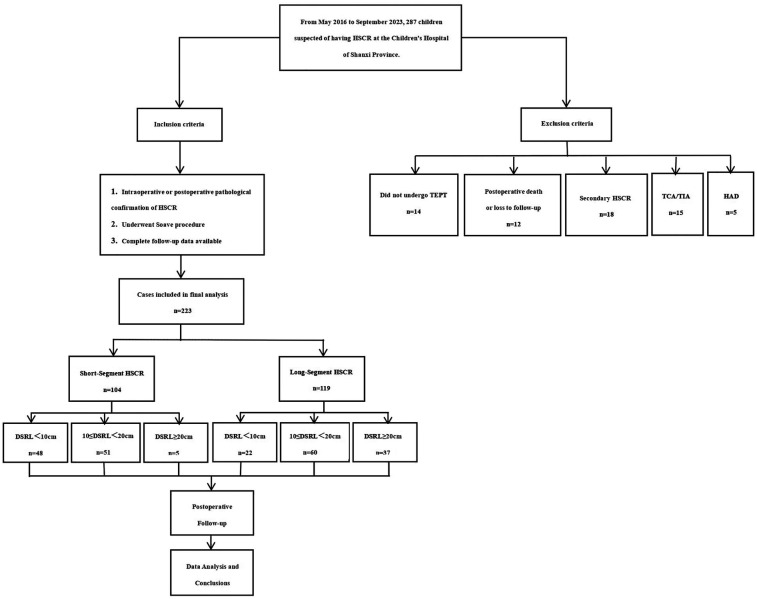 Figure 1
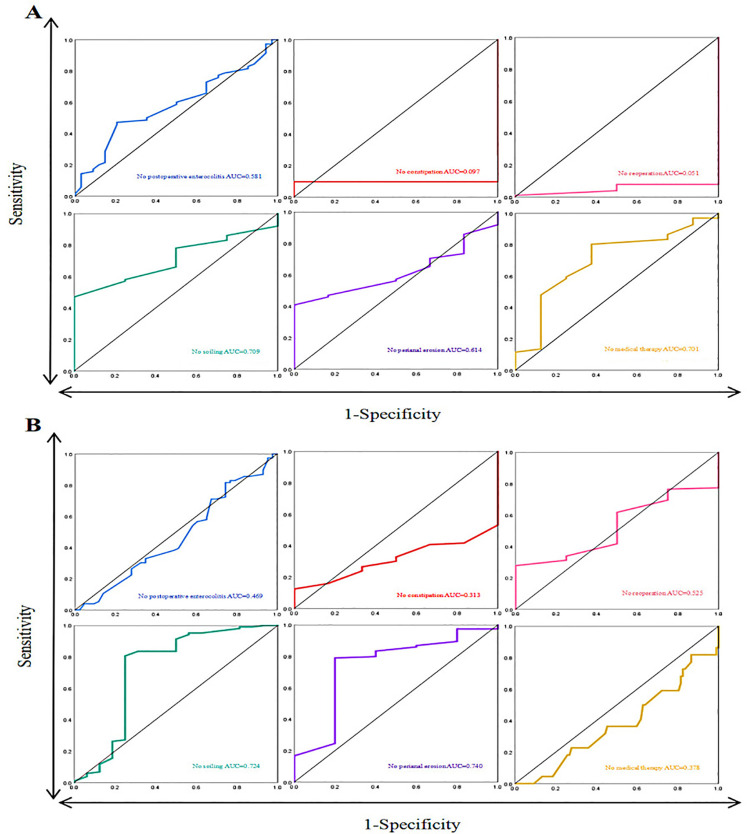 Figure 2
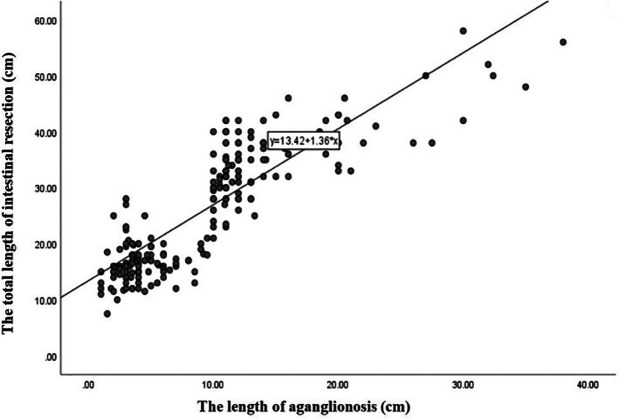 Figure 3
Peer Reviews
No public reviews on file for this paper yet. If you reviewed it on a platform where reviews are public (OpenReview, ICLR, NeurIPS, ICML), you can paste yours below so the community can read it here.
Videos
No videos yet. Explain this paper in a talk, walkthrough, or lecture? Add one.
Taxonomy
TopicsCongenital gastrointestinal and neural anomalies · Intestinal Malrotation and Obstruction Disorders · Gastroesophageal reflux and treatments