Establishing an algorithm for molecular genetic diagnostics in Chinese children with brachydactyly type E
Xueqian Wang, Shengzhuang Guan, Yiqing Gao, Rongrong Xie, Fengyun Wang, Xiuli Chen, Haiying Wu, Xiaohui Zhang, Dandan Zhang, Bingyu Yang, Qisang Fan, Qing Wang, Hongying Wang, Tao Feng, Haitao Lv, Ting Chen

TL;DR
This study creates a genetic testing algorithm to improve diagnosis of brachydactyly type E in Chinese children and identifies key gene mutations linked to the condition.
Contribution
The study proposes a novel diagnostic algorithm for BDE and identifies genotype-phenotype correlations specific to Chinese patients.
Findings
Causative genetic variants were identified in 19 out of 60 patients with BDE.
GNAS mutations were the most common cause of BDE followed by EXT1 and ACAN defects.
Diagnostic yield was highest in patients with brachydactyly combined with intellectual disability (83.3%).
Abstract
Brachydactyly type E (BDE) is characterized by variable shortening of metacarpals or metatarsals, often involving phalanges. It may occur as an isolated anomaly or as part of congenital syndromes. With advancements in molecular diagnostic technologies, how genetic testing enhances the precise diagnosis of BDE remains unclear. Our aims were to establish an algorithm for molecular genetic diagnostics in Chinese children with BDE and to explore the phenotype-genotype correlations of Chinese patients with BDE. We reviewed left-hand wrist X-rays from children visiting Children’s Hospital of Soochow University (Jun 2021–Dec 2023). From 60,650 films, 135 BDE cases were identified, and their comprehensive phenotypes were collected. Whole-exome sequencing (WES) with copy number variation (CNV) analysis was performed on 60 patients and their parents. Sanger sequencing was used to validate single…
Genes, proteins, chemicals, diseases, species, mutations and cell lines named across the full text — each resolved to its canonical identifier and authoritative record.
Click any figure to enlarge with its caption.
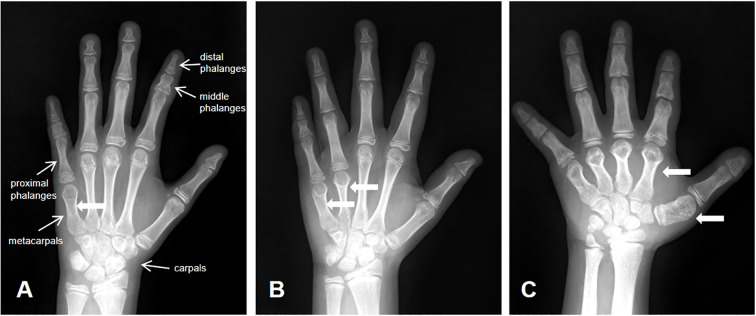 Figure 1
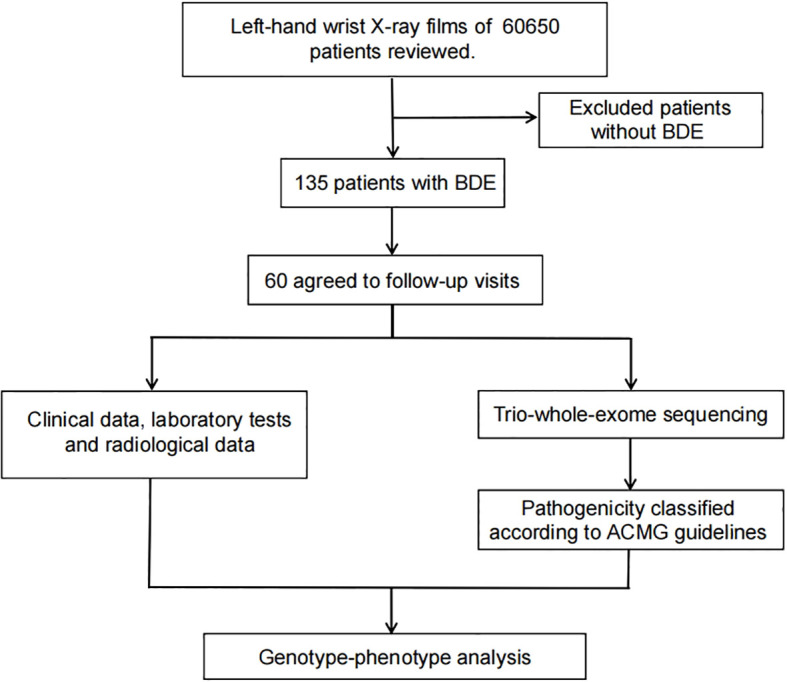 Figure 2
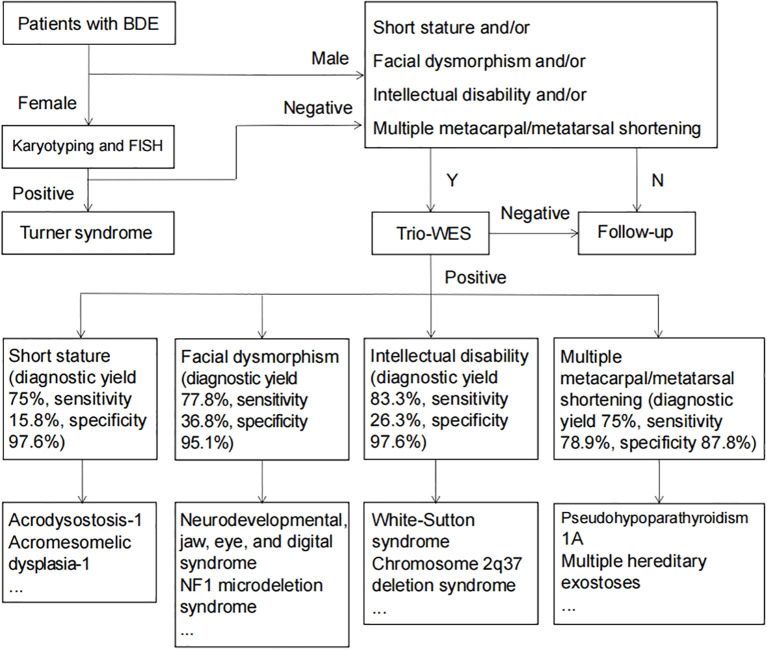 Figure 3
Peer Reviews
No public reviews on file for this paper yet. If you reviewed it on a platform where reviews are public (OpenReview, ICLR, NeurIPS, ICML), you can paste yours below so the community can read it here.
Videos
No videos yet. Explain this paper in a talk, walkthrough, or lecture? Add one.
Taxonomy
TopicsGenomic variations and chromosomal abnormalities · Congenital limb and hand anomalies · Genomics and Rare Diseases