Identification of Drug-Resistant Laterality in Bilateral Temporal Lobe Epilepsy
Hiroharu Suzuki, Takumi Mitsuhashi, Yasushi Iimura, Tetsuya Ueda, Kazuki Nishioka, Madoka Nakajima, Hidenori Sugano, Akihide Kondo

TL;DR
This study explores using brain activity changes from medication to identify which side of the brain is more resistant to treatment in a type of epilepsy affecting both temporal lobes.
Contribution
The study introduces the use of medication-induced changes in phase-amplitude coupling as a potential biomarker for lateralizing drug resistance in bilateral temporal lobe epilepsy.
Findings
MI values decreased in the right hippocampus and entorhinal cortex after resuming ASM, but not in the left entorhinal cortex.
A left temporal lobectomy resulted in seizure freedom for 37 months without changing the ASM regimen.
ASM-induced MI changes may help identify the more refractory temporal lobe in BTLE patients.
Abstract
Selecting the optimal resection side in bilateral temporal lobe epilepsy (BTLE) remains a challenge due to independent seizure origins in both temporal lobes. This study, therefore, aimed to evaluate whether antiseizure medication (ASM)-induced changes in the Modulation Index (MI), a measure of phase-amplitude coupling, could serve as a biomarker for determining the predominant laterality of drug resistance in BTLE. A 35-year-old patient with drug-resistant BTLE underwent stereoelectroencephalography (SEEG) targeting bilateral temporal structures. To assess refractory epileptic focus, MI values were compared between the ASM-withdrawn and ASM-resumed states. The MI was calculated between high-frequency oscillations and 3-4 Hz slow-wave activity during interictal epochs. Following ASM resumption, MI values significantly decreased in the right hippocampus and entorhinal cortex, while the…
Genes, proteins, chemicals, diseases, species, mutations and cell lines named across the full text — each resolved to its canonical identifier and authoritative record.
Click any figure to enlarge with its caption.
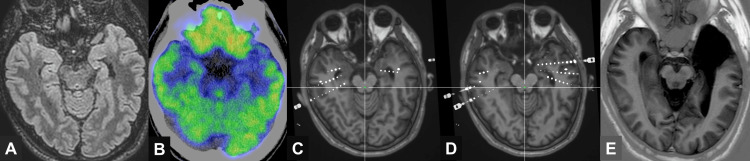 Figure 1
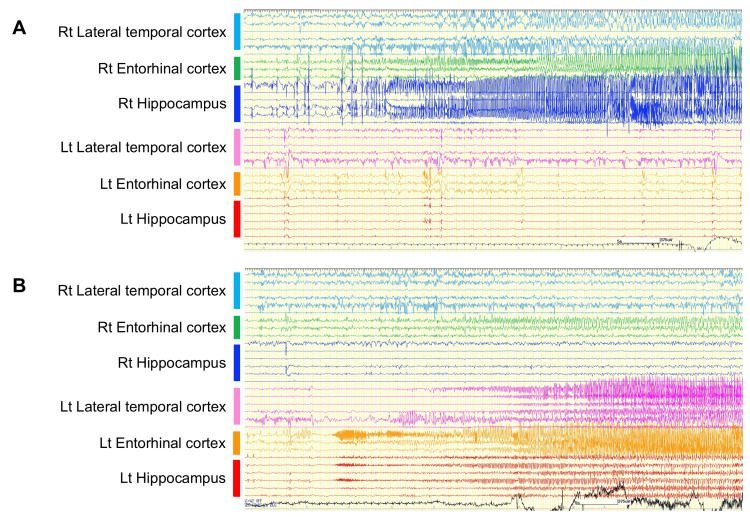 Figure 2
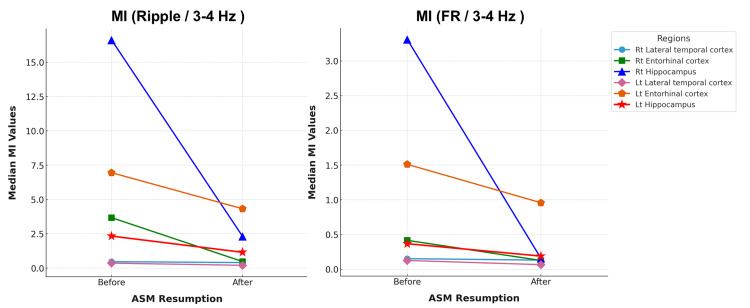 Figure 3
Peer Reviews
No public reviews on file for this paper yet. If you reviewed it on a platform where reviews are public (OpenReview, ICLR, NeurIPS, ICML), you can paste yours below so the community can read it here.
Videos
No videos yet. Explain this paper in a talk, walkthrough, or lecture? Add one.
Taxonomy
TopicsEpilepsy research and treatment · Vestibular and auditory disorders · Neurobiology of Language and Bilingualism