Utilizing cardiac magnetic resonance to assess the sequelae of prior rejection episodes on myocardium and correlation with clinical outcomes
Akila Bersali, Farhan Ishaq, Mianli Xiao, Edward A Graviss, George Naufal, Ashrith Guha, Dipan J. Shah, Rayan Yousefzai

TL;DR
This study uses cardiac MRI to show how past heart transplant rejections affect heart structure and function, and how these changes relate to future health outcomes.
Contribution
The study demonstrates that CMR can detect long-term effects of acute cellular rejection in heart transplant recipients and predict clinical outcomes.
Findings
Heart transplant recipients with ACR had reduced left and right ventricular strain and increased LV mass.
LV ejection fraction, RV ejection fraction, and LV scar size were significantly associated with cardiovascular hospitalization or mortality.
Indexed RV stroke volume and LV scar size remained significant predictors after adjusting for covariates.
Abstract
This study compared structural and functional alterations using cardiac MRI (CMR) in heart transplant recipients with and without acute cellular rejection (ACR) and analyzed their association with clinical outcomes. ACR patients showed reduced left ventricular global longitudinal strain (LV GLS) (10% vs 12%; P = 0.03), reduced right ventricular global longitudinal strain (16% vs 18%; P = 0.04), increased left ventricular (LV) mass (72 vs 61 g/m²; P = 0.003), and decreased right ventricular stroke volume (70 vs 79 mL; P = 0.05). Univariate analysis revealed that LV ejection fraction (EF) (HR 0.90, P < 0.001), RV ejection fraction (HR 0.91, P = 0.004), LV stroke volume (SV) (HR 0.96, P = 0.01), RV SV (HR 0.96, P = 0.003), and LV scar size (HR 1.13, P = 0.002) were significantly associated with cardiovascular hospitalization or mortality. After adjusting for relevant covariates, indexed RV…
Genes, proteins, chemicals, diseases, species, mutations and cell lines named across the full text — each resolved to its canonical identifier and authoritative record.
Click any figure to enlarge with its caption.
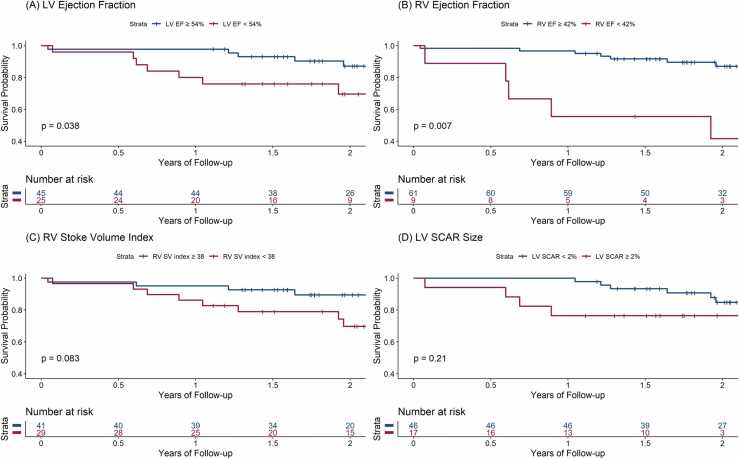 Figure 1
Peer Reviews
No public reviews on file for this paper yet. If you reviewed it on a platform where reviews are public (OpenReview, ICLR, NeurIPS, ICML), you can paste yours below so the community can read it here.
Videos
No videos yet. Explain this paper in a talk, walkthrough, or lecture? Add one.
Taxonomy
TopicsCardiac Imaging and Diagnostics · Cardiovascular Function and Risk Factors · Cardiac Valve Diseases and Treatments