Serum Serotonin Levels as a Potential Risk Factor for Overactive Bladder in a Community‐Dwelling Population: A Four‐Year Longitudinal Study
Takafumi Fukushima, Teppei Okamoto, Tomoko Hamaya, Hirotake Kodama, Naoki Fujita, Hayato Yamamoto, Atsushi Imai, Shigeyuki Nakaji, Shingo Hatakeyama

TL;DR
This study found that low blood serotonin levels may increase the risk of developing overactive bladder in a community-dwelling population over four years.
Contribution
The study identifies serum serotonin levels as a novel potential risk factor for overactive bladder.
Findings
Participants with OAB had significantly lower serum serotonin levels compared to those without OAB.
Low serum serotonin levels (<134 ng/mL) were independently associated with an increased risk of OAB.
Age, mental status, and prior OAB were also independent risk factors for OAB.
Abstract
This study aims to investigate the potential influence of serum serotonin (5‐HT) levels on the development of overactive bladder (OAB) in a community‐dwelling population. A four‐year longitudinal study was conducted involving 615 subjects who participated in the Iwaki Health Promotion Project in Hirosaki, Japan, in both 2015 and 2019. OAB was defined as experiencing urinary urgency at least once a week with an Overactive Bladder Symptom Score (OABSS) of ≥ 3. Baseline data from 2015, including serum 5‐HT levels, other laboratory data, and comorbidity information, were used for the analysis. The association between serum 5‐HT levels and incident OAB in 2019 (OAB‐2019) was examined using multivariate logistic regression analyses. The study included 250 men and 365 women, of whom 74 individuals (29 men and 45 women) met the diagnostic criteria for OAB in 2019. Significant differences were…
Genes, proteins, chemicals, diseases, species, mutations and cell lines named across the full text — each resolved to its canonical identifier and authoritative record.
Click any figure to enlarge with its caption.
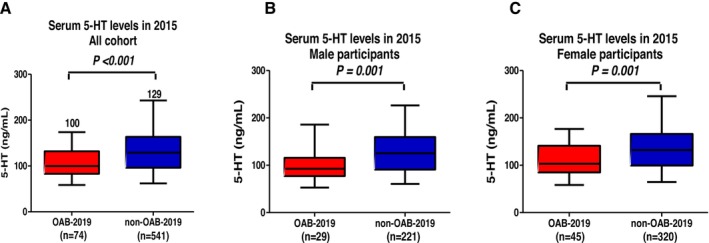 Figure 1
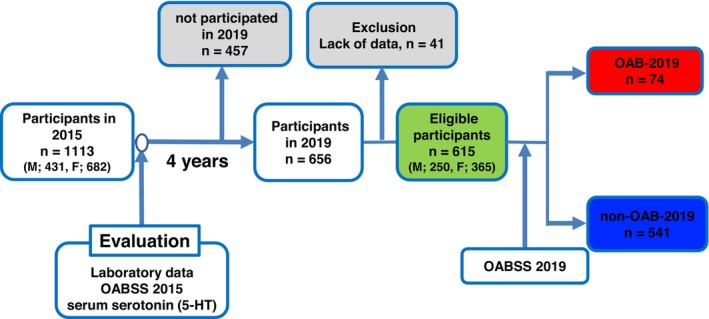 Figure 2
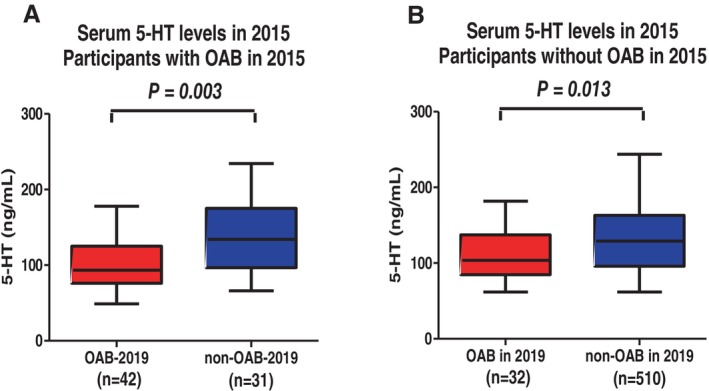 Figure 3
Peer Reviews
No public reviews on file for this paper yet. If you reviewed it on a platform where reviews are public (OpenReview, ICLR, NeurIPS, ICML), you can paste yours below so the community can read it here.
Videos
No videos yet. Explain this paper in a talk, walkthrough, or lecture? Add one.
Taxonomy
TopicsUrinary Bladder and Prostate Research · Pelvic floor disorders treatments · Urinary Tract Infections Management