Lyme Disease Testing Practices, Wisconsin, USA, 2016–2019
Kiersten J. Kugeler, Erica Scotty, Austin Earley, Alison F. Hinckley, Sarah A. Hook, Courtney C. Nawrocki, Alexandra M. Linz, Jennifer Meece, Anna M. Schotthoefer

TL;DR
This study examines Lyme disease testing patterns in Wisconsin from 2016 to 2019, finding that many people tested positive multiple times, which could affect how surveillance data is interpreted.
Contribution
The study reveals that repeat testing frequency increases with age and may impact surveillance data accuracy.
Findings
6%–15% of persons with a positive test each year had previously tested positive.
Repeat testing frequency increased with patient age.
Repeat testing of persons with prior seropositivity may affect surveillance data interpretation.
Abstract
Positive laboratory results are increasingly used for Lyme disease surveillance in the United States. We found 6%–15% of persons with a positive test each year tested positive in a prior year; repeat testing frequency increased with patient age. Repeat testing of persons with previous seropositivity could affect surveillance data interpretation.
Genes, proteins, chemicals, diseases, species, mutations and cell lines named across the full text — each resolved to its canonical identifier and authoritative record.
Click any figure to enlarge with its caption.
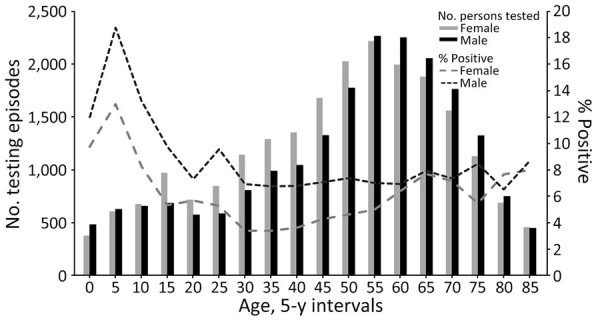 Figure 1
Peer Reviews
No public reviews on file for this paper yet. If you reviewed it on a platform where reviews are public (OpenReview, ICLR, NeurIPS, ICML), you can paste yours below so the community can read it here.
Videos
No videos yet. Explain this paper in a talk, walkthrough, or lecture? Add one.
Taxonomy
TopicsVector-borne infectious diseases · Viral Infections and Vectors · Mosquito-borne diseases and control