ist-1/IRS1 affects L1 starvation resistance in daf-16/FoxO- dependent and independent fashion
Jingxian Chen, Ainsley R. Scheiner, Ivan B. Falsztyn, L. Ryan Baugh

TL;DR
The study explores how the ist-1 gene in C. elegans affects resistance to starvation during early development, both through and independent of a known signaling pathway.
Contribution
The study reveals that ist-1/IRS1 influences L1 starvation resistance via DAF-16/FoxO-dependent and -independent mechanisms.
Findings
ist-1/IRS1 mutants show increased larval growth and reproduction after L1 starvation.
ist-1/IRS1 promotes DAF-16 nuclear localization in starved larvae, suggesting involvement in insulin signaling.
ist-1/IRS1 also functions independently of DAF-16/FoxO, indicating novel roles.
Abstract
The mammalian IRS1 gene is an important adaptor for the insulin and insulin-like growth factor receptors, but its sole homolog in the nematode C. elegans , ist-1 , has received relatively little attention. We show that ist-1 /IRS1 has modest effects on L1 starvation resistance, with two null mutants increasing larval growth and reproduction after recovery from extended L1 arrest. ist-1 /IRS1 mutants increase nuclear localization of DAF-16 /FoxO, a critical effector of insulin/IGF signaling, in starved L1 larvae, consistent with IST-1 /IRS1 transducing DAF-2 /IGFR signaling. However, epistasis analysis suggests that ist-1 /IRS1 also functions independently of daf-16 /FoxO , suggesting additional, novel function.
Genes, proteins, chemicals, diseases, species, mutations and cell lines named across the full text — each resolved to its canonical identifier and authoritative record.
Click any figure to enlarge with its caption.
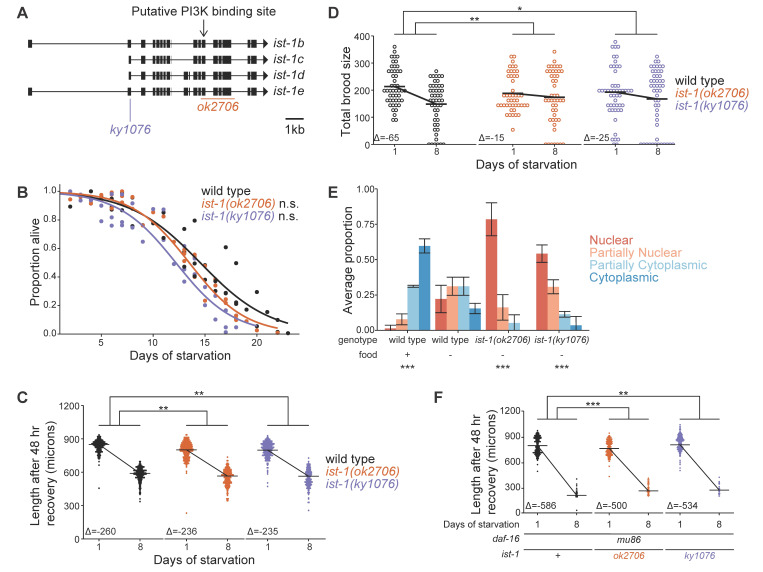 Figure 1
Peer Reviews
No public reviews on file for this paper yet. If you reviewed it on a platform where reviews are public (OpenReview, ICLR, NeurIPS, ICML), you can paste yours below so the community can read it here.
Videos
No videos yet. Explain this paper in a talk, walkthrough, or lecture? Add one.
Taxonomy
TopicsCardiovascular Function and Risk Factors