Environmental Exposures Relative to Locally Acquired Hansen Disease, United States
Danielle Chaney, Jennifer Breiman, Jessica K. Fairley

TL;DR
This study explores how contact with nine-banded armadillos may contribute to the spread of Hansen disease in the United States.
Contribution
The study provides evidence linking outdoor activities and armadillo contact to Hansen disease exposure.
Findings
Frequent outdoor activities were associated with higher risk of Hansen disease.
Contact with nine-banded armadillos was identified as a likely source of exposure.
The study was conducted using a telephone survey and chart review in a Georgia clinic.
Abstract
Nine-banded armadillos (Dasypus novemcinctus) are suspected transmission sources of Hansen disease in North America. We conducted a telephone survey and chart review of patients with Hansen disease seen at a Georgia, USA, clinic during 1997–2022. Findings suggest frequent outdoor activities and armadillo contact were likely sources of exposure.
Genes, proteins, chemicals, diseases, species, mutations and cell lines named across the full text — each resolved to its canonical identifier and authoritative record.
Click any figure to enlarge with its caption.
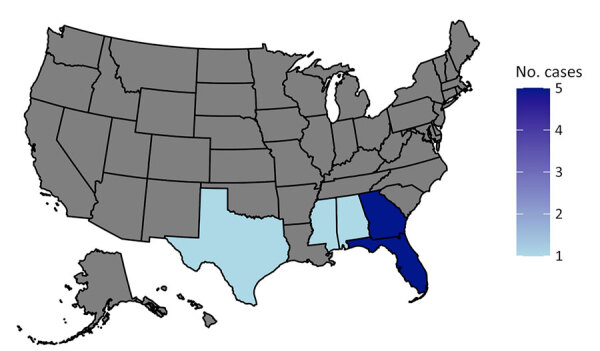 Figure 1
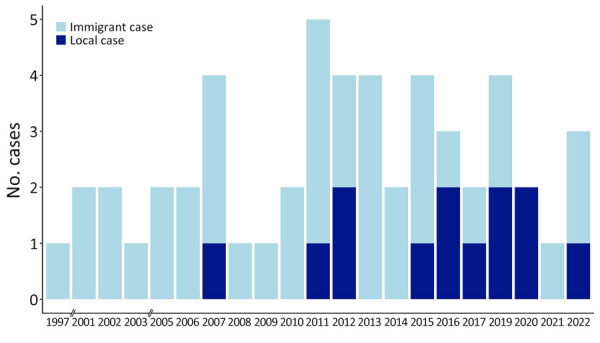 Figure 2
Peer Reviews
No public reviews on file for this paper yet. If you reviewed it on a platform where reviews are public (OpenReview, ICLR, NeurIPS, ICML), you can paste yours below so the community can read it here.
Videos
No videos yet. Explain this paper in a talk, walkthrough, or lecture? Add one.
Taxonomy
TopicsLeprosy Research and Treatment · Infectious Diseases and Tuberculosis · Mycobacterium research and diagnosis