Mitochondrial markers (cytochrome c oxidase subunit I and 16S ribosomal RNA) as supporting biomarkers for wild bird identification
Julián Marín-Villa, Albeiro López-Herrera, Daisy A. Gómez-Ruiz, Diana C. Restrepo-Rodas, Geraldine Sánchez-Rodríguez, Cristina Úsuga-Monroy

TL;DR
This study shows that mitochondrial markers COI and 16S rRNA can accurately identify psittacine birds, aiding in wildlife trafficking investigations and conservation.
Contribution
The study validates COI and 16S rRNA as reliable molecular tools for psittacine species identification in forensic and conservation contexts.
Findings
COI and 16S rRNA sequences achieved 100% concordance with morphological identification for six psittacine birds.
Phylogenetic analyses using both markers produced congruent results with high branch support (>90%).
Generated sequences were submitted to GenBank and BOLD, enhancing genetic databases for Neotropical avifauna.
Abstract
Illegal wildlife trafficking is a critical threat to biodiversity, particularly in megadiverse countries such as Colombia. Birds, notably psittacines, are among the most targeted taxa. Morphological identification is often insufficient, especially when dealing with cryptic species or degraded samples. This study aimed to assess the utility of mitochondrial markers cytochrome c oxidase subunit I (COI) and 16S ribosomal RNA (16S rRNA) as molecular tools for species-level identification of psittacines housed at the Conservation Park of Medellín. Six adult psittacines from the genera Ara and Pionus were selected based on availability. Blood samples were collected and genomic DNA was extracted using a commercial kit. Polymerase chain reaction amplification of partial COI and 16S rRNA gene fragments was performed, followed by Sanger sequencing. Sequence identity was confirmed using BLASTn…
Genes, proteins, chemicals, diseases, species, mutations and cell lines named across the full text — each resolved to its canonical identifier and authoritative record.
Click any figure to enlarge with its caption.
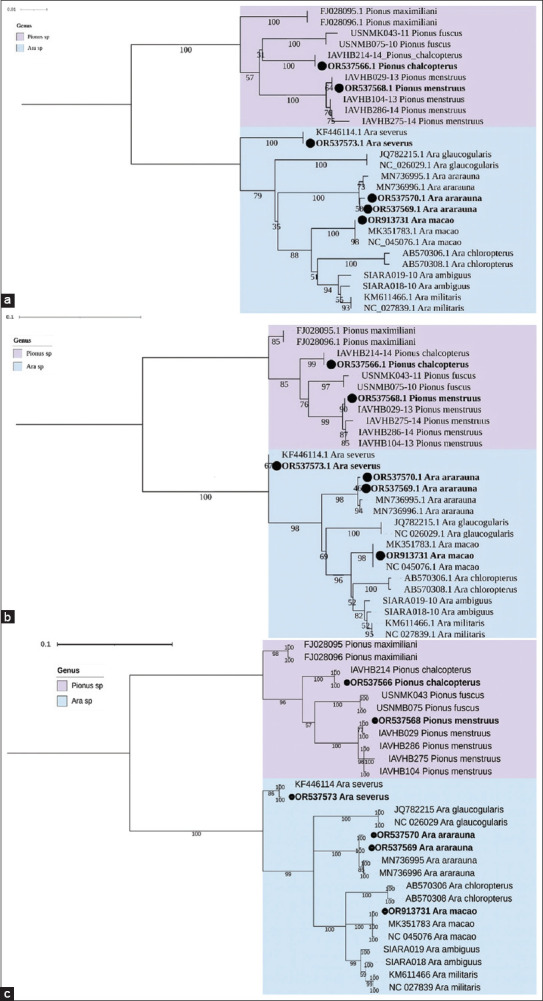 Figure 1
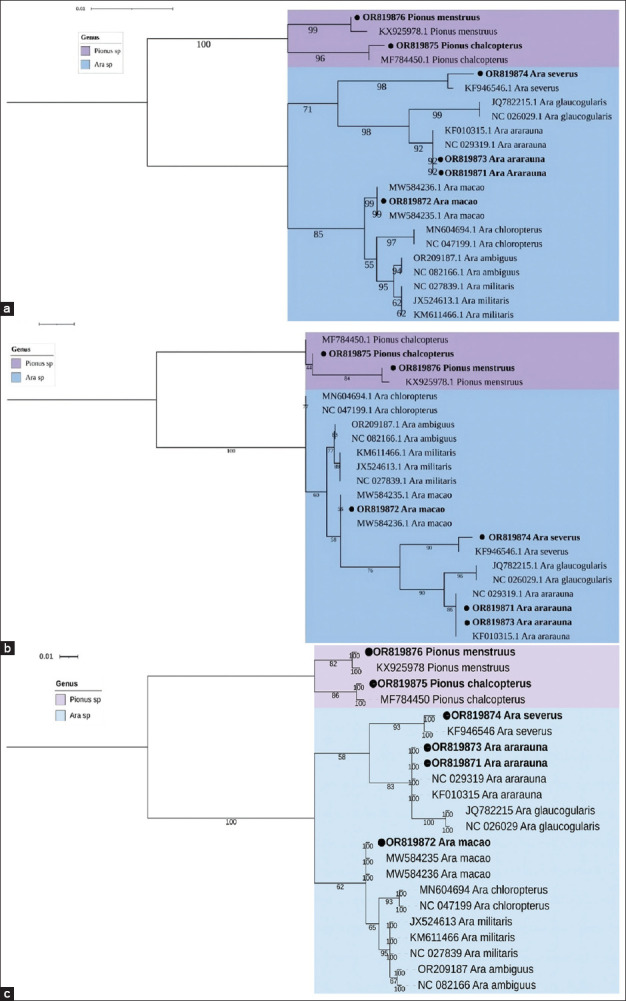 Figure 2
Peer Reviews
No public reviews on file for this paper yet. If you reviewed it on a platform where reviews are public (OpenReview, ICLR, NeurIPS, ICML), you can paste yours below so the community can read it here.
Videos
No videos yet. Explain this paper in a talk, walkthrough, or lecture? Add one.
Taxonomy
TopicsIdentification and Quantification in Food · Wildlife Ecology and Conservation · Genetic diversity and population structure