Validation of a Longitudinal Marker as a Surrogate Using Mediation Analysis and Joint Modeling: Evolution of the PSA as a Surrogate of the Disease‐Free Survival
Quentin Le Coent, Catherine Legrand, James J. Dignam, Virginie Rondeau

TL;DR
This paper introduces a new method to validate longitudinal biomarkers as surrogates for time-to-event outcomes in clinical trials, using joint modeling and mediation analysis.
Contribution
A novel approach combining joint modeling and mediation analysis is proposed to assess the validity of longitudinal biomarkers as surrogates for time-to-event endpoints.
Findings
The method estimates treatment effects through a surrogate biomarker using mediation analysis.
A simulation study and application to prostate cancer data demonstrate the approach's feasibility.
The method integrates meta-analytic data with random effects at individual and trial levels.
Abstract
Longitudinal biomarkers constitute a broad class of potential surrogate endpoints in clinical trials. Several approaches have been proposed for surrogate validation but available methods for validating a longitudinal biomarker as a surrogate of a time‐to‐event endpoint such as death remain limited. In this work, we propose a method for validating a longitudinal outcome as a surrogate of a time‐to‐event endpoint using a combination of joint modeling and mediation analysis. The proportion of the total treatment effect on the time‐to‐event endpoint due to its effect on the biomarker is used as a surrogacy measure. This method is developed to integrate meta‐analytic data using a joint model with random effects at both the individual and trial levels. From this model, the indirect treatment effect through the surrogate as well as the direct and total treatment effects is derived using a…
Genes, proteins, chemicals, diseases, species, mutations and cell lines named across the full text — each resolved to its canonical identifier and authoritative record.
Click any figure to enlarge with its caption.
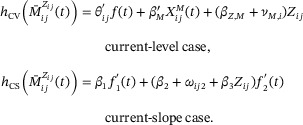 Figure 1
 Figure 2
 Figure 3
 Figure 4
 Figure 5
 Figure 6
 Figure 7
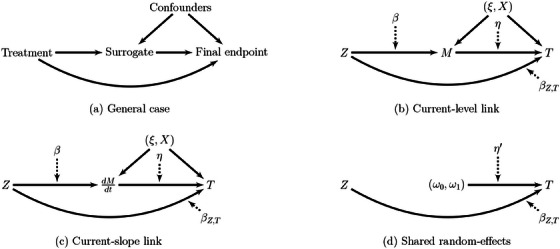 Figure 8
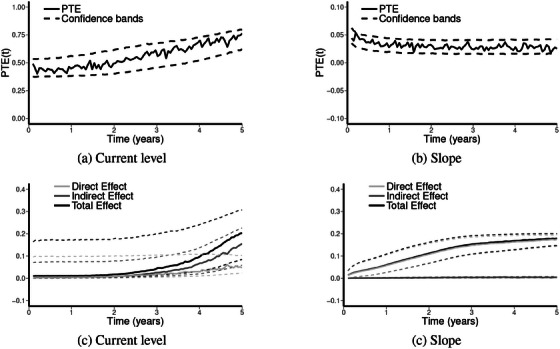 Figure 9
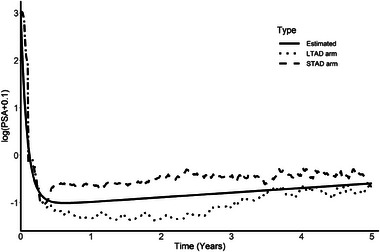 Figure 10
Peer Reviews
No public reviews on file for this paper yet. If you reviewed it on a platform where reviews are public (OpenReview, ICLR, NeurIPS, ICML), you can paste yours below so the community can read it here.
Videos
No videos yet. Explain this paper in a talk, walkthrough, or lecture? Add one.
Taxonomy
TopicsAdvanced Causal Inference Techniques · Statistical Methods in Clinical Trials · Health Systems, Economic Evaluations, Quality of Life