Putative neural and endocrine control of thermal acclimation in fish
Robine H J Leeuwis, Rachael Morgan, Anna H Andreassen, Lorena Silva-Garay, Zara-Louise Cowan, Eirik R Åsheim, Jeremy De Bonville, Sandra A Binning, Graham D Raby, Fredrik Jutfelt

TL;DR
This study explores how fish adjust to temperature changes, finding that blood-borne factors may influence metabolism but skin exposure alone does not trigger acclimation.
Contribution
The study demonstrates that plasma transfusions from cold-acclimated fish can elevate metabolism in recipients, suggesting a role for endocrine signals in thermal acclimation.
Findings
Plasma transfusions from cold-acclimated fish increased standard metabolic rate in cod.
Brief skin temperature changes did not affect critical thermal maximum or metabolic rate.
Thyroid hormone levels were not linked to metabolic compensation in acclimation.
Abstract
Fishes can acclimate to a range of temperatures. However, the signalling factors controlling thermal acclimation are not well understood. Here, in two experiments, we examined the putative roles of plasma-borne factors (e.g. hormones) and skin thermoreception in the acclimation process. In experiment 1, 16°C-acclimated Atlantic cod (Gadus morhua) were subjected to a transfusion treatment by injecting plasma from 8°C (cold), 16°C (control) or 21°C (warm) acclimated cod, 10 times over four days. Plasma was collected from donor cod that were 24 h into their acclimation. In experiment 2, 16°C-acclimated goldsinny wrasse (Ctenolabrus rupestris) were exposed to an immersion treatment consisting of 10 s immersions in an 8°C (cold), 16°C (control) or 24°C (warm) water bath, repeated five times daily for five days. These brief immersions allowed for changes to skin temperature but not deeper…
Genes, proteins, chemicals, diseases, species, mutations and cell lines named across the full text — each resolved to its canonical identifier and authoritative record.
Click any figure to enlarge with its caption.
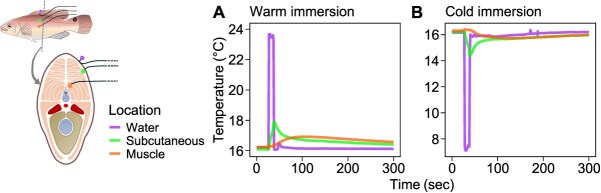 Figure 1
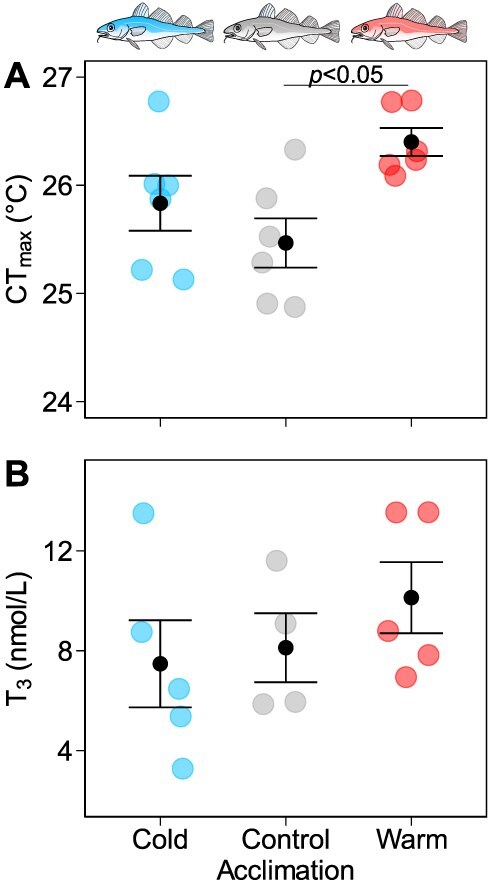 Figure 2
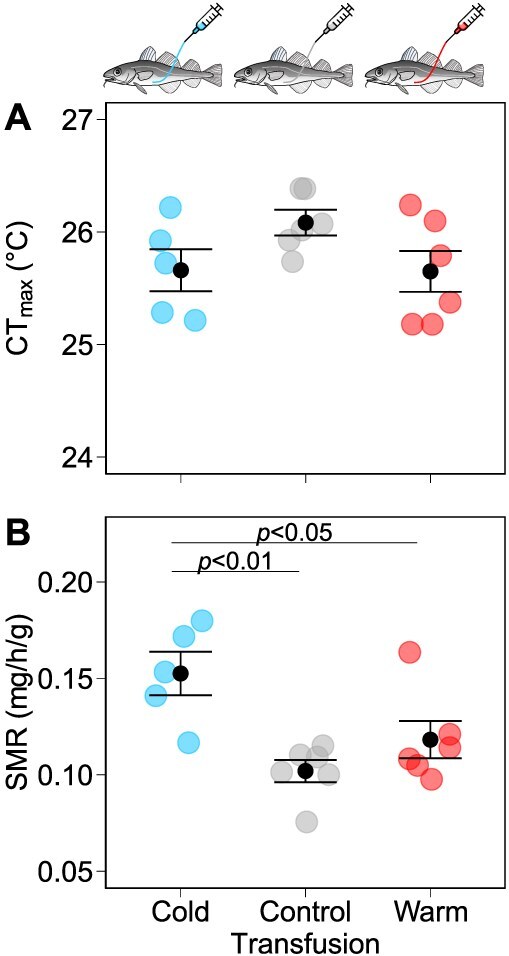 Figure 3
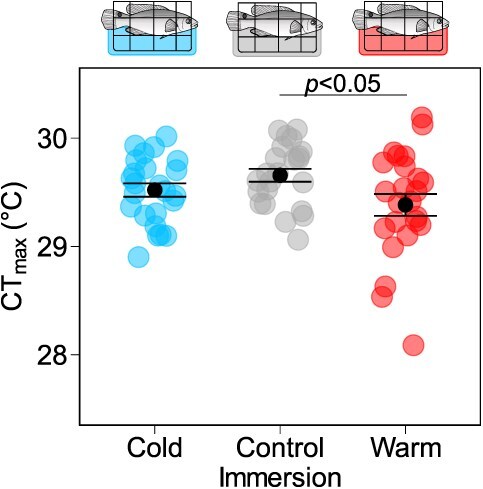 Figure 4
Peer Reviews
No public reviews on file for this paper yet. If you reviewed it on a platform where reviews are public (OpenReview, ICLR, NeurIPS, ICML), you can paste yours below so the community can read it here.
Videos
No videos yet. Explain this paper in a talk, walkthrough, or lecture? Add one.
Taxonomy
TopicsPhysiological and biochemical adaptations · Neurobiology and Insect Physiology Research · Animal Behavior and Reproduction