Negative Hits Hit Different
Arkadiy L. Maksimovskiy, Abigail Moline, Daniel G. Dillon

TL;DR
This study shows that memory retrieval affects emotional experiences differently depending on the emotional content of the memories.
Contribution
The study reveals that memory accuracy influences valence ratings differently for positive, negative, and neutral stimuli.
Findings
Valence ratings were higher for neutral and positive Hits compared to CRs.
Negative Hits elicited lower valence ratings than negative CRs.
Perceived oldness, regardless of accuracy, boosted valence for positive stimuli.
Abstract
Neuroimaging of recognition memory reveals that the striatum responds more strongly to Hits (encoded stimuli recognized as old) vs. Correct Rejections (CRs: lures recognized as new), possibly because remembering old items is rewarding. If this is so, then Hits should elicit higher valence ratings than CRs for emotional and neutral stimuli. Alternatively, memory may interact with emotion such that while positive and neutral Hits drive valence up, negative Hits drive valence down (relative to CRs of the same type). We investigated this by analyzing data from 47 healthy participants who encoded negative, neutral, and positive pictures, completed a recognition memory test, and rated the emotions elicited by each picture. Valence ratings were higher for neutral and positive Hits vs. CRs but only positive FAs (FAs; falsely recognized lures) elicited higher valence ratings than CRs.…
Genes, proteins, chemicals, diseases, species, mutations and cell lines named across the full text — each resolved to its canonical identifier and authoritative record.
Click any figure to enlarge with its caption.
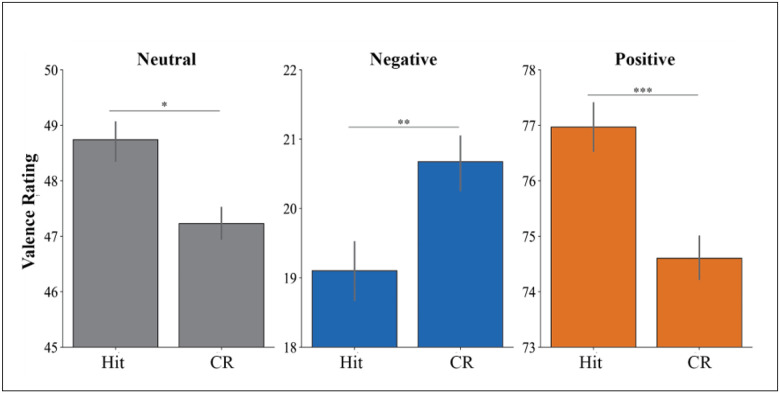 Figure 1
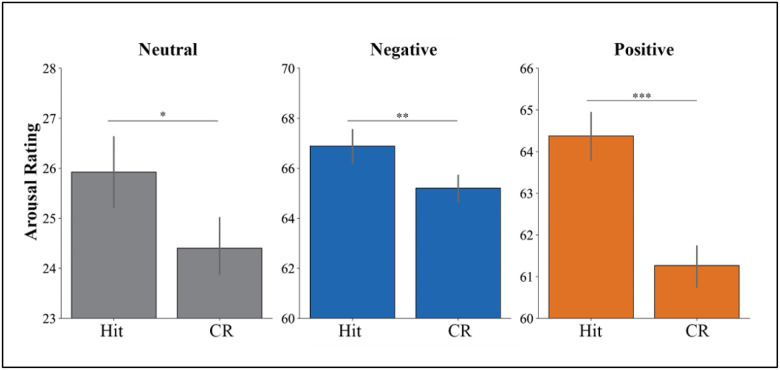 Figure 2
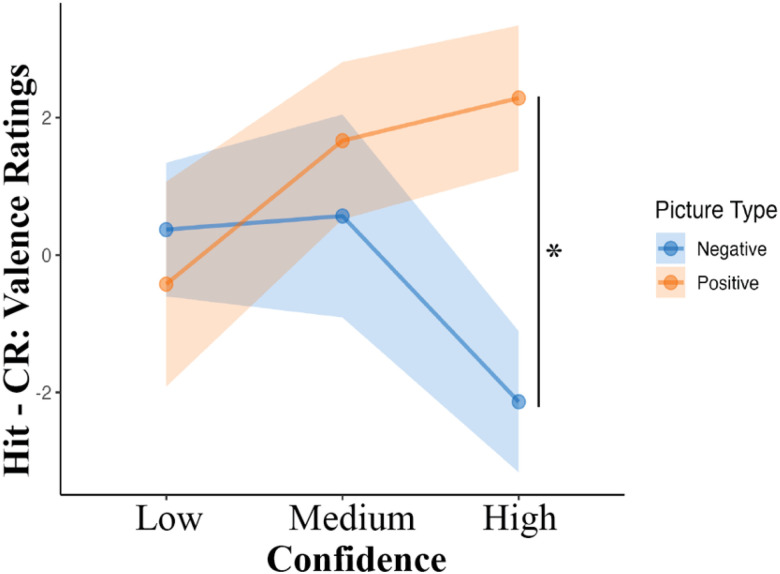 Figure 3
Peer Reviews
No public reviews on file for this paper yet. If you reviewed it on a platform where reviews are public (OpenReview, ICLR, NeurIPS, ICML), you can paste yours below so the community can read it here.
Videos
No videos yet. Explain this paper in a talk, walkthrough, or lecture? Add one.
Taxonomy
TopicsMind wandering and attention · Psychological Well-being and Life Satisfaction · Sleep and Wakefulness Research