Iterative Implementation of the Dipole Interaction Model for Atomic Polarizabilities
Raphael F. Ligorio, Leonardo H. R. Dos Santos, Anna Krawczuk

TL;DR
A new iterative method improves the calculation of atomic polarizabilities without sacrificing accuracy or increasing memory use.
Contribution
A direct iterative approach for polarizability calculations that avoids matrix inversion and maintains precision at scale.
Findings
The new method eliminates matrix inversion, enabling large-scale polarizability calculations.
Memory usage is optimized by avoiding storage of large arrays.
The approach maintains accuracy while allowing efficient computation for large systems.
Abstract
Despite its name, the dipole interaction model (DIM) serves not only to adjust dipole moments due to atomic interactions but also to assess polarizabilities. Traditionally, polarizability calculations via DIM rely on matrix inversion, posing constraints on memory usage and computational time. Recent implementations have shown significant performance boosts by employing an iterative inversion solver, albeit reducing accuracy. In this paper, we present a direct approach for computing polarizabilities via iterative cycles, eliminating the need for matrix inversion. This allows for scaling up the model to hundreds of thousands of atoms without sacrificing precision, as often happens when simplifying the standard inversion procedure to reduce computational costs. Additionally, we have addressed memory issues associated with storing extensive arrays in standard implementations. Our…
Genes, proteins, chemicals, diseases, species, mutations and cell lines named across the full text — each resolved to its canonical identifier and authoritative record.
Click any figure to enlarge with its caption.
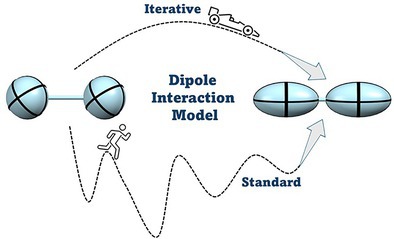 Figure 1
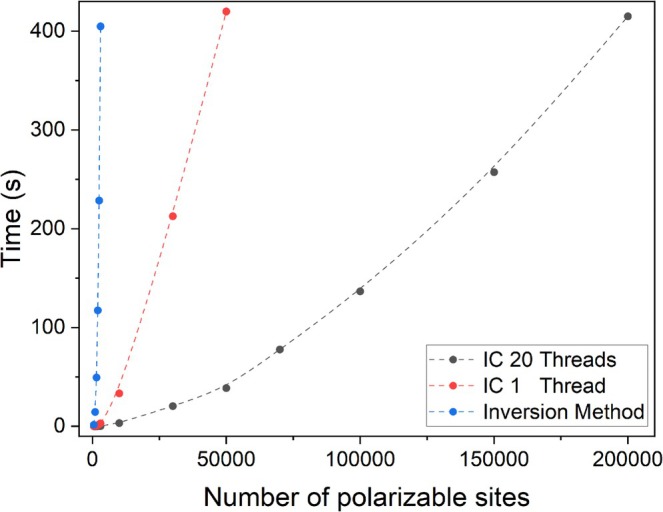 Figure 2
Peer Reviews
No public reviews on file for this paper yet. If you reviewed it on a platform where reviews are public (OpenReview, ICLR, NeurIPS, ICML), you can paste yours below so the community can read it here.
Videos
No videos yet. Explain this paper in a talk, walkthrough, or lecture? Add one.
Taxonomy
TopicsAdvanced Chemical Physics Studies · Advanced NMR Techniques and Applications · Solid-state spectroscopy and crystallography