Trajectories of physical functioning and its implication for all-cause mortality in Chinese older people: a large-scale national longitudinal study
Shisi Shen, Jialu Yang, Ning Ma, Yang Xiong, Tingting Wu, Feng Qin

TL;DR
This study tracks physical function changes in older Chinese adults over 16 years and finds that those with consistently low function face higher mortality risks.
Contribution
The study identifies distinct physical functioning trajectories and their mortality associations in a large-scale longitudinal cohort.
Findings
Three IADL trajectories were identified: stable and high function, rapid increase, and stable and low function.
Stable low IADL function was linked to a 33% higher mortality risk compared to stable high function.
The mortality risk association was modified by age, income, marital status, social activity, and cognitive impairment.
Abstract
Based on the previous evidence, physical function has been associated with all-cause mortality. However, these studies have been inconsistent. We aimed to conduct trajectory analysis to identify instrumental activities of daily living (IADL) types and estimate their effects on all-cause mortality among older people. In the Chinese Longitudinal Healthy Longevity Survey, a total of 13 385 older people aged ≥60 years were included between 2002–18. We employed a group-based trajectory model to determine the IADL trajectories. We fitted a multivariate Cox regression model to evaluate the effects of various IADL trajectories on all-cause mortality. We applied subgroup analyses to explore potential modified effects. We further conducted sensitivity analyses to ascertain the robustness of findings. Over the 16-year follow-up period, three IADL trajectories were identified, including ‘stable…
Genes, proteins, chemicals, diseases, species, mutations and cell lines named across the full text — each resolved to its canonical identifier and authoritative record.
Click any figure to enlarge with its caption.
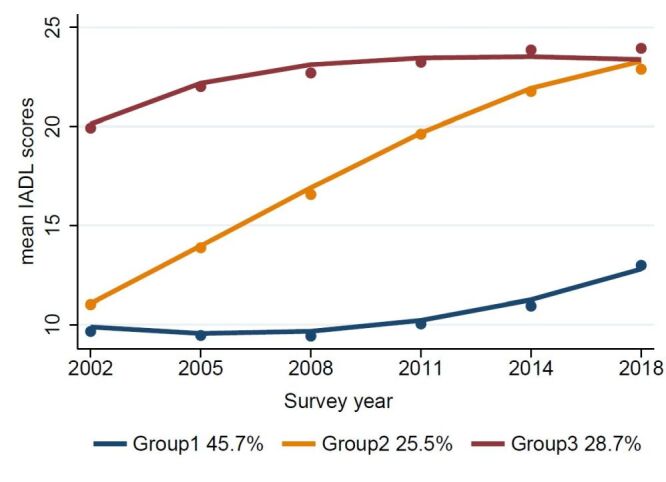 Figure 1
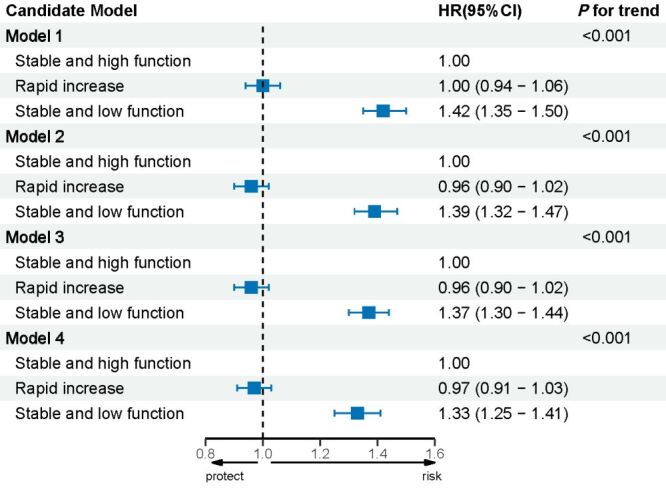 Figure 2
Peer Reviews
No public reviews on file for this paper yet. If you reviewed it on a platform where reviews are public (OpenReview, ICLR, NeurIPS, ICML), you can paste yours below so the community can read it here.
Videos
No videos yet. Explain this paper in a talk, walkthrough, or lecture? Add one.
Taxonomy
TopicsFrailty in Older Adults · Nutrition and Health in Aging · Health Systems, Economic Evaluations, Quality of Life