Suspicious looking mu rhythm on SEEG
Aayesha J. Soni, Ana Suller Marti, Giovanni Pellegrino

Abstract
Genes, proteins, chemicals, diseases, species, mutations and cell lines named across the full text — each resolved to its canonical identifier and authoritative record.
Click any figure to enlarge with its caption.
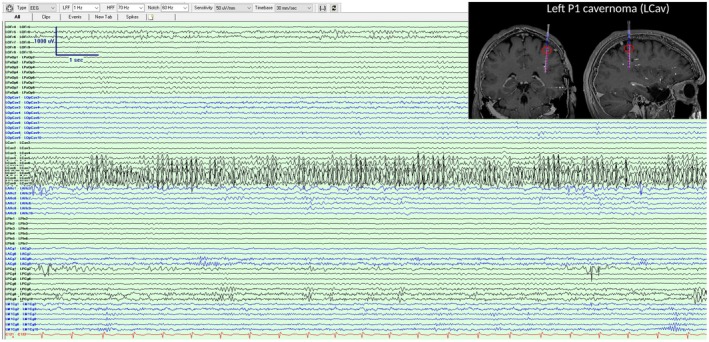 Figure 1
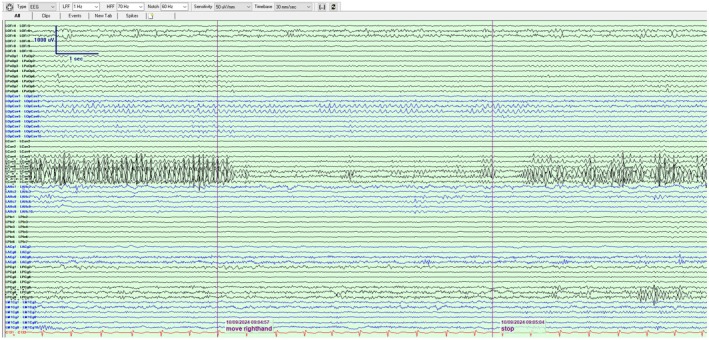 Figure 2
Peer Reviews
No public reviews on file for this paper yet. If you reviewed it on a platform where reviews are public (OpenReview, ICLR, NeurIPS, ICML), you can paste yours below so the community can read it here.
Videos
No videos yet. Explain this paper in a talk, walkthrough, or lecture? Add one.
Taxonomy
TopicsZebrafish Biomedical Research Applications
A 39‐year‐old gentleman was investigated with stereo‐electroencephalography (SEEG) in the context of multiple cavernomas (left posterior frontal and parietal) and recurrent seizures despite a previous left amygdalectomy. Abundant high‐amplitude activity in long runs was suspected to be epileptiform due to its morphology and close association with the left parietal cavernoma. With right hand movement and sleep, the discharges consistently attenuated, in contrast to other epileptiform discharges, leading us to conclude that it was mu rhythm (Figures 1 and 2).
Mu rhythm, a well‐recognized variant of the dominant alpha/beta rhythms seen in the central sensori‐motor regions,1 is blocked by contralateral voluntary/passive movement or somatosensory stimulation.2 Its generating sources are located at the somatosensory cortex.3, 4, 5
To the best of our knowledge, there is only one other study that assessed mu in three patients with SEEG.6 Literature on the appearance of normal variants in SEEG is lacking. Care should be taken that physiological rhythms are not mistaken for epileptiform activity. When in doubt, reactivity and activity protocols can be helpful.
FUNDING INFORMATION
No funding information.
CONFLICT OF INTEREST STATEMENT
AJS has no relevant disclosures. ASM has no relevant disclosures. GP has no relevant disclosures.
PATIENT CONSENT
Telephonic consent for publication was obtained from the patient.
Test Yourself
- How can normal variant mu rhythm present on SEEG?
- Rhythmic spike waves at low frequency.
- Low voltage fast activity.
- Apiculate/arciform alpha/beta (typically around 12 Hz in frequency) wave forms seen during normal wakefulness.
- Mu rhythm is not seen on SEEG.
- Where is mu rhythm most commonly seen?
- Occipital cortex.
- Sensori‐motor regions.
- Superior temporal gyrus.
- Premotor region.
- What attenuates mu rhythm, both on scalp and stereo‐EEG?
- Contralateral voluntary movement.
- Contralateral somatosensory stimulation.
- Normal sleep.
- A + B + C.
- Placing a white sheet of paper in front of the patient's eyes.
Answers may be found in the Supporting information.
Supporting information
Data S1.
Data S2.
The reference list from the paper itself. Each links out to its DOI / PubMed record.
- 1Lapenta OM , Ferrari E , Boggio PS , Fadiga L , D'Ausilio A . Motor system recruitment during action observation: No correlation between mu‐rhythm desynchronization and corticospinal excitability. P Lo S One. 2018;13:e 0207476.30440042 10.1371/journal.pone.0207476 PMC 6237396 · doi ↗ · pubmed ↗
- 2Gastaut H , Terzian H , Gastaut Y . Study of a little electroencephalographic activity: rolandic arched rhythm. Mars Med. 1952;89:296–310.12991978 · pubmed ↗
- 3Cheyne D , Gaetz W , Garnero L , Lachaux JP , Ducorps A , Schwartz D , et al. Neuromagnetic imaging of cortical oscillations accompanying tactile stimulation. Brain Res Cogn Brain Res. 2003;17:599–611.14561448 10.1016/s 0926-6410(03)00173-3 · doi ↗ · pubmed ↗
- 4Hari R , Forss N , Avikainen S , Kirveskari E , Salenius S , Rizzolatti G . Activation of human primary motor cortex during action observation: a neuromagnetic study. Proc Natl Acad Sci U S A. 1998;95:15061–15065.9844015 10.1073/pnas.95.25.15061 PMC 24575 · doi ↗ · pubmed ↗
- 5Rossi S , Tecchio F , Pasqualetti P , Ulivelli M , Pizzella V , Romani GL , et al. Somatosensory processing during movement observation in humans. Clin Neurophysiol. 2002;113:16–24.11801420 10.1016/s 1388-2457(01)00725-8 · doi ↗ · pubmed ↗
- 6Szurhaj W , Derambure P , Labyt E , Cassim F , Bourriez JL , Isnard J , et al. Basic mechanisms of central rhythms reactivity to preparation and execution of a voluntary movement: a stereoelectroencephalographic study. Clin Neurophysiol. 2003;114:107–119.12495771 10.1016/s 1388-2457(02)00333-4 · doi ↗ · pubmed ↗