Prevalence, satisfaction and preference of tooth shades and their correlation with age, gender and skin shade: A cross sectional study
Tanay Chawda, Prashanth Bajantri, Srikant Natarajan, Alisha Ono, Thilak Shetty, Shobha Rodrigues, Umesh Pai, Mahesh M, Sharon Saldanha, Puneeth Hegde, Sandipan Mukherjee, Ann Sales, Vignesh Kamath, Dr. Gbenga Emmanuel Adebayo, Dr Prashanth Bajantri, Stephen Westland

TL;DR
This study examines tooth shade preferences and satisfaction across age, gender, and skin shade, finding a strong preference for Value 2 shades.
Contribution
The study identifies a universal preference for Value 2 tooth shades across diverse demographics, offering insights for dental shade selection.
Findings
Value 2 was the most common and desired tooth shade among participants.
Participants aged 41 to 50 showed the highest satisfaction with their tooth shades.
Significant differences in shade satisfaction were observed among males.
Abstract
Shade selection is one of the most important factors that determines the satisfaction of the patient with the dental prosthesis and thus the overall success of the treatment. Conventional methods of shade selection require the presence of existing teeth or past dental/photographic records. In the absence of these, shade selection becomes challenging and must be done subjectively and arbitrarily based on the patient’s age and sex. This study aims to assess the prevalence, satisfaction, and preference of tooth shades, investigating their correlation with age, sex, and skin shade in a diverse sample of 120 participants. A total of 120 participants, evenly distributed among 60 males and 60 females, were surveyed. Participants were categorized into age groups (n=15) and asked about their satisfaction with existing tooth shades and their preferences. The most common existing tooth shade was…
Genes, proteins, chemicals, diseases, species, mutations and cell lines named across the full text — each resolved to its canonical identifier and authoritative record.
Click any figure to enlarge with its caption.
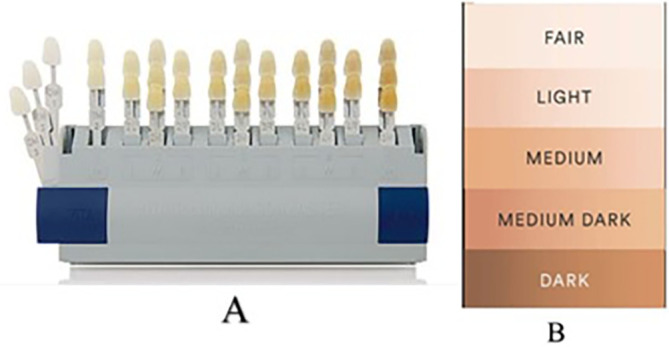 Figure 1
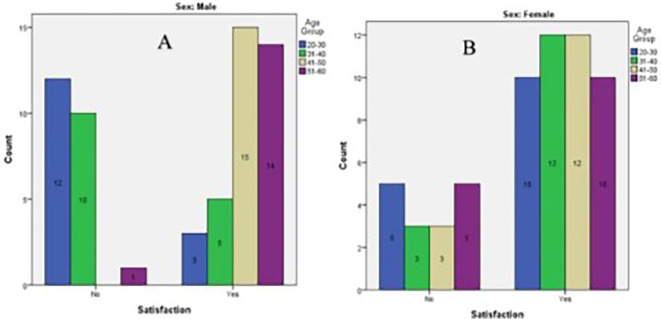 Figure 2
| Male 20-30 | Female 20-30 |
| Male 30-40 | Female 30-40 |
| Male 40-50 | Female 40-50 |
| Male 50-60 | Female 50-60 |
| Percentage of participants who had the value of shade | Percentage of participants who wanted the value of shade | |
|---|---|---|
| Value 0 | 0% | 3.33% |
| Value 1 | 8.33% | 20% |
| Value 2 | 52.5% | 58.33% |
| Value 3 | 36.66% | 17.5% |
| Value 4 | 2.5% | 0.83% |
| Chi-Square Tests | ||||
|---|---|---|---|---|
| Age Group | Value | df | P value (<0.05 is significant) | |
| 20-30 | Pearson Chi-Square | 4.419 | 4 | .352 |
| N of Valid Cases | 30 | |||
| 31-40 | Pearson Chi-Square | 5.559 | 3 | .135 |
| N of Valid Cases | 30 | |||
| 41-50 | Pearson Chi-Square |
| 2 | 1
|
| N of Valid Cases | 30 | |||
| 51-60 | Pearson Chi-Square | 2.274 | 2 | .321 |
| N of Valid Cases | 30 | |||
| Chi-Square Tests | ||||
|---|---|---|---|---|
| Sex | Value | df | P value (<0.05 is significant) | |
| Female | Pearson Chi-Square | 1.364 | 3 | .714 |
| N of Valid Cases | 60 | |||
| Male | Pearson Chi-Square | 31.798 | 3 |
|
| N of Valid Cases | 60 | |||
Peer Reviews
No public reviews on file for this paper yet. If you reviewed it on a platform where reviews are public (OpenReview, ICLR, NeurIPS, ICML), you can paste yours below so the community can read it here.
Videos
No videos yet. Explain this paper in a talk, walkthrough, or lecture? Add one.
Taxonomy
TopicsOrthodontics and Dentofacial Orthopedics · Dental Erosion and Treatment · Dental materials and restorations
Introduction
Facial esthetics have become important in modern society as they seem to define one’s character. Dental appearance is one of the main features that determines the attractiveness of our face and plays a key role in our social interactions. ^ 1 ^ It has been found that the most important factors that influence the perception of beautiful teeth are age, gender, and skin color. ^ 2 ^ ^,^ ^ 3 ^
Shade selection is an important procedure for providing patients with an esthetic restoration that harmoniously blends with the patient’s existing dentition. ^ 4 ^ The selection of teeth with proper shade positively influences the patient’s aesthetic perception and improves prosthesis acceptance. ^ 5 ^
The selection of artificial teeth to replace missing natural teeth is a relatively straightforward procedure when natural anterior teeth remain. Various tooth-shade guides have been developed for use in patients with natural teeth. However, the choice of tooth shade is problematic for edentulous individuals with no preextraction records. ^ 6 ^
Various factors such as age, sex, and skin color have been proposed as aids for artificial tooth shade selection. ^ 7 ^ Some dentists have even suggested the color of hair and eye color, but most authors favor the use of facial skin tone as a guide for tooth shade selection. ^ 8 ^
There is limited scientific information on the relationship between facial skin complexion and tooth color in the Indian population. This lack of knowledge may impact the ability of prosthodontists to provide better aesthetics to the patient.
The perception among dentists is that individuals with darker skin color have lighter shades of teeth. This perception is commonly explained by the illusion of a greater contrast between skin color and tooth shade. ^ 3 ^
The age of the patient was found to have a definite relationship with the tooth shade value, which has been corroborated by many studies that have shown darker tooth shade values with an increase in age and vice versa. ^ 3 ^ ^,^ ^ 6 ^
Sex is another factor significantly associated with tooth shade values. Men were more likely to have darker tooth shade values, whereas women of the same age group were more likely to have lighter tooth shade values. ^ 9 ^
Various studies have been conducted to establish a relationship between age, sex, and skin color in individuals with tooth shades, but contrasting results have been reported. One reason for the varying results can be attributed to the ethnic origin of the study samples. ^ 8 ^ ^,^ ^ 9 ^
Individual studies conducted by Ajayi et al. (2011), Albashaireh et al., Hamamci et al. (2009), and Afshar MK et al. (2019) had reported satisfaction with dental appearance of 79.4% in Nigeria, ^ 10 ^ 67.6% in Jordan, ^ 11 ^ 71.1% in Turkey, ^ 12 ^ and 47.2% in Malaysia. ^ 13 ^
A study conducted by Maghaireh et al. (2016) found that most people were not satisfied with their tooth color, and the sought-after treatment was tooth whitening. They also reported that women are significantly more likely to seek cosmetic and orthodontic restorations. ^ 14 ^
In a study by Tin-Oo (2011), satisfaction with tooth color was significantly lower in women, and tooth whitening was the most preferred treatment. ^ 15 ^
Research in the field of esthetics and shade matching has predominantly been conducted in Western populations. However, with increasing dental awareness and demand for esthetics in developing countries, such as the Indian subcontinent, research in the field of esthetics based on the local population has become the need of the hour.
This study aimed to determine the prevalence, satisfaction, and preference of tooth shades and their correlation with sex, age, and skin color.
The null hypothesis was that there would be no difference in the prevalence, preference, and satisfaction of tooth shades between the age class, gender, and skin shade patterns.
Methods
Study setting
This study was conducted in the Department of Prosthodontics and Crown and Bridge, Manipal College of Dental Sciences, Mangalore.
Pilot study and sample size calculation
A Pilot study was conducted which showed a prevalence of satisfaction of 56.52% with an alpha of 5 % the corresponding z value was Z=-1.95996398454005.
Using the formula n=(Z(α/2)/d) 2^ “p(1-p)” the minimum percentage difference to be deemed clinically significant at 10%, the minimum sample size required would be 95 for the study. A method of matched quota sampling was employed to recruit an equal number of participants in each age group and sex. For the easy divisibility of the groups, a sample size of 120 was selected.
Eligibility criteria
120 participants were included in this study using the following inclusion criteria:
- 1)All six maxillary anterior teeth (canine-to-canine) (13, 12, 11, 21, 22, 23) should be present.
- 2)Teeth should be no external discoloration or staining
- 3)All the 6 maxillary anterior teeth should have similar shades
Grouping
The 120 participants were then equally divided into eight groups based on their age and gender, as follows:
**: **
Procedure
Questionnaire
The participants were then asked to complete a questionnaire on their age, gender, and ethnic origin. They were then shown a face mirror and asked if they were satisfied with the shade of their upper front teeth.
Shade selection
The investigators then selected the most common tooth shade among the maxillary anterior teeth using a shade guide (3D Master, VITA Zahnfabrik H. Rauter GmbH & Co. KG Postfach 1338 D-79704 Bad Säckingen), as per manufacturer instructions ( Figure 1A).
A - VITA Tooth-Guide 3D Master. B - L'Oreal skin shade guide.
If the test subjects were not satisfied with their existing tooth shade, they were guided to find the preferred tooth shade using the “VITA Tooth-Guide 3D Master” shade guide.
The participants’ skin color was recorded using the L’Oreal skin shade guide ( Figure 1B).
Data management and statistical analysis
After collecting the data from all 120 participants, statistical analysis was done using χ ^2^ test to correlate Tooth shade, skin shade, age and gender. Odds ratios were calculated using a logistic regression. Statistical significance was considered at 95% confidence interval, and p values less than 0.05 were considered significant. IBM SPSS Statistics version 20.0 was used for these statistical calculations.
Results
A total of 120 participants were grouped based on their age and sex to evaluate the prevalence, satisfaction, and preference of tooth shade and their correlation with age, sex, and skin shade using questionnaires along with the VITA Tooth-Guide 3D Master shade guide and L’Oreal skin shade guide.
Existing tooth shades
As can be seen in Table 1, the most common existing among the participants was Value 2 (52.5%) of VITA Tooth-Guide 3D Master shade. Shade 2L1.5 (n=26) was the most common, followed by 3L1.5 (n=14), 2M1 (n=12), 2R1.5 (n=10), and 2M2 (n=9).
The least common existing tooth shades were of value 0, with no participants showing any existing shade.
Wanted tooth shades
The most commonly desired tooth shade was of value 2 (58.33%). Shade 2L1.5, the most commonly preferred tooth shade (n=21), followed by 2M1 (n=18), 1M1 (n=15), 2R1.5 (n=14), and 1M2 (n=9).
Chi-square tests revealed that value 2 was the most preferred shade among males and females equally in the age group of 41–50 years, and this was statistically significant (p<0.001) ( Table 2).
Satisfaction
Among the shades present, highest satisfaction was observed with people having shades of value 1 (90%), followed by values 2 (82.25%), value 3 (44.44%), and value 4 (33.33%).
As shown in Figure 2, the highest satisfaction with existing shade was seen in males aged 41–50 years (n=15), followed by males aged 51–60 years (n=14), and females aged 31–40(n=12) and 41–50 (n=12). The lowest satisfaction was observed in males aged 20-30 (n=12), followed by males aged 31–40 years (n=10), and females aged 20-30 (n=5).
Bar graph of Satisfaction of tooth shade among participants of different age groups.A) Males. B) Females.
The differences in satisfaction with tooth shades among the males were statistically significant (p<0.001) ( Table 3).
Skin shades
No statistically significant correlations or differences were found between participants with different skin shades concerning shade present, shade wanted, and satisfaction with existing shades.
Discussion
Various methods of dental shade selection can be broadly categorized into visual and digital methods. Visual methods include the use of stocks and custom shade guides. Digital methods include digital cameras, color-measuring software, colorimeters, spectrophotometers, and intraoral scanners. Despite developments in dental shade selection methods, shade selection remains a challenge that affects esthetic outcomes. ^ 16 ^
This challenge is augmented when patients are edentulous and lack any prior photographic or dental records of the shade of their original teeth, and conventional dental shade selection tools cannot be used.
According to the protocols, the age, sex, and complexion of the patient should be taken into consideration while choosing the dental shade for completely edentulous patients. There are several recommendations for selecting the shape and size of artificial teeth, which are supported by rationale and empirical data. ^ 17 ^ ^–^ ^ 20 ^
However, shade selection for completely edentulous patients follows vague and broad criteria and is therefore more subjective and arbitrary. These add complexities to complete dentures and full-mouth rehabilitation. ^ 17 ^ ^–^ ^ 22 ^
The current study demonstrated that the age and sex of the patient affect their satisfaction with existing dental shades and their shade preferences. No correlation was observed between skin shade and existing or desired shade in the observed test subjects. These observations are similar to those of a previous study. Esan TA, et al. ^ 23 ^
Overall, 67.5% of participants were satisfied with their existing dental shades, while 32.5% people wanted to change their dental shades.
8.3% of the test subjects had dental shade of Vita 3D master value 1. Ninety% of these people were satisfied with their existing dental shade, while 10% of the people wanted to change their shade to value 3.
51.6% Of the test subjects had dental shade with vita 3d master value 2. 82.25% Of these people were satisfied with their existing dental shade, while 11.2% of the people wanted to change their shade to value 1.
37.5% Of the test subjects had dental shade with vita 3d master value 3. 44.44% Of these people were satisfied with their existing dental shade, while 37.77% of the people wanted to change their shade to value 2.
2.5% of the test subjects had dental shade of vita 3d master value 1. 33.33% Of these people were satisfied with their existing dental shade, while 66.66% of the people wanted to change their shade to value 2.
Therefore, shades of value 2 were the most desired shades among the Vita 3D master shades.
The most wanted/liked shades by the test subjects were 2L1.5 (17.5%), 2M1 (15%), 1M1 (12.5%), 2R1.5 (11.67%), 1M2 (7.5%), 2M2 (6.67%), and 2L2.5 (5.83%).
In the age group of 20 to 30 years, 53.3% of the female participants had shades of value 2, while 40% had shades of value 3. 66.7% were satisfied with their existing shade. 46.7% liked shades of value 2 and 26.7% liked value 3.
53.3% Of the male participants had shades of value 2, while 33.3% had shades of value 3. Twenty% were satisfied with their existing shade. 46.7% liked value 2 and 33.3% liked value 1.
In the age group of 30 to 40 years, 46.7% of the female participants had shades of value 3, while 40% had shades of value 2. Eighty% were satisfied with their existing shade. 53.3% liked value 2, and 26.7% liked value 3.
46.7% Of the male participants had shades of value 2, while 46.7% had shades of value 3. 33.3% were satisfied with their existing shade. Sixty% liked value 2, and 33.3% liked value 1.
In the age group of 40 to 50 years, 53.3% of the female participants had shades of value 2, while 40% had shades of value 3. Eighty% were satisfied with their existing shade. 73.3 % liked value 2, and 20% wanted to liked value 3.
66.7% Of the male participants had shades of value 2, while 20% had shades of value 3. 80% were satisfied with their existing shade.
In age group 50 to 60, 40% of the female participants had shades of value 3, while 40% had shades of value 4. 66.7% were satisfied with their existing shade. 53.3% liked value 2, and 26.7% liked value 1.
66.7% Of the male participants had shades of value 2, while 26.7% had shades of value 3. 93.3% were satisfied with their existing shade. 73% liked value 2 and 20% liked value 3.
Males in the higher age groups were more satisfied with their teeth than younger age groups and females. This was also observed in studies conducted by Tin-Oo et al. and Maghaireh et al. ^ 14 ^ ^,^ ^ 15 ^
The results of this study showed that people become more satisfied with their shade as age advances. In addition, shades of value 2 were the most common and the most liked shade by males and females of all genders as compared to shades of other values.
Conclusions
Within the limitations of this study, the following conclusions can be drawn:
- 1.Satisfaction with existing shade increases in males, especially in the age group of 41–50 years.
- 2.The most desired tooth shades by both males and females were of value 2, as per the VITA Tooth-Guide 3D Master shade guide.
Limitations of the study
- 1.In this study, participants with different skin shades were not evenly selected. Light shade (n=5), fair shade (n=14), medium shade (n=45), Medium Dark shade (n=37), or dark shade (n=19). This can influence the results with respect to the relationship between skin shade and the satisfaction of existing tooth shades, along with tooth shades preferred by the participants of different skin shades.
- 2.A larger sample size may reveal further correlations between the hue, value, and chroma of existing and preferred tooth shades.
Key points
- 1.In the case of the unavailability of dental photographic records in edentulous patients, age and sex can act as a guide for shade selection.
- 2.If the patient or dentist is unsure about the shade of complete dentures and full-mouth rehabilitations, shades of value 2 can be selected, as they are the most liked shades according to the present study.
- 3.Older men may prefer darker shades of teeth, whereas women of all ages may prefer lighter shades.
Ethical considerations
All observations were performed in conformity with the ethical standards of the Institutional Ethics Committee, Manipal College of Dental Sciences Mangalore, after receiving approval from the committee (ref:22007 dated:12/02/2022). Each individual assigned to participate in the study gave written informed consent to participate in the study.
The reference list from the paper itself. Each links out to its DOI / PubMed record.
- 1Samorodnitzky-Naveh GR Geiger SB Levin L : Patients’ satisfaction with dental esthetics. J. Am. Dent. Assoc. 2007;138:805–808. 10.14219/jada.archive.2007.0269 17545270 · doi ↗ · pubmed ↗
- 2Jahangiri L Reinhardt SB Mehra RV : Relationship between tooth shade value and skin color: an observational study. J. Prosthet. Dent. 2002;87:149–152. 10.1067/mpr.2002.121109 11854669 · doi ↗ · pubmed ↗
- 3Mc Andrew R : Contemporary Fixed Prosthodontics. 3rd ed.Vol.29. Sage;2014 Dec; pp.328–329. 10.1093/ortho/29.4.328-a · doi ↗
- 4Azad A Ahmad S Zia M : Relationship of age, gender and skin tone to shades of permanent maxillary central incisors. Pak. Oral Dent. J. 2007;27:119–125.
- 5Moon RJ Millar BJ : Dental Aesthetics: A Study Comparing Patients’ Own Opinions with Those of Dentists. Open J. Stomatol. 2017 Apr 17 [cited 2022 Jan 6];07:225–233. 10.4236/ojst.2017.74016 · doi ↗
- 6Marcucci B : A shade selection technique. J. Prosthet. Dent. 2003;89:518–521. 10.1016/S 0022-3913(03)00076-3 12806332 · doi ↗ · pubmed ↗
- 7Hammad IA : Intrarater repeatability of shade selections with two shade guides. J. Prosthet. Dent. 2003;89:50–53. 10.1067/mpr.2003.60 12589286 · doi ↗ · pubmed ↗
- 8Zarb G Bolender CL : Prosthodontic treatment for edentulous patients: complete dentures and implant-supported prostheses. 12th ed. St. Louis: Mosby Inc.;2004; pp.190–207.