Consumers’ Concerns Regarding Dining Out and Food Hygiene During the COVID-19 Pandemic in Japan: A Web-Based Questionnaire Survey
Shinya Matsumoto, Yoshiyuki Kanagawa, Kiwamu Nagoshi, Tomoaki Imamura, Manabu Akahane

TL;DR
This study explores how the COVID-19 pandemic affected Japanese consumers' dining habits and food safety concerns, revealing heightened anxiety about eating out, especially at buffets and bars.
Contribution
The study identifies specific dining settings and practices that caused heightened anxiety during the pandemic in Japan.
Findings
Consumers were more anxious about eating at restaurants than at home or high-end establishments.
Buffet-style meals, drink bars, and unwrapped disposable chopsticks were perceived as particularly risky.
The pandemic led to a decline in restaurant visits and a shift toward home-cooked meals.
Abstract
Background During a global infectious disease pandemic, governments impose varying levels of restrictions on daily life, including social activities, travel, and dining out. Understanding how these restrictions during the coronavirus disease 2019 (COVID-19) pandemic affected people's lifestyles and behaviors, especially regarding food and eating out, is essential for preparing effective countermeasures in future pandemics. The infection was believed to spread through droplets, with the first cluster reported on a pleasure boat. To prevent transmission, the government advised avoiding the "three Cs" (closed spaces, crowded places, and close-contact settings), increasing public anxiety about eating at restaurants. Objective This study aimed to examine the impact of the COVID-19 pandemic on consumer behavior and attitudes toward food and eating out in Japan, focusing on factors…
Genes, proteins, chemicals, diseases, species, mutations and cell lines named across the full text — each resolved to its canonical identifier and authoritative record.
Click any figure to enlarge with its caption.
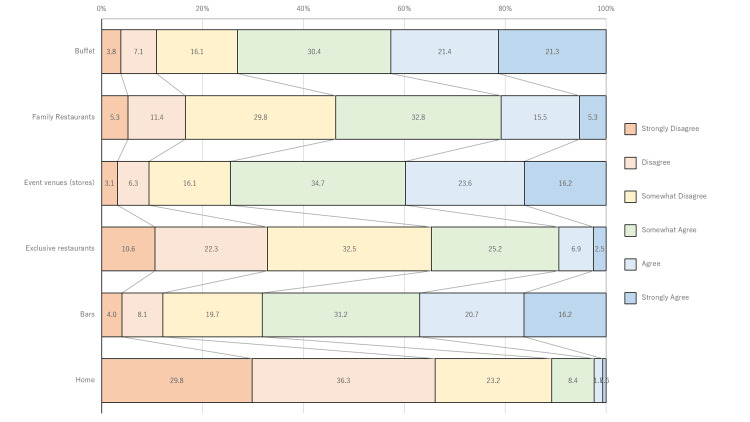 Figure 1
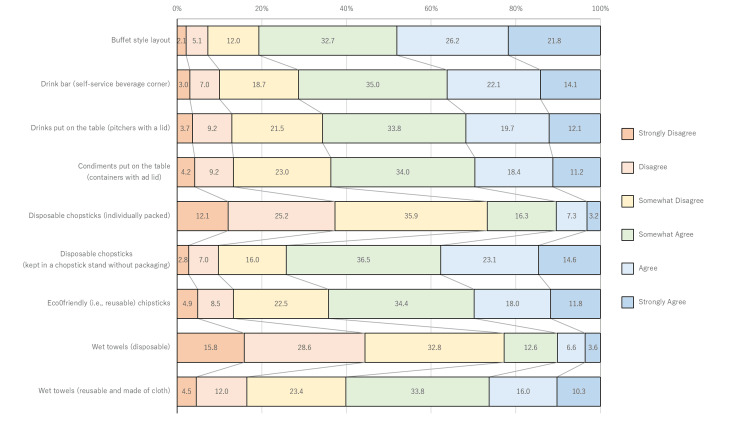 Figure 2
| Component 1 | Component 2 | |
| Buffet | 0.830 | -0.285 |
| Family restaurants | 0.887 | 0.093 |
| Event venues (stores) | 0.836 | -0.271 |
| Exclusive restaurants | 0.783 | 0.370 |
| Bars | 0.819 | -0.222 |
| Home | 0.309 | 0.884 |
| No. | Question | t-value |
| 1 | You consider the following as “unhygienic” when eating at a restaurant: Buffet-style layout. | 17.86 |
| 2 | You consider the following as “unhygienic” when eating at a restaurant: Drinks placed on the table (pitchers with a lid). | 16.64 |
| 3 | You consider the following as “unhygienic” when eating at a restaurant: Drink bar (self-service beverage corner). | 16.41 |
| 4 | You consider the following as “unhygienic” when eating at a restaurant: Condiments placed on the table (containers with a lid). | 15.77 |
| 5 | You consider the following as “unhygienic” when eating at a restaurant: Disposable chopsticks (kept in a chopstick stand without packaging). | 15.49 |
| 6 | You consider the following as “unhygienic” when eating at a restaurant: Eco-friendly (i.e., reusable) chopsticks. | 14.76 |
| 7 | You consider the following as “unhygienic” when eating at a restaurant: Wet towels (reusable and made of cloth). | 14.28 |
| 8 | You consider the following when purchasing food. (Here, the rating would indicate the degree of consideration given.): Place (i.e., country) of production | 10.095 |
| 9 | The following are important to prevent food poisoning when eating at home. (“Expiry date” means the date by which food can be eaten safely, “best-before date” means the date by which food can be eaten without there being any change in its taste or quality, and “order of cooking” means the order in which you handle the ingredients when cooking chicken, seafood, and vegetables.): Order of cooking | 9.819 |
| 10 | You consider the following when purchasing food. (Here, the rating would indicate the degree of consideration given.): Foreign substance contamination countermeasures in the manufacturing process | 9.514 |
| No. | Question | t-value |
| Constant | -20.389 | |
| 1 | You consider the following as “unhygienic” when eating at a restaurant: Buffet-style layout. | 7.466 |
| 2 | When making a purchase, you consider product labels (marks, etc.) indicating that the product has been manufactured in a factory that adopts the following measures: Food defense measures. | 2.261 |
| 3 | You consider the following as “unhygienic” when eating at a restaurant: Wet towels (reusable and made of cloth). | 2.593 |
| 4 | The following are important to prevent food poisoning when eating at home: Order of cooking. | 3.918 |
| 5 | You consider the following as “unhygienic” when eating at a restaurant: Drinks placed on the table (pitchers with a lid). | 2.693 |
| 6 | You consider the following as “unhygienic” when eating at a restaurant: Eco-friendly (i.e., reusable) chopsticks. | 1.943 |
| 7 | When making a purchase, you consider product labels (marks, etc.) indicating that the product has been manufactured in a factory that adopts the following measures: Allergen labeling. | 2.656 |
| 8 | You consider the following as “unhygienic” when eating at a restaurant: Wet towels (disposable). | 3.283 |
| 9 | Do you try to obtain new information on the following topics?: Health | 2.364 |
| 10 | The following are important to prevent food poisoning when eating at home: Cleanliness of the place where you are cooking. | 2.102 |
| 11 | You consider the following as “unhygienic” when eating at a restaurant: Disposable chopsticks (kept in a chopstick stand without packaging). | 2.016 |
Peer Reviews
No public reviews on file for this paper yet. If you reviewed it on a platform where reviews are public (OpenReview, ICLR, NeurIPS, ICML), you can paste yours below so the community can read it here.
Videos
No videos yet. Explain this paper in a talk, walkthrough, or lecture? Add one.
Taxonomy
TopicsCOVID-19 Pandemic Impacts · Food Safety and Hygiene · Infection Control and Ventilation
Introduction
Since the end of 2019, coronavirus disease 2019 (COVID-19) has spread globally, causing numerous deaths and leading to restrictions on economic activity [1]. The virus reached Japan in early 2020, prompting initial restrictions on social activities due to uncertainties about its characteristics [2]. Travel abroad was restricted, and working from home was recommended, except for essential workers. The COVID-19 pandemic has profoundly impacted various aspects worldwide, significantly altering people’s behavior and perceptions [3,4]. Cancer screenings were scaled back, and older people went out less frequently. It is predicted that cancer mortality rates will increase in the future [5], and there are concerns about increased frailty in older adults [6].
The pandemic also intensified concerns about food safety and dining practices. As the pandemic spread, governments imposed restrictions that affected routines, including dining habits and hygiene practices [7]. Restrictions on movement, social distancing measures, and heightened awareness of viral transmission have led to a shift in consumer attitudes toward eating out and food safety [8]. Consumption patterns shifted with changes in the frequency and amount of snacks, alcohol, vegetables, and fruits consumed [9-12]. Food delivery services increased as restaurants and other food and beverage businesses faced restrictions. This shows that COVID-19 has had a significant impact not only on consumer behaviors related to eating out and food consumption but also on the entire dining industry and food supply chain [8], encompassing stages from food production to distribution.
COVID-19 primarily spreads through droplets. In droplet infection, the virus is transmitted when saliva or other bodily fluids containing the virus land on mucous membranes. Individuals can also become infected by touching their mucous membranes after contact with contaminated surfaces [13]. In Japan, the first cluster was reported on a houseboat (a boat with a covered room for sightseeing on a river or seaside that often serves food and drink). Other cluster cases were also reported in restaurants and karaoke [14]. Avoiding the "three Cs (closed spaces, crowded places, and close-contact settings)" has been suggested and recommended by the Japanese government. However, restaurants have been cited as an example of a place where the "three Cs" are likely to occur, and many people feel anxious about eating at restaurants. Consequently, the frequency of eating out decreased. Consumers' awareness and behavior regarding food and eating out may have changed significantly in Japan due to the COVID-19 pandemic.
This study aimed to explore changes in consumer behavior and attitudes toward food and eating out during the COVID-19 pandemic and to identify factors associated with anxiety about eating out. This study mainly focuses on hygiene and food safety during a pandemic, specifically examining consumer attitudes and behavioral intentions toward food during the COVID-19 pandemic. The aim is to identify findings that may be useful in the event of a future pandemic. These findings could have important implications for controlling the spread of infection and avoiding unnecessary or overly burdensome lifestyle restrictions during emergency situations. Based on the results of this study, it is hoped that a better understanding of consumer behavior and attitudes during a public health crisis will support timely and effective risk communication, not only to the food and beverage industry but also to the general public.
Materials and methods
Study design and setting
The questionnaire survey was outsourced to an internet research company (Macromill, Inc.) and conducted online between January 27 and 28, 2021. A state of emergency was in effect when the survey was conducted. The survey targeted 1,442 males and females aged 10-70 years, with equal sex representation across all age groups.
Questionnaire items
The survey covered the following major categories with more detailed questions for each category: (1) What do you consider important when purchasing food? (2) Do you think the following are important for preventing food poisoning at home? (3) Do you think the following are "unsanitary" when eating at restaurants? (4) How worried are you about eating in the following places and formats during the COVID-19 pandemic?
Sex, age, residential area, and other demographic characteristics were collected as monitoring information data. In addition to personality, hygiene measures, information gathering, safety awareness, and brand awareness (electrical appliances, food, and clothing) were also collected.
For each item (with some exceptions), respondents were asked to respond using a six-point scale: “Completely disagree,” “Disagree,” “Somewhat disagree,” “Somewhat agree,” “Agree,” and “Strongly agree.” The questionnaire is shown in Appendix A.
Data analysis
First, we conducted a simple tabulation of responses to the following questions: "Are you worried about eating in the following places and ways during the COVID-19 pandemic?" and "When eating at a restaurant during the COVID-19 pandemic, are you worried that the following things may increase the risk of infection?"
Second, a principal component analysis was conducted on the question, "Are you worried about eating in the following places and ways during the COVID-19 pandemic?" Subsequently, a univariate regression analysis was conducted using the principal component score from the first principal component as the objective variable, with other questionnaire items not included in the principal component analysis serving as explanatory variables. The items used as explanatory variables were "Personality," "Hygiene measures," "Information gathering," "Safety awareness," "Brand awareness (electrical appliances, food, clothing)," "Things to consider when purchasing food, and what you think is important for preventing food poisoning at home," and "Feeling that eating at a restaurant is 'unsanitary.'" Next, a multivariate linear regression analysis (stepwise method) was conducted using the principal component score of the first principal component as the objective variable and the following questionnaire items not used in the principal component analysis as explanatory variables. If variable selection is performed using multivariate linear regression with a stepwise method, variables that are not very similar (i.e., have different meanings) tend to be selected. Multivariate linear regression was also performed to make the results easier to interpret. The results were evaluated using the t-value output from the linear regression analysis model. The t-value expresses the degree of discrepancy between the results and chance and indicates whether a variable should be included in the model. We used R version 4.1.1 (R Core Team, Vienna, Austria) for analysis.
Ethical approval
This study was approved by the Ethics Committee of the National Institute of Public Health, Japan (approval number: NIPH-IBRA12302), and the participants provided informed consent (completed online) for data collection and storage.
Results
Of the 1,442 participants (103 males and females across age groups) who completed all survey questions, the distribution of residential areas was as follows: Hokkaido, 4.6%; Tohoku region, 5.0%; Chubu region, 16.5%; Kanto region, 40.2%; Kinki region, 19.1%; Chugoku region, 4.4%; Shikoku region, 2.1%; Kyushu region, 8.0%. These values were close to the approximate population distribution.
Figure 1 shows the results of the question, "To what extent do you feel anxious about eating in the following places and formats during the COVID-19 pandemic?" Concerns about eating at home or high-end restaurants tended to be lower than in other places. Figure 2 shows the results of the question, "When eating at a restaurant during the COVID-19 pandemic, were you worried that the following things would increase the risk of infection?" Individuals tended to feel anxious about buffet-style meals, drink bars, and disposable chopsticks (unwrapped: kept in a chopstick stand without packaging).
Percent of individuals concerned about eating at each location and business type during the COVID-19 pandemicMany people feel less anxious at home or in exclusive restaurants.
Percent of individuals concerned about increased infection risk from each of the following when eating in restaurants during a COVID-19 pandemicMany people don't feel particularly uneasy about individually packed chopsticks or disposable wet towels.
A principal component analysis was conducted on the six sub-questions in Q22: "How anxious do you feel about eating in the following places and formats during the COVID-19 pandemic?" In this study, we employed principal component analysis, a statistical technique that enables the extraction of common underlying components among variables. The most dominant component is identified as the first principal component, followed by the second most dominant as the second principal component.
Table 1 presents the factor loadings. Regarding the factor loadings resulting from the principal component analysis, the first principal component had the same sign, which is thought to indicate an overall sense of anxiety. The second principal component indicated a distinction between dining at home or in high-end restaurants and other restaurants (or locations/formats). This difference likely reflects the contrast in location and dining style, i.e., between eating at home/in a high-end dining restaurant and eating in restaurants other than those.
The results of the univariate linear regression analysis (top 10 variables) using the principal component score of the first principal component as the dependent variable are shown in Table 2. The top 10 variables were those that people felt were deemed unhygienic when eating at restaurants.
The results of the multivariate linear regression analysis using the principal component score of the first principal component as the dependent variable are presented in Table 3. Related factors included the perception of unsanitary eating at restaurants, as well as what is important for preventing food poisoning at home.
Discussion
This study revealed that, during the spread of COVID-19 infection, anxiety was lower for meals at home and high-end dining restaurants than in other venues. Participants expressed greater anxiety about buffet-style meals, drink bars, and unwrapped disposable chopsticks in Japan.
COVID-19 spreads primarily through droplets [13]. Specifically, droplets from direct contact with people through conversations or from surfaces are transferred through touch. These reports may have caused people to become highly anxious about the infectiousness and mode of COVID-19 transmission, leading them to focus on avoiding the "three C's" recommended by the government. Eating outside the home or in fine dining restaurants is a typical “three Cs”-related activity and may have contributed to people's anxiety. In the present study, the first principal component of the principal component analysis showed the same sign, indicating overall anxiety. In contrast, the second principal component revealed distinct trends for meals at home and high-end dining restaurants, suggesting that people’s anxiety was influenced by the intensity of their contact with others.
Filimonau et al. [15] conducted a study after the COVID-19 pandemic and reported how COVID-19 affected food consumption in British households. It found that during lockdown, home cooking increased, leading to more food waste. After the pandemic, people remained hesitant to eat out and preferred sustainable food at home, but not in restaurants. The findings suggest that foodservice providers should adopt hygiene measures and redesign their services to meet changing consumer expectations.
Univariate linear regression analysis showed that feeling unsanitary was one of the top factors. Multivariate linear regression analysis further highlighted concerns about hygiene in restaurants and the prevention of food poisoning at home as significant factors. At home, meals involve limited interaction with non-family members, while high-end dining restaurants reduce contact through widely spaced tables and private rooms. In contrast, casual dining venues typically have narrow gaps between tables, and quick-service restaurants may require customers to share tables with others.
Univariate linear regression analysis was used to evaluate the strength of connections between the dependent and explanatory variables. The first principal component, which places where people felt anxious during the COVID-19 pandemic, was the dependent variable. A comprehensive analysis of explanatory variables was performed; however, the top-ranking variable was strongly associated with services (Q16), prone to droplets sticking to objects, and increasing infection risk. Anxiety during the COVID-19 pandemic is believed to be closely related to infection risk. In a multivariate linear regression analysis (stepwise), variables with strong collinearity between explanatory variables were unlikely to be selected. Questionnaire items ranked high in the univariate linear regression but not selected in the multivariate linear regression were considered to represent concepts similar to the selected variables. Questionnaire items selected for the multivariate linear regression represented somewhat distant concepts. Items ranked high in the univariate linear regression and considered likely to transmit COVID-19 were selected first. Items related to food defense were also selected second. Food defense refers to the protection of food products from intentional contamination or adulteration, which can result from malicious acts [16,17] and is not directly related to COVID-19 infections. Cooking order was selected fourth. This was not related to eating out or to COVID-19 infection. It is a method to avoid regular food poisoning. People who are anxious about eating out are not only interested in infection but also in food defense and food hygiene.
The COVID-19 pandemic has profoundly impacted various aspects of daily life worldwide, significantly altering consumer behavior and perceptions, particularly concerning food safety and dining practices. As the pandemic spread, national governments imposed restrictions that affected people's routines, including dining habits and hygiene practices [7]. Restrictions on movement, social distancing measures, and heightened awareness of viral transmission have led to a shift in consumer attitudes toward eating out and food safety [8,12]. Before the pandemic, dining out was a common social activity and a frequent choice for many individuals. However, as COVID-19 began to spread, infection risk from going out increased, and this heightened anxiety influenced consumer behavior, making many people more cautious and changing their eating habits. The increased perception of the risks associated with eating out led to a greater preference for home-cooked meals and a significant decline in restaurant visits [18].
Consumers’ heightened focus on hygiene and safety has intensified during the pandemic, prompting a reevaluation of food-handling practices and the sanitation standards maintained by food establishments [19]. This increased vigilance is reflected in the consumer demand for enhanced safety measures, including stricter hygiene protocols and transparency in food preparation and handling processes [20]. The emphasis on hygiene has led to the implementation of new standards and practices within the food industry aimed at addressing consumer concerns and ensuring dining safety. In addition, the concept of food defense has gained renewed importance during the pandemic. Heightened awareness and concerns regarding food safety during the pandemic underscore the need for comprehensive food defense strategies. This includes securing supply chains, monitoring potential threats, and ensuring food product integrity throughout production and distribution processes. Integrating food defense with existing safety protocols is essential for maintaining consumer trust and safeguarding public health.
Limitations
This study has several limitations that must be acknowledged. First, this survey was conducted online, and the sample was selected based on age group and sex distribution; therefore, it did not consider the age distribution of the population in the country or place of residence. Second, the data were collected only from respondents registered with an internet research company, which may have introduced sample bias. Nonetheless, panel-based surveys have been widely used in recent years [21,22]. Third, the time frame of this study is limited. This study is based on data collected at a single point in time during the COVID-19 pandemic. Given the prolonged duration of the pandemic, it may be possible that social conditions and consumer attitudes varied throughout that period. At this point, further research is needed to examine how consumer attitudes have evolved as social conditions have recovered in the post-pandemic period.
Conclusions
During the spread of COVID-19 in Japan, concerns about meals at home and in high-end restaurants were lower than in other dining settings. Greater anxiety was reported for buffet-style meals, drink bars, and unwrapped disposable chopsticks. Although dining at bars and restaurants is likely to resume once the pandemic subsides, lingering memories of anxiety and related concerns may prevent a complete return to pre-pandemic behaviors. The restaurant industry must adapt to these changes to meet evolving consumer expectations.
The reference list from the paper itself. Each links out to its DOI / PubMed record.
- 1COVID-19 pandemic: a review of the global lockdown and its far-reaching effects Sci Prog Onyeaka H Anumudu CK Al-Sharify ZT Egele-Godswill E Mbaegbu P 36850421101985410420213406168510.1177/00368504211019854 PMC 10454957 · doi ↗ · pubmed ↗
- 2Covid-19: Japan prepares to extend state of emergency nationwide as "untraceable" cases soar BMJ Looi MK 0369202010.1136/bmj.m 154332299811 · doi ↗ · pubmed ↗
- 3Changes in diet, physical activity, alcohol consumption, and tobacco use in adults during the COVID-19 pandemic: a systematic review Inquiry Nindenshuti PM Caire-Juvera G 4695802311757806020233721907310.1177/00469580231175780 PMC 10208950 · doi ↗ · pubmed ↗
- 4A prospective study of the impact of COVID-19-related restrictions on activities and mobility upon physical activity, travel behaviour and attitudes J Transp Health Stanesby O Greaves S Jose K 1016243120233722826210.1016/j.jth.2023.101624 PMC 10196155 · doi ↗ · pubmed ↗
- 5The impact of the COVID-19 pandemic on cancer deaths due to delays in diagnosis in England, UK: a national, population-based, modelling study Lancet Oncol Maringe C Spicer J Morris M 102310342120203270231010.1016/S 1470-2045(20)30388-0PMC 7417808 · doi ↗ · pubmed ↗
- 6Did the number of older adults with frailty increase during the COVID-19 pandemic? A prospective cohort study in Japan Eur Geriatr Med Shinohara T Saida K Tanaka S Murayama A Higuchi D 108510891220213408131310.1007/s 41999-021-00523-2PMC 8172364 · doi ↗ · pubmed ↗
- 7The socio-economic implications of the coronavirus pandemic (COVID-19): a review Int J Surg Nicola M Alsafi Z Sohrabi C 1851937820203230553310.1016/j.ijsu.2020.04.018PMC 7162753 · doi ↗ · pubmed ↗
- 8The food systems in the era of the coronavirus (COVID-19) pandemic crisis Foods Galanakis CM 523920203233125910.3390/foods 9040523 PMC 7230343 · doi ↗ · pubmed ↗