Successful treatment of a full-thickness mucosal injury with a fully covered metal stent during peroral endoscopic myotomy
Anna Pèlach, Luis Wong, Raquel Muñoz-González, Elisenda Garsot, Harold Benites-Goñi, Vicente Moreno de Vega, Hugo Uchima

Abstract
Genes, proteins, chemicals, diseases, species, mutations and cell lines named across the full text — each resolved to its canonical identifier and authoritative record.
Click any figure to enlarge with its caption.
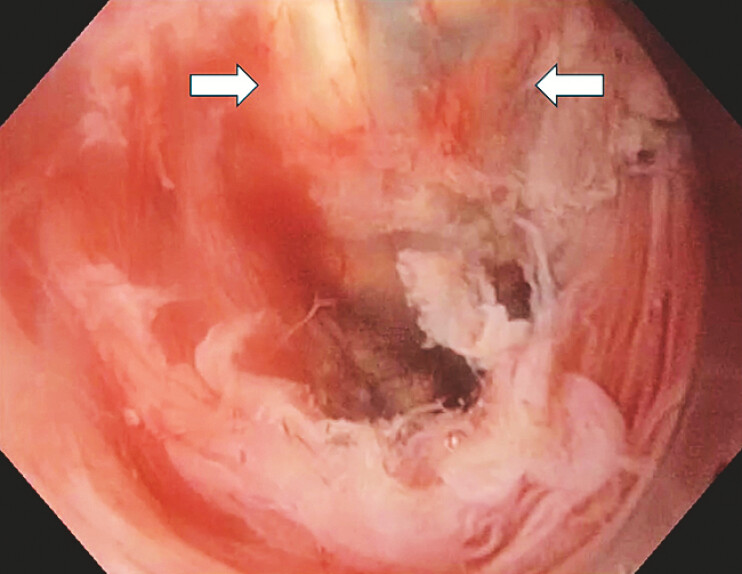 Fig. 1
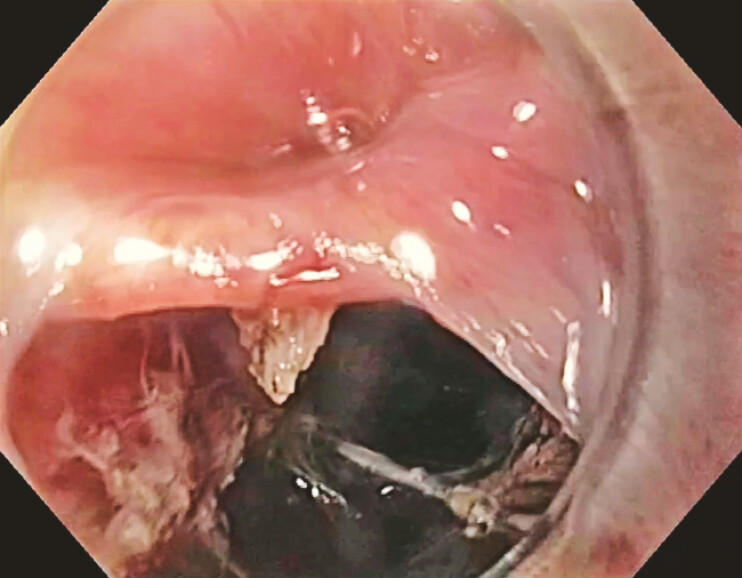 Fig. 2
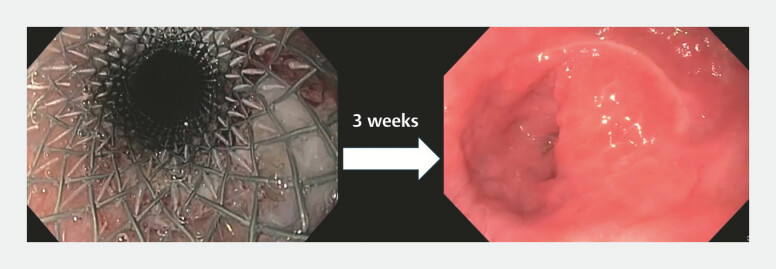 Fig. 3
Peer Reviews
No public reviews on file for this paper yet. If you reviewed it on a platform where reviews are public (OpenReview, ICLR, NeurIPS, ICML), you can paste yours below so the community can read it here.
Videos
No videos yet. Explain this paper in a talk, walkthrough, or lecture? Add one.
Taxonomy
TopicsDysphagia Assessment and Management · Esophageal and GI Pathology · Tracheal and airway disorders
Peroral endoscopic myotomy (POEM) is a highly effective and safe first-line treatment for achalasia 1 . The rate of full-thickness mucosal injuries during POEM has been reported at 1.7%, occurring most commonly in the cardia 2 . Significant risk factors associated with full-thickness mucosal injuries include previous POEM (OR, 5.005) and submucosal fibrosis (OR, 12.074) 2 . Small mucosal injuries are usually easily treated using endoscopic clips, whereas larger injuries may require additional techniques such as suturing or stents 2 . Since achalasia lacks peristalsis, stent migration risk may be lower.
We present the case of a 23-year-old man who underwent POEM for type II achalasia. Although previous biopsies showed four eosinophils per high-power field, this finding was not conclusive for eosinophilic esophagitis.
During POEM, inadvertent intramuscular tunneling left muscle fibers attached to the mucosal plane, requiring further dissection and potentially compromising the muscularis mucosae ( Video 1 ). A spastic area was identified, and a thin pediatric gastroscope was used for double-scope transillumination 3 , requiring a forced push to advance it, and an unusual translucency suggestive of mucosal injury was seen ( Fig. 1 ). Intraluminal evaluation confirmed mild mucosal changes, prompting initiation of myotomy to prevent further damage.
Successful treatment of a full-thickness mucosal injury during peroral endoscopic myotomy with a fully covered metal stent.Video 1
Unusual translucency (arrows) during double-scope transillumination.
After the myotomy was initated, a second intraluminal inspection revealed a full-thickness mucosal injury ( Fig. 2 ). To complete the procedure safely, underwater myotomy was performed. Upon completion of the myotomy, attempts to close the defect with clips were unsuccessful due to mucosal denudation and direct communication with the mediastinum. Finally, after closure of the mucosal incision with clips, a fully covered metal stent was placed to seal the defect ( Fig. 3 ). A nasogastric tube was subsequently inserted under endoscopic guidance, and prophylactic antibiotics were administered. A computed tomography scan ruled out any leaks, allowing the patient to begin oral intake and be discharged after one week without complications. The stent was removed three weeks post-procedure, and complete re-epithelialization was confirmed.
Full-thickness mucosal defect.
Fully covered metal stent placed for the full-thickness defect (left). Complete re-epithelization after removal of the stent three weeks post-procedure (right).
Endoscopy_UCTN_Code_CPL_1AH_2AL
The reference list from the paper itself. Each links out to its DOI / PubMed record.
- 1Werner YB Hakanson B Martinek J Endoscopic or surgical myotomy in patients with idiopathic achalasia N Engl J Med 20193812219222910.1056/NEJ Moa 190538031800987 · doi ↗ · pubmed ↗
- 2Wang Y Liu ZQ Xu MD Clinical and endoscopic predictors for intraprocedural mucosal injury during per-oral endoscopic myotomy Gastrointest Endosc 20198976977830218646 10.1016/j.gie.2018.09.003 · doi ↗ · pubmed ↗
- 3Lee JH Kedia P Stavropoulos SNAGA Clinical Practice Update on Endoscopic Management of Perforations in Gastrointestinal Tract: Expert Review Clin Gastroenterol Hepatol 2021192252226110.1016/j.cgh.2021.06.04534224876 · doi ↗ · pubmed ↗