Beyond severe iodinated contrast allergy: a contrast-free endoscopic ultrasound-guided rendezvous approach
Elena De Cristofaro, Jérôme Rivory, Charles-Eric Ber, Florian Rostain, Alexandru Lupu, Mathieu Pioche

Abstract
Genes, proteins, chemicals, diseases, species, mutations and cell lines named across the full text — each resolved to its canonical identifier and authoritative record.
Click any figure to enlarge with its caption.
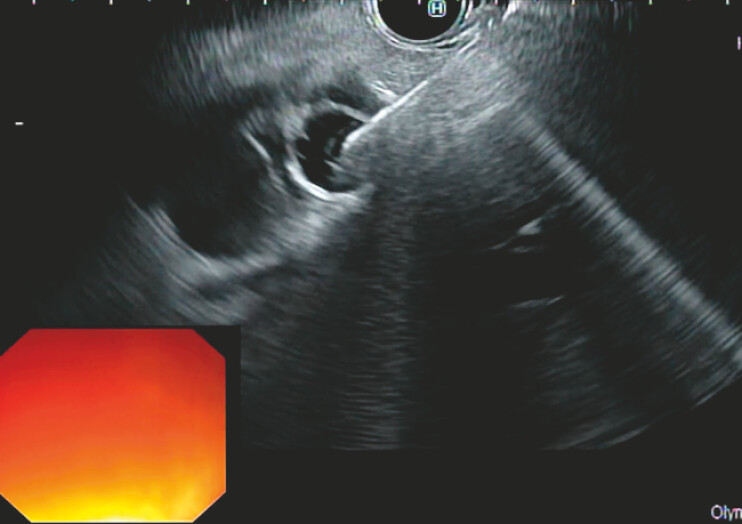 Fig. 1
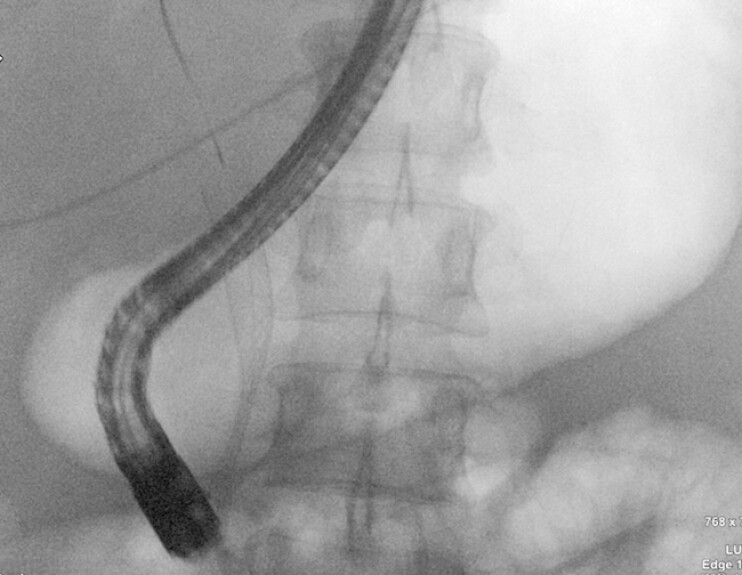 Fig. 2
Peer Reviews
No public reviews on file for this paper yet. If you reviewed it on a platform where reviews are public (OpenReview, ICLR, NeurIPS, ICML), you can paste yours below so the community can read it here.
Videos
No videos yet. Explain this paper in a talk, walkthrough, or lecture? Add one.
Taxonomy
TopicsLanthanide and Transition Metal Complexes · Migraine and Headache Studies · Traumatic Ocular and Foreign Body Injuries
Endoscopic retrograde cholangiopancreatography (ERCP) is a standard technique for managing various pancreatobiliary conditions. When ERCP fails or is not feasible, endoscopic ultrasound-guided (EUS) biliary drainage has emerged as a valuable alternative 1 . Both procedures typically rely on fluoroscopic guidance using iodinated contrast media to visualize the biliary and pancreatic ducts, essential for diagnosis and intervention.
Although rare, allergies to iodinated contrast can be severe. Reactions are mostly mild to moderate, with life-threatening events occurring in only 0.01%–0.02% of cases. In most situations, premedication with steroids and antihistamines is sufficient 2 3 4 .
We report the case of a 45-year-old woman with pancreatic neoplasia and jaundice, referred for biliary drainage. She had a confirmed history of severe anaphylactic shock to iodinated contrast media, with a formal contraindication confirmed by the hospital’s allergy unit ( Video 1 ).
Contrast-free endoscopic ultrasound-guided rendezvous approach.Video 1
Due to the impossibility of performing ERCP, an EUS-guided rendezvous approach was adopted. After identifying the pancreatic lesion and confirming absence of cystic duct invasion, an opaque iron wire was fixed on the skin to mark the optimal biliary access point. Under EUS guidance, the dilated bile duct was punctured at the cystic confluence ( Fig. 1 ), and a guidewire was advanced toward the duodenum and retrieved with forceps using a duodenoscope.
Puncture of the dilated bile duct at the cystic confluence under endoscopic ultrasound guidance.
A second guidewire was placed retrogradely in the bile duct. Positioning of a fully covered metal stent was assisted by the radio-opaque marker of the first scope wire placed in the cystic duct. Good biliary flow was confirmed, with clear visualization of the restricted section of the prothesis within the stenotic area at fluoroscopy ( Fig. 2 ). No adverse events occurred. Biochemical improvement was evident by Day 2.
Fluoroscopic visualization of the restricted portion of the prosthesis within the stenotic area.
This case highlights the feasibility and safety of EUS-guided rendezvous as an alternative when ERCP is contraindicated. The procedure enabled successful biliary drainage without iodinated contrast, demonstrating its potential role in managing pancreatobiliary obstructions in high-risk patients.
Endoscopy_UCTN_Code_TTT_1AR_2AK
Endoscopy_UCTN_Code_TTT_1AS_2AH
The reference list from the paper itself. Each links out to its DOI / PubMed record.
- 1Facciorusso A CrinòSF Gkolfakiset P Diagnostic work-up of bile duct strictures: European Society of Gastrointestinal Endoscopy (ESGE) Guideline Endoscopy 20255616618510.1055/a-2481-704839689874 · doi ↗ · pubmed ↗
- 2Rosado Ingelmo A Doña Diaz I Cabañas Moreno R Clinical practice guidelines for diagnosis and management of hypersensitivity reactions to contrast media J Investig Allergol Clin Immunol 20162614415510.18176/jiaci.005827326981 · doi ↗ · pubmed ↗
- 3Schabelman E Witting M The relationship of radiocontrast, iodine, and seafood allergies: a medical myth exposed J Emerg Med 20103970170710.1016/j.jemermed.2009.10.01420045605 · doi ↗ · pubmed ↗
- 4Sampson CS Goddard KB Bedy SC The “myth” of iodine allergy to radiocontrast in emergency medicine Am J Emerg Med 2019371363136510.1016/j.ajem.2018.12.01130553637 · doi ↗ · pubmed ↗