Successful Pregnancy After Combined Liver and Renal Transplantation in a Patient With Acute Intermittent Porphyria
Petro E. Petrides, Joachim Andrassy, Markus Guba, Manfred Stangl, Olivia Bronisch, Maria K. Beykirch

TL;DR
A patient with a rare metabolic disorder successfully had a combined liver and kidney transplant and later gave birth to a healthy baby.
Contribution
This case report demonstrates successful combined liver and renal transplantation in a patient with acute intermittent porphyria.
Findings
The patient recovered well after combined liver and renal transplantation.
She delivered a premature baby who developed normally over five years.
This is only the third documented case of successful combined transplantation for this condition.
Abstract
Acute intermittent porphyria is a rare inborn disease of porphyrin metabolism which can cause severe abdominal pain attacks and neurological symptoms. Here, we report a patient with a 20-year history of severe chronic manifestations of acute intermittent porphyria that led to end-stage renal disease and liver function impairment. Since only transplants can cure both disease manifestations, a combined liver and renal transplantation was performed. The patient recovered so well that she delivered a very low birth extreme premature baby 16 months later which developed normally over the next 5 years. Our case represents the third case in the literature with a successful combined liver/renal transplantation of a patient with acute porphyria. Thus, transplantation seems to be a viable backup option, should novel therapies such as siRNA treatment with givosiran fail.
Genes, proteins, chemicals, diseases, species, mutations and cell lines named across the full text — each resolved to its canonical identifier and authoritative record.
Click any figure to enlarge with its caption.
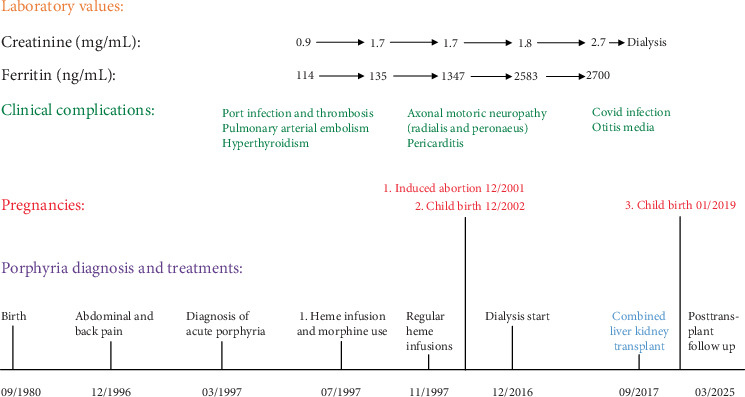 Figure 1
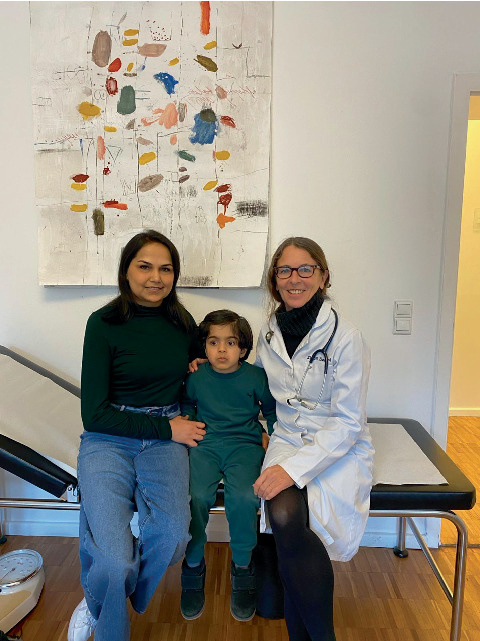 Figure 2
- —Projekt DEAL
Peer Reviews
No public reviews on file for this paper yet. If you reviewed it on a platform where reviews are public (OpenReview, ICLR, NeurIPS, ICML), you can paste yours below so the community can read it here.
Videos
No videos yet. Explain this paper in a talk, walkthrough, or lecture? Add one.
Taxonomy
TopicsPorphyrin Metabolism and Disorders · Neonatal Health and Biochemistry · Folate and B Vitamins Research
1. Introduction
Acute porphyrias are rare inherited disorders of heme metabolism characterized by acute abdominal pain and neurological complications [1]. Symptomatic patients may require heme infusions. A small minority of patients experience recurrent attacks, which historically required long-term heme therapy for many years. These attacks can be so debilitating that chronic use of morphine becomes necessary. The only definitive cure at present is a liver transplant. Long-term complications include renal disease [2], liver fibrosis [3], and hepatocellular carcinoma [4]. However, newer therapies, such as givosiran, may help prevent these complications [5].
2. Case History
We report the case of a patient from Afghanistan who had emigrated to Germany. At the age of 16, in December 1996, she suddenly developed abdominal and back pain. In March 1997, she was diagnosed with acute intermittent porphyria (AIP) with a porphobilinogen (PBG)-deaminase activity of 48% and the c.445C>T, p.Arg199X mutation. Since her diagnosis, she has required regular heme infusions every 3 months as part of our Munich cohort of patients with acute porphyria [6].
Over the following years, the frequency and severity of her attacks, characterized by back, abdominal, and stomach pain, progressively worsened, necessitating monthly heme infusions. Between these attacks, she mainly experienced fatigue. Any attempt to extend the interval between infusions aggravated her symptoms. In 2001, she became pregnant but requested an abortion in December that year. In December 2002, after a second pregnancy, she gave birth to a healthy son. In August 2003, hormonal ablation using the gonadorelin analogue goserelin (3.6 mg/month) to prevent further porphyria attacks was attempted but proved unsuccessful [7].
A major issue contributing to her acute attacks was her low body weight (40 kg, height 162 cm, BMI 15.2 kg/m^2^), so parenteral nutrition was often necessary. In February 2011, she was offered liver transplantation as a curative option, but she declined the offer.
Chronic administration of iron-containing heme resulted in elevated ferritin levels (Figure 1), prompting the initiation of iron mobilization therapy with the oral iron chelator deferasirox. However, this treatment had to be discontinued because of side effects such as diarrhea and increasing creatinine levels. Phlebotomy was not considered because the patient's hemoglobin level was just above 10 g/dL. Consequently, her ferritin levels continued to increase, reaching 2700 ng/mL by July 2015. Owing to her frequent need for pain management, she was regularly seen in the pain clinic and was prescribed tramadol, with subcutaneous morphine (5–10 mg) administered during acute attacks. Over time, she developed opioid tolerance, complicating effective pain relief. Simultaneously, her creatinine levels increased to 1.8 mg/dL (glomerular filtration rate (GFR) 36 mL/min), further rising to 2.7 mg/dL (GFR 22 mL/min) by July 2015 (Figure 1). Eventually, she developed end-stage renal disease (ESRD) by December 2016.
3. Treatment
With informed consent and a multidisciplinary approach, a combined liver and kidney transplantation was carried out in September 2017. The operation took 7.5 h: first, the liver was transplanted and then the kidney. The HLA type of the donor was A9, A9, A24, B7, B8, Cw7, Cw7, DR3, DR8, DR52, DQ2, and DQ4; the one of the recipient was A∗ 03,30; B∗ 13,51; C∗ 06,16; DRB1∗ 04,11; and DQB1∗ 03,03, indicating a complete mismatch. Immunosuppression with tacrolimus, azathioprine, and steroids was started.
Histological analysis of the explanted liver showed severe hemosiderosis, although no fibrosis was present at that time.
4. Outcome and Follow-Up
Since the liver transplantation, our patient has been free of acute attacks. Her urine PBG and 5-aminolaevulinic acid values have returned to normal. However, PBG-deaminase in erythrocytes remains reduced at 48% owing to the persistent genetic defect in the bone marrow.
Less than a year after the transplant, the patient became pregnant again while on immunosuppressive therapy with 6.5 mg of tacrolimus daily. At gestational week 25 + 0, she was diagnosed with early preeclampsia. The baby was delivered by secondary caesarean section at gestational week 29 + 4 in January 2019, with a low birth weight of 1090 g and placental infarction. To prevent respiratory distress syndrome in the newborn, she received steroid prophylaxis.
Regular follow-up over the past 8 years has shown that the patient maintains a good performance status, with a body weight of 49 kg and a stable creatinine level of 1.5 mg/dL (GFR 40 mL/min, normal above 60 mL/min). However, her hemoglobin level was temporarily low at 7.6 g/dL (normal range 12–16 g/dL) because of hypochromic anemia, which was treated with parenteral iron infusions (ferritin 7 ng/mL, normal > 50 ng/mL). Her child, who was 6 years old at the time of this writing, has developed normally (Figure 2).
During the last follow-ups in 01/2025 and 03/2025, her hemoglobin values were between 11.9 and 13.1 g/dL and her creatinine levels between 1.3 and 1.5 mg/dL (GFR 42–50 mL/min) with a discrete albuminuria of 40 mg/g creatinine. She was negative for anti-HLA antibodies as well as negative on BK virus and CMV-PCRs.
Taking 50-mg azathioprine, 5-mg prednisone, and 2.5-mg tacrolimus per day, her tacrolimus levels (LC-MS/MS) were between 3.2 and 4.9 ng/mL. In addition, her antihypertensive treatment consisted of bisoprolol (5 mg), lercanidipine (10 mg), and candesartan (8 mg).
She reported that her well-being is mainly dependent upon her iron supplies.
5. Discussion
Most patients with acute porphyrias, such as AIP, experience only one major attack during their lifetime. However, a small minority of patients, usually females aged 20–40 years, suffer from chronic attacks that can last for years. These patients often require repeated iron-containing heme infusions and strong pain medications. In some patients, the chronic nature of their illness can lead to liver and/or renal function impairment. Liver damage may be caused by chronic inflammation and fibrosis due to iron accumulation because of heme infusions [8] or the disease itself [9, 10]. Chronic renal damage occurs in 50% of the patients with symptomatic AIP, many of whom also have hypertension [2]. Owing to the invasive nature of liver transplantation, the need for lifelong immunosuppression, and the shortage of donors, it is considered a last resort option for patients who continue to experience frequent attacks and no longer respond to pharmacological therapies. Moreover, transplant-associated complications such as hepatic artery thrombosis can occur. The first liver transplantation in a patient with AIP was reported 20 years ago [11], and since then, this treatment has been performed several times [12].
A large European review reported data from 38 patients with AIP who underwent liver transplantation: 89% of the patients were female, with a median age of 37 years [13]. All patients experienced relief from acute attacks, and their survival rates were comparable to those of patients who had undergone transplantations for other similar diseases. While neurological symptoms improved after liver transplantation, renal function continued to decline in some cases.
Renal transplants are performed less frequently than liver transplants in patients with AIP, typically after appropriate pretransplant evaluation [14]. The outcomes of 11 patients with AIP and ESRD with a median age of 35 years were documented in the French Porphyria Center Registry [15]. In this cohort, two patients died from different causes, and no episodes of rejection or significant adverse events were observed. The authors concluded that renal transplantation is the treatment of choice for patients with AIP with ESRD, as posttransplantation care is simple, drug management is easy, and quality of life improves significantly.
In extremely rare cases, chronic illness can lead to both liver and renal function impairments, requiring the replacement of both organs. This dual transplant approach is occasionally used in rare metabolic diseases where ESRD is caused by a genetic defect in the liver [16]. To date, there have been only two reports of such a combined procedure in patients with acute porphyrias [17, 18].
After transplantation, pregnancy carries an increased risk [19]. However, in patients with AIP, successful pregnancies can occur not only after liver [20] or renal transplantation [21] but also, as observed in our patient, after a combined renal and liver transplant.
Recently, novel therapies such as siRNA technology with givosiran have become available for treating patients with recurrent attacks [5]. These therapies hold promise in protecting patients from the risks of organ involvement, potentially reducing the need for transplant procedures in the future.
The reference list from the paper itself. Each links out to its DOI / PubMed record.
- 1Balwani M. Keel S. Meissner P. Sonderup M. Stein P. Yasuda M. Case‐Based Discussion of the Acute Hepatic Porphyrias: Updates on Pathogenesis, Diagnosis and Management Liver International 2025453 e 1592410.1111/liv.1592438618923 · doi ↗ · pubmed ↗
- 2Ricci A. Guida C. C. Manzini P. Cuoghi C. Ventura P. Kidney Involvement in Acute Hepatic Porphyrias: Pathophysiology and Diagnostic Implications Diagnostics 20211112 p. 232410.3390/diagnostics 1112232434943561 PMC 8700387 · doi ↗ · pubmed ↗
- 3Willandt B. Langendonk J. G. Biermann K. Liver Fibrosis Associated With Iron Accumulation due to Long-Term Heme-Arginate Treatment in Acute Intermittent Porphyria: A Case Series JIMD Reports 20152577981310.1007/8904_2015_4582-s 2.0-84991547155 PMC 505918826093628 · doi ↗ · pubmed ↗
- 4Lissing M. Vassiliou D. Floderus Y. Risk of Primary Liver Cancer in Acute Hepatic Porphyria Patients: A Matched Cohort Study of 1244 Individuals Journal of Internal Medicine 2022291682483610.1111/joim.1346335112415 PMC 9311710 · doi ↗ · pubmed ↗
- 5Ventura P. Bonkovsky H. L. Gouya L. Efficacy and Safety of Givosiran for Acute Hepatic Porphyria: 24‐Month Interim Analysis of the Randomized Phase 3 ENVISION Study Liver International 202242116117210.1111/liv.1509034717041 PMC 9299194 · doi ↗ · pubmed ↗
- 6Bronisch O. Stauch T. Haverkamp T. Beykirch M. K. Petrides P. E. Acute Porphyrias: A German Monocentric Study of the Biochemical, Molecular Genetic and Clinical Data of 62 Families Annals of Hematology 201998122683269110.1007/s 00277-019-03831-731745600 · doi ↗ · pubmed ↗
- 7Schulenburg-Brand D. Gardiner T. Guppy S. An Audit of the Use of Gonadorelin Analogues to Prevent Recurrent Acute Symptoms in Patients With Acute Porphyria in the United Kingdom JIMD Reports 2017369910710.1007/8904_2017_22-s 2.0-8505287082328220410 PMC 5680288 · doi ↗ · pubmed ↗
- 8Schmitt C. Lenglet H. Yu A. Recurrent Attacks of Acute Hepatic Porphyria: Major Role of the Chronic Inflammatory Response in the Liver Journal of Internal Medicine 20182841789110.1111/joim.127502-s 2.0-8504439517229498764 · doi ↗ · pubmed ↗