Clinical Significance of Elevated Levels of Soluble‐Form Immune Checkpoint Molecules in Patients With Aggressive Adult T‐Cell Leukemia‐Lymphoma
Shigeo Fuji, Junya Makiyama, Kuniko Takano, Ilseung Choi, Takeo Suzuki, Chihiro Suminaka, Mao Kuroishi, Yosuke Iwasaki, Hidenori Kasahara, Yuma Tada, Yasuhiro Shingai, Sayako Yuda, Takafumi Yokota, Jun Ishikawa

TL;DR
This study shows that high levels of soluble immune checkpoint molecules are linked to worse outcomes in aggressive adult T-cell leukemia-lymphoma patients.
Contribution
The study identifies elevated soluble PD-1, PD-L1, and CTLA-4 as novel adverse prognostic markers in aggressive ATL.
Findings
Soluble PD-1, PD-L1, and CTLA-4 levels were significantly higher in aggressive ATL compared to indolent ATL.
Elevated soluble IC levels correlated strongly with soluble IL-2R and predicted adverse prognosis.
These markers may serve as potential indicators of immune status and disease severity in ATL.
Abstract
Immune checkpoint (IC) pathways, including programmed death protein 1 (PD‐1), its ligand PD‐L1, and CTLA‐4, mediate negative regulatory signals in immune responses. Recent studies in autoimmune diseases and malignancies reported that the presence of the soluble form of these ICs would reflect the overall immune status. We assessed the clinical significance of these soluble‐form ICs in HTLV‐1 carriers and adult T‐cell leukemia‐lymphoma (ATL) patients. After obtaining informed consent, plasma from HTLV‐1 carriers and ATL patients was prospectively collected in participating centers. Plasma concentrations of soluble‐form PD‐1, PD‐L1, and CTLA‐4 (sPD‐1, sPD‐L1, and sCTLA‐4) were measured. Ninety‐six cases were included (HTLV‐1 carriers, n = 4; indolent ATL, n = 14; aggressive ATL, n = 78). The median age at sampling was 65.5 (range, 23–85) years. Soluble factors levels were significantly…
Genes, proteins, chemicals, diseases, species, mutations and cell lines named across the full text — each resolved to its canonical identifier and authoritative record.
Click any figure to enlarge with its caption.
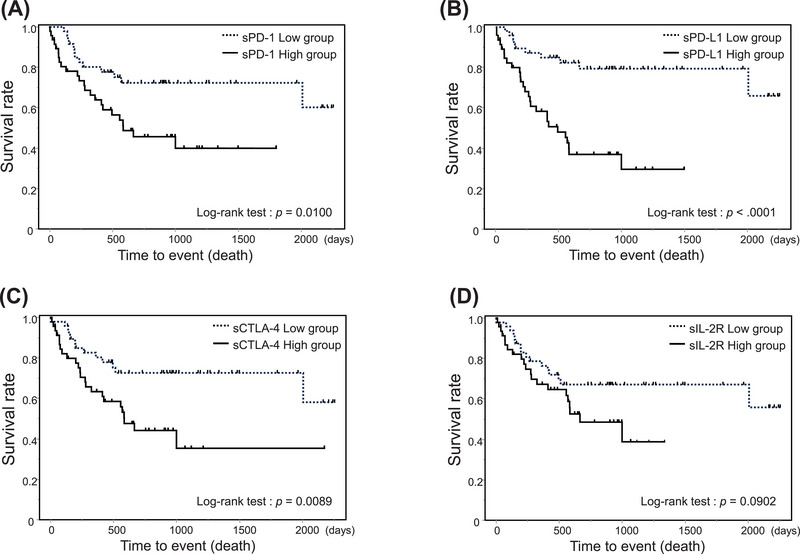 Figure 1
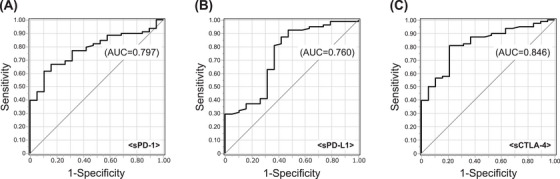 Figure 2
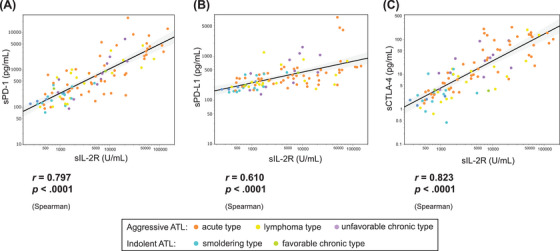 Figure 3
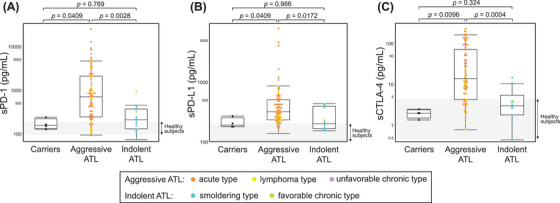 Figure 4
Peer Reviews
No public reviews on file for this paper yet. If you reviewed it on a platform where reviews are public (OpenReview, ICLR, NeurIPS, ICML), you can paste yours below so the community can read it here.
Videos
No videos yet. Explain this paper in a talk, walkthrough, or lecture? Add one.
Taxonomy
TopicsT-cell and Retrovirus Studies · Immune Cell Function and Interaction · Galectins and Cancer Biology