Brain-Computer Interface tool use and the Contemplation Conundrum: a blueprint of mental action, agency, and control
Dvija Mehta

TL;DR
The paper explores ethical issues in brain-computer interface use by examining the nature of intention and agency in mental actions.
Contribution
It introduces the 'contemplation conundrum' to highlight ethical challenges when BCI actions are voluntary yet unintentional.
Findings
Certain BCI-mediated movements may be both voluntary and unintentional under some theories of action.
The paper proposes studying neural correlates of intention and imagination to address BCI control and privacy issues.
Abstract
This paper approaches the role of intentional action in brain-computer interface (BCI) tool use to allow for an ethical discourse regarding the development and usage of neurotechnology. The exploration of mental actions and user control in BCI tool use brings us closer to understanding the philosophical underpinnings of intentions and agency for BCI-mediated actions. The author presents that under some theories of intentional action, certain BCI-mediated overt movements qualify as both voluntary and unintentional. This plausibly magnifies the ethical considerations surrounding BCI tool use. This problem is referred by the author as the contemplation conundrum. Thus, the paper proposes research scope for the neural correlates of intention formation and the neural correlates of imagination aimed at clarifying implementational control and safeguarding privacy of thought in BCI tool use.
Genes, proteins, chemicals, diseases, species, mutations and cell lines named across the full text — each resolved to its canonical identifier and authoritative record.
Click any figure to enlarge with its caption.
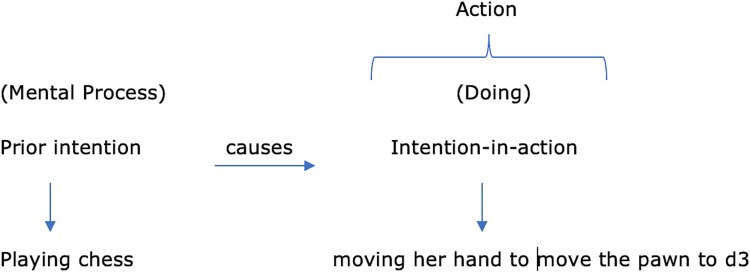 Figure 1
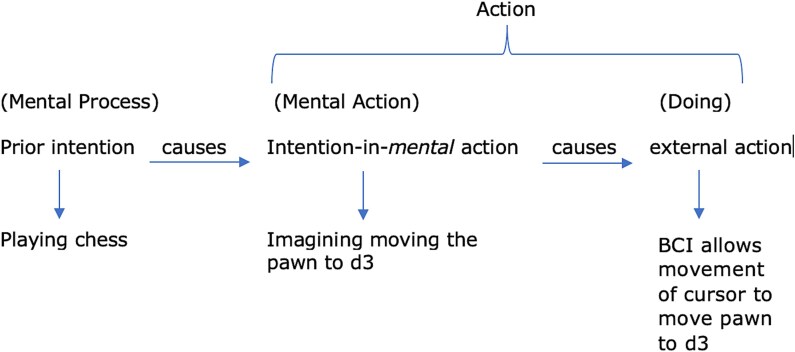 Figure 2
Peer Reviews
No public reviews on file for this paper yet. If you reviewed it on a platform where reviews are public (OpenReview, ICLR, NeurIPS, ICML), you can paste yours below so the community can read it here.
Videos
No videos yet. Explain this paper in a talk, walkthrough, or lecture? Add one.
Taxonomy
TopicsEEG and Brain-Computer Interfaces · Neuroscience and Neural Engineering · Neural and Behavioral Psychology Studies