Blunt-Nosed Viper (Macrovipera lebetinus) Venom: Proteomic Composition, Antioxidant Properties, and Anti-Alzheimer Assessment
Noor Subhee Azz-Aldeen Azz-Aldeen, Hülya Tuba Kıyan, Sabriye Percin Ozkorucuklu, Mehmet Zülfü Yıldız, Naşit İğci, Mert Karış, Ebru Gurel Gurevin

TL;DR
This study explores the venom of the blunt-nosed viper, analyzing its protein composition and antioxidant and anti-Alzheimer properties.
Contribution
The study identifies nonprotein components in viper venom that may contribute to its biological activities, expanding beyond traditional protein-based analysis.
Findings
Methanol and ethyl acetate fractions of the venom showed significant antioxidant and enzyme inhibitory properties.
Nineteen unique proteins from eight families were identified in the crude venom and its fractions.
The ethyl acetate fraction exhibited strong acetylcholinesterase inhibition comparable to the drug donepezil.
Abstract
This study examines the antioxidant and enzyme (acetylcholinesterase, butyrylcholinesterase) inhibitory properties of crude and different solvent fractions of Macrovipera lebetinus obtusa venom and investigates the proteomic composition of its fractions (ethyl acetate, methanol, and water) employing liquid chromatography-tandem mass spectrometry (LC-MS/MS) analysis. The results revealed many peptide and protein families, suggesting considerable biological potential. Nineteen unique protein identifications belonging to eight families were achieved in the crude venom, along with additional identifications in particular fractions. Although major bioactive molecules in snake venoms are proteins and peptides, which dissolve readily in water-based solvents and can be separated by chromatography, here we also wondered if nonprotein components with different polarities and solubilization…
Genes, proteins, chemicals, diseases, species, mutations and cell lines named across the full text — each resolved to its canonical identifier and authoritative record.
Click any figure to enlarge with its caption.
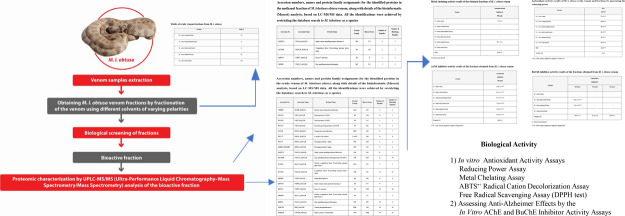 Figure 1
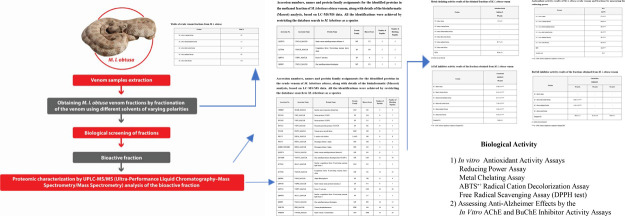 Figure 2
 Figure 3
 Figure 4
 Figure 5
 Figure 6
Peer Reviews
No public reviews on file for this paper yet. If you reviewed it on a platform where reviews are public (OpenReview, ICLR, NeurIPS, ICML), you can paste yours below so the community can read it here.
Videos
No videos yet. Explain this paper in a talk, walkthrough, or lecture? Add one.
Taxonomy
TopicsVenomous Animal Envenomation and Studies · Healthcare and Venom Research · Insect and Pesticide Research