Corticomuscular coherence during upright standing in unilateral transfemoral amputees
Britta Meyer, Thomas Krauskopf, Katharina Fuchs, Marvin Beusterien, Lukas Klein, Marc Mueller, Tonio Ball, Georg W Herget, Natalie Mrachacz-Kersting, Vinzenz von Tscharner, Carsten Mehring, Thomas Stieglitz, Cristian Pasluosta

TL;DR
This study explores how brain and muscle coordination changes in people with a lower limb amputation during standing, revealing altered sensory feedback and increased cognitive load.
Contribution
The study introduces new insights into corticomuscular coherence changes in unilateral transfemoral amputees during upright standing.
Findings
Amputees showed significant differences in afferent and efferent corticomuscular coherence compared to controls.
Increased power and reduced alpha frequencies in the motor cortex suggest higher cognitive load in amputees.
Visual conditions and dual tasking influenced corticomuscular coherence patterns in amputees.
Abstract
Patients with a lower limb amputation suffer from an impaired balance control and thereby are at a higher risk to fall. To cope with this deficit, they adapt their neuromuscular system by modifying biomechanical and neuromuscular structures. In this study, we investigated changes in corticomuscular coherence between the motor cortex and muscles of the trunk and the intact lower leg. We recorded electroencephalogram (EEG) and electromyogram (EMG) data from 10 unilateral transfemoral amputees and 10 age-matched able-bodied controls during quiet upright stance with eyes open, eyes closed and during dual tasking. To analyse afferent and efferent corticomuscular coherence, directional wavelet coherence between EEG and EMG signals was computed. The corticomuscular coherence analysis showed significant differences between amputees and controls in the afferent and efferent direction and across…
Genes, proteins, chemicals, diseases, species, mutations and cell lines named across the full text — each resolved to its canonical identifier and authoritative record.
Click any figure to enlarge with its caption.
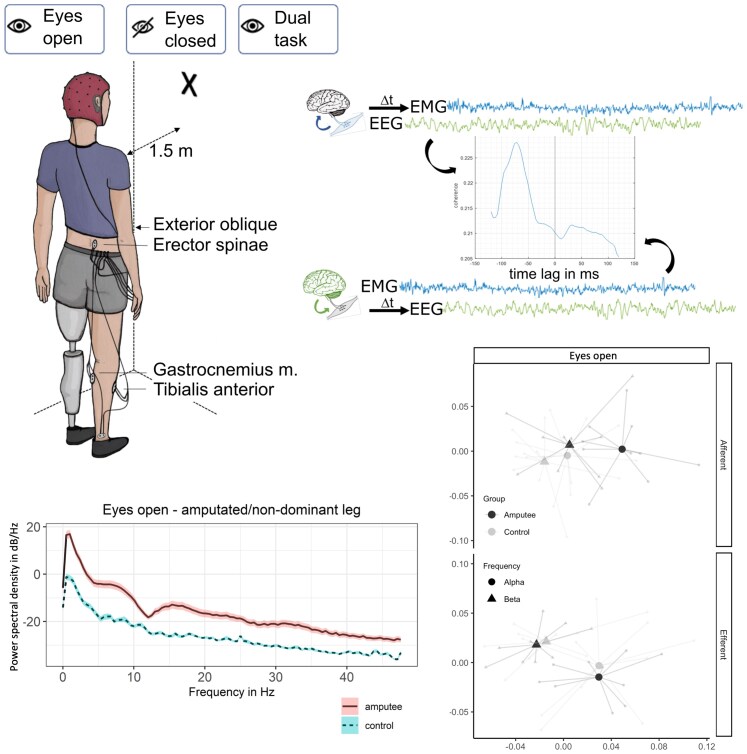 Figure 1
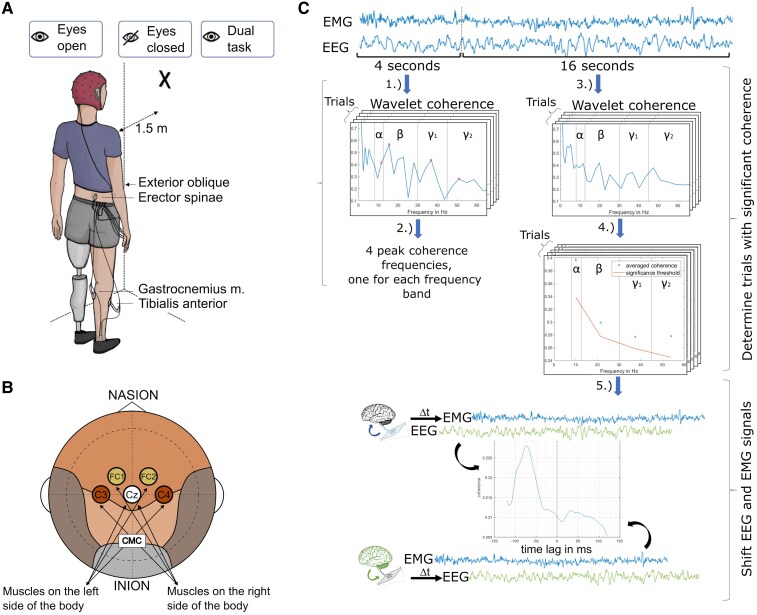 Figure 2
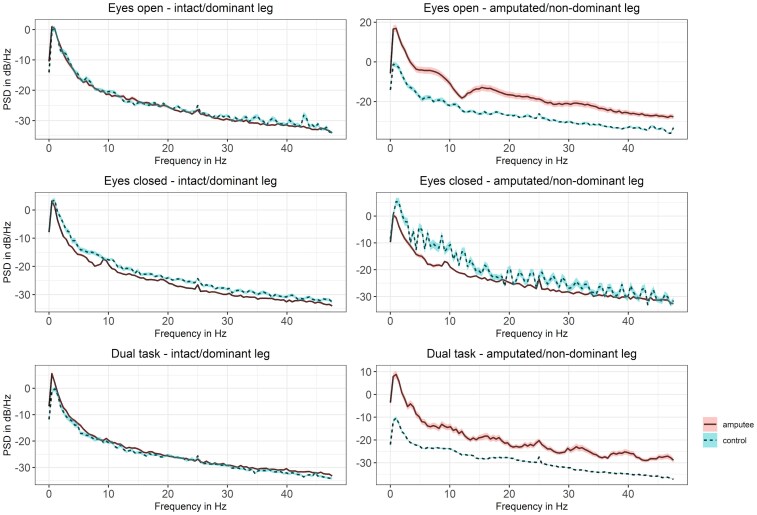 Figure 3
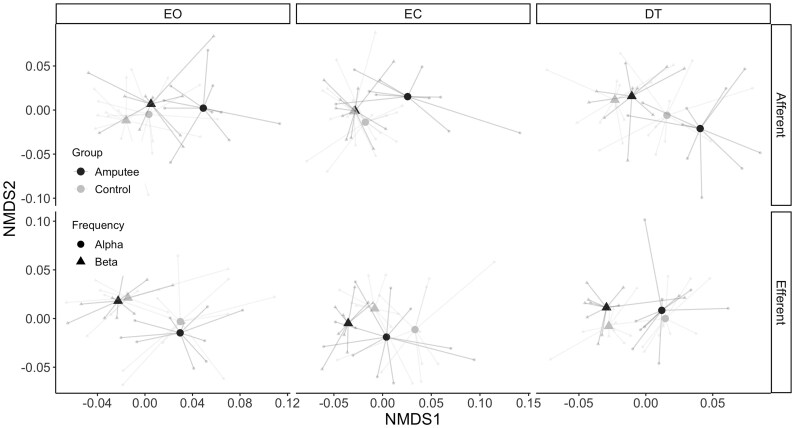 Figure 4
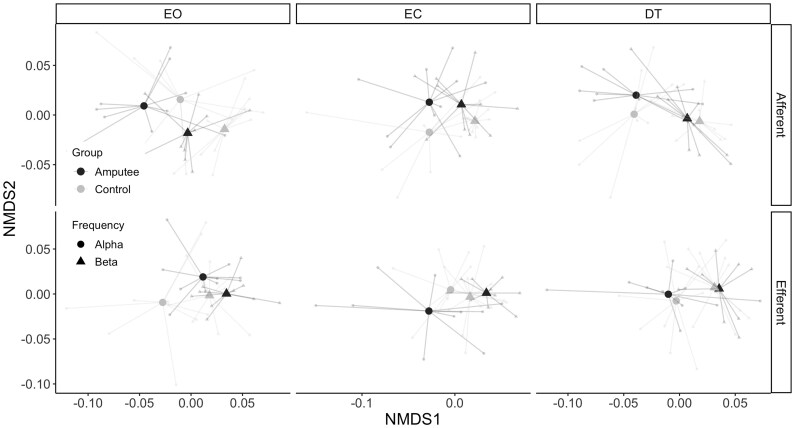 Figure 5
Peer Reviews
No public reviews on file for this paper yet. If you reviewed it on a platform where reviews are public (OpenReview, ICLR, NeurIPS, ICML), you can paste yours below so the community can read it here.
Videos
No videos yet. Explain this paper in a talk, walkthrough, or lecture? Add one.
Taxonomy
TopicsMuscle activation and electromyography studies · Stroke Rehabilitation and Recovery · EEG and Brain-Computer Interfaces