Staple Formations in Bronchial Closure with Equal-Height Staples to Those with Graduated-Height Staples Using Motorized Staplers
Kenji Tomizawa, Hana Oiki, Shota Fukuda, Masaya Nishino, Katsuaki Sato, Tetsuya Mitsudomi

TL;DR
This study compares staple formation completeness in bronchial closure using two types of motorized staplers, finding that graduated-height staples perform better, especially in calcified bronchi.
Contribution
The study provides empirical evidence on the performance of graduated-height versus equal-height staples in bronchial closure using motorized staplers.
Findings
Graduated-height staples showed a higher incidence of staple scores above the median compared to equal-height staples.
Graduated-height staples had a higher rate of complete staple formation, particularly in calcified bronchi.
No bronchopleural fistula was observed in any patients during the study period.
Abstract
Purpose: Motorized automatic staplers are used for bronchial closure following pulmonary resection. This study aimed to compare the completeness of staple formation in bronchial closure using 2 commonly adopted staple cartridges with motorized automatic staplers as follows: graduated-height staples (GHS) and equal-height staples (EHS). Methods: This prospective observational study included 103 patients (105 bronchial stumps) undergoing pulmonary resections for lung cancer. Resected bronchi were embedded in paraffin, X-rays were taken, and staple formations were scored on a 0–4 scale, with a score of 4 indicating complete staple formation. Stump scores represented the average score of all staples per bronchial stump. Results: The GHS exhibited a higher incidence of staple scores above the median (3.91) than that of the EHS (37/59 [62.7%] vs. 19/46 [41.3%], respectively; p = 0.033).…
Genes, proteins, chemicals, diseases, species, mutations and cell lines named across the full text — each resolved to its canonical identifier and authoritative record.
Click any figure to enlarge with its caption.
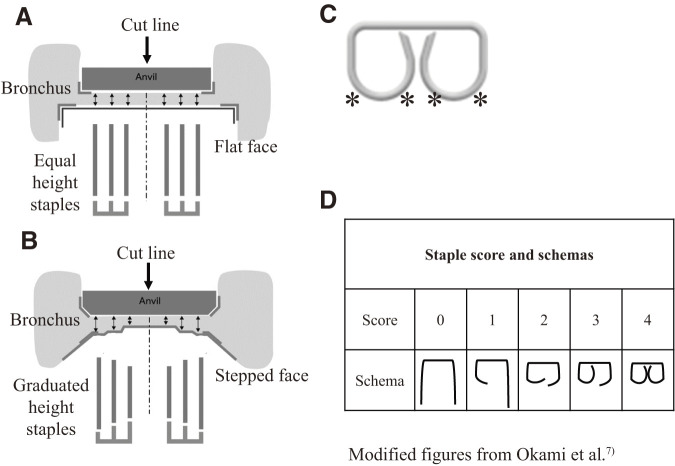 Figure 1
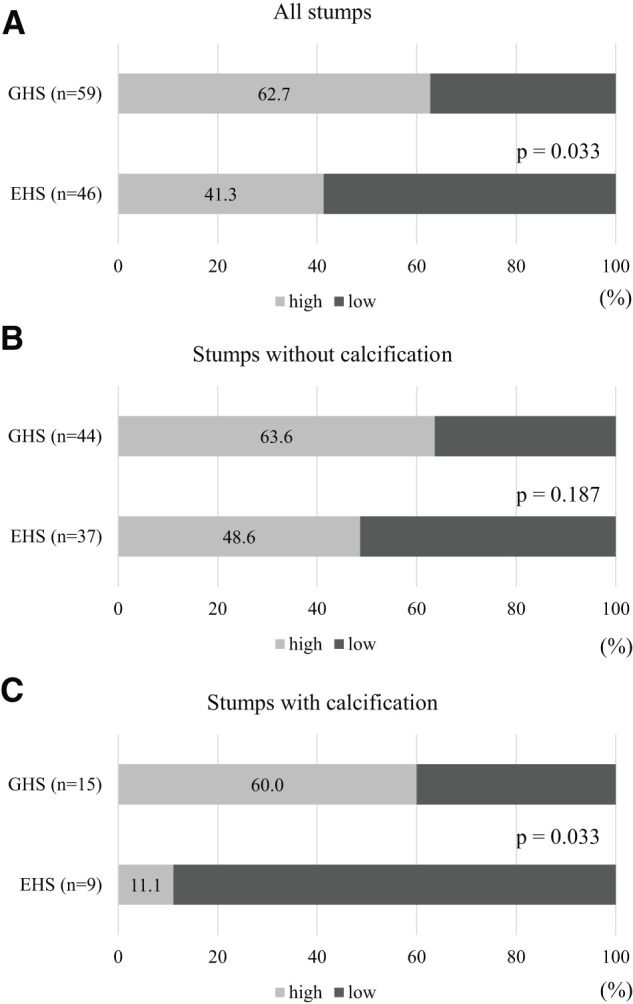 Figure 2
Peer Reviews
No public reviews on file for this paper yet. If you reviewed it on a platform where reviews are public (OpenReview, ICLR, NeurIPS, ICML), you can paste yours below so the community can read it here.
Videos
No videos yet. Explain this paper in a talk, walkthrough, or lecture? Add one.
Taxonomy
TopicsPleural and Pulmonary Diseases · Airway Management and Intubation Techniques · Tracheal and airway disorders