Investigation of erythema migrans patients identifies Borrelia species and Neoehrlichia mikurensis with implications for clinical assessment
Samuel Cronhjort, Peter Wilhelmsson, Ivar Tjernberg, Mattias Waldeck, Anna J. Henningsson, Chris Anderson, Pia Forsberg, Per-Eric Lindgren

TL;DR
This study examines skin lesions caused by tick-borne infections to better understand co-infections and improve diagnosis.
Contribution
The study identifies Borrelia species and Neoehrlichia mikurensis co-infections in erythema migrans patients and links lesion morphology to bacterial load.
Findings
Borrelia DNA was detected in 88% of erythema migrans skin lesions, predominantly Borrelia afzelii.
Two co-infection cases were identified, including one with Borrelia afzelii and Neoehrlichia mikurensis.
Homogeneous lesions had higher spirochete quantities in the central zone compared to annular lesions.
Abstract
Emerging tick-borne infections pose public health challenges and may complicate treatment decisions. The EMBio study, a multicenter observational study, aims to describe erythema migrans (EM), an early localized manifestation of Borrelia burgdorferi sensu lato (s.l.) infection, and investigate the occurrence of tick-borne co-infections among patients presenting with this skin lesion. Additionally, the study seeks to determine relations between EM morphology, other clinical manifestations, specific pathogens, and disease prognosis. Clinical characteristics, skin biopsies, and blood samples were analyzed from 26 patients to assess co-infections, quantity, Borrelia species, and spirochete load. Borrelia DNA was detected in 88% of EM skin lesions, with Borrelia afzelii as the predominant species. Two cases of co-infections were identified, one involving two Borrelia species and one…
Genes, proteins, chemicals, diseases, species, mutations and cell lines named across the full text — each resolved to its canonical identifier and authoritative record.
Click any figure to enlarge with its caption.
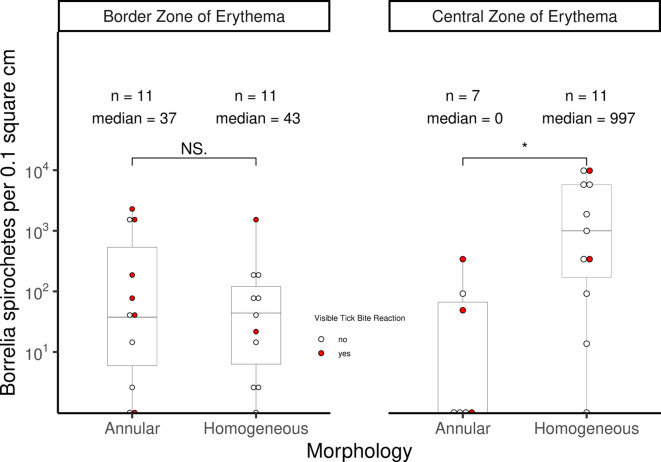 Figure 1
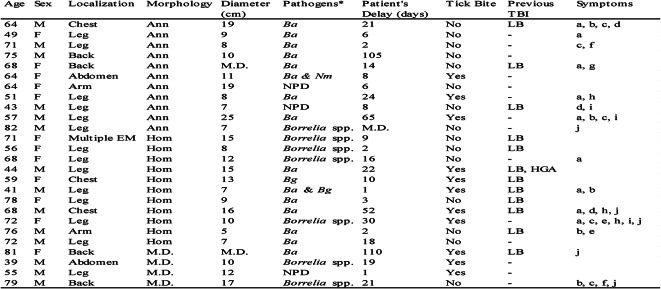 Figure 2
Peer Reviews
No public reviews on file for this paper yet. If you reviewed it on a platform where reviews are public (OpenReview, ICLR, NeurIPS, ICML), you can paste yours below so the community can read it here.
Videos
No videos yet. Explain this paper in a talk, walkthrough, or lecture? Add one.
Taxonomy
TopicsVector-borne infectious diseases · Dermatological diseases and infestations · Viral Infections and Vectors