Stimulant medication and symptom interrelations in children, adolescents and adults with attention-deficit/hyperactivity disorder
Zarah van der Pal, Hilde M. Geurts, Jonas M. B. Haslbeck, Alex van Keeken, Anne Marijn Bruijn, Linda Douw, Daan van Rooij, Barbara Franke, Jan Buitelaar, Nanda Lambregts-Rommelse, Catharina Hartman, Jaap Oosterlaan, Marjolein Luman, Liesbeth Reneman, Pieter J. Hoekstra

TL;DR
This study explores how stimulant medication affects the relationships between ADHD symptoms in treated and untreated individuals.
Contribution
The study is the first to use network analysis to compare ADHD symptom interrelations in stimulant-treated and untreated individuals.
Findings
Stimulant-treated individuals showed stronger symptom associations compared to untreated individuals and controls.
No differences were found between subgroups based on stimulant treatment trajectory.
Longitudinal studies are needed to determine if differences are due to treatment or pre-existing factors.
Abstract
Stimulant medication is effective in alleviating overall symptom severity of attention-deficit/hyperactivity disorder (ADHD), yet interindividual variability in treatment response and tolerability still exists. While network analysis has identified differences in ADHD symptom relations, the impact of stimulant medication remains unexplored. Increased understanding of this association could provide valuable insights for optimizing treatment approaches for individuals with ADHD. In this study, we compared and characterized ADHD symptom networks (including 18 ADHD symptoms) between stimulant-treated (n = 348) and untreated (n = 70) individuals with ADHD and non-ADHD controls (NACs; n = 444). Moreover, we compared symptom networks between subgroups defined by their stimulant treatment trajectory (early-and-intense use, late-and-moderate use). Stimulant-treated individuals with ADHD showed…
Genes, proteins, chemicals, diseases, species, mutations and cell lines named across the full text — each resolved to its canonical identifier and authoritative record.
Click any figure to enlarge with its caption.
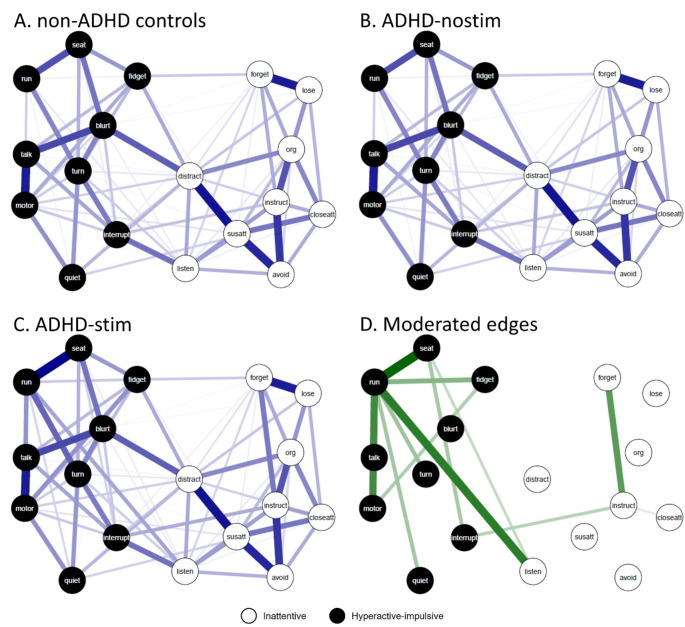 Figure 1
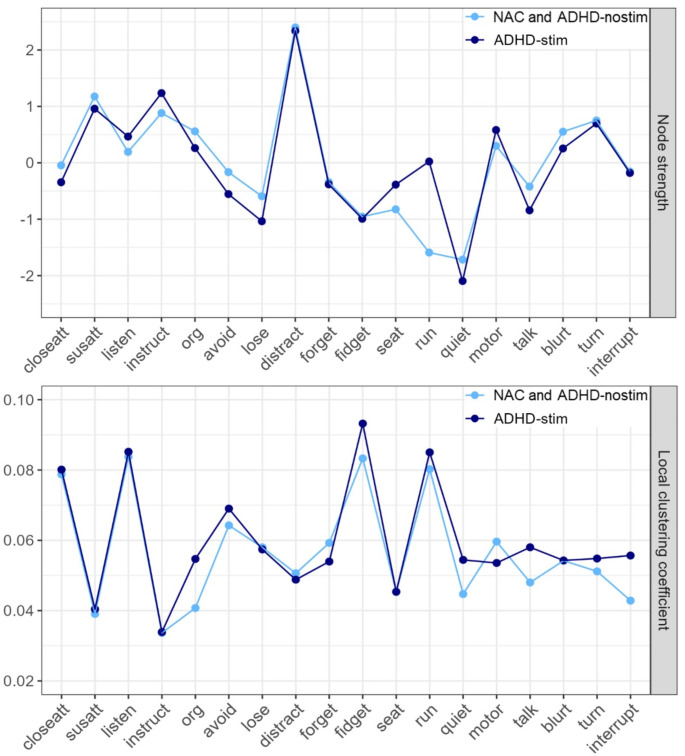 Figure 2
Peer Reviews
No public reviews on file for this paper yet. If you reviewed it on a platform where reviews are public (OpenReview, ICLR, NeurIPS, ICML), you can paste yours below so the community can read it here.
Videos
No videos yet. Explain this paper in a talk, walkthrough, or lecture? Add one.
Taxonomy
TopicsAttention Deficit Hyperactivity Disorder · Mental Health Research Topics · Bipolar Disorder and Treatment