Structural remodeling activates bacterial anti-phage immunity: insights from HerA-DUF4297
Xiaoyan Wang, Leiliang Zhang

TL;DR
Bacteria use structural changes in a protein complex to activate defenses against phage infections.
Contribution
The study reveals that structural remodeling of the HerA-DUF4297 complex activates nuclease activity for anti-phage immunity.
Findings
DUF4297 has minimal nuclease activity alone but becomes active when bound to HerA.
Structural changes in the HerA-DUF4297 complex regulate its nuclease activity.
This mechanism offers a new model for signal transduction in bacterial immune systems.
Abstract
In response to phage infection, bacteria have evolved a variety of sophisticated immune defense systems to combat viral predation. Among these defense mechanisms, the transmission of immune signals via intracellular signal transduction molecules is a common strategy that often accompanies enzyme activity. Recent studies have characterized the HerA-DUF4297 protein complex, a two-component defense system that integrates ATPase and nuclease activities. This complex inhibits phage infection by inducing DNA degradation. Notably, DUF4297 displays minimal nuclease activity when it operates on its own. However, it demonstrates robust nuclease activity when in complex with HerA. Crucially, the nuclease activity within this complex is regulated by structural changes. These findings provide novel insights into the activation of bacterial immune systems against phages, suggesting that the…
Genes, proteins, chemicals, diseases, species, mutations and cell lines named across the full text — each resolved to its canonical identifier and authoritative record.
Click any figure to enlarge with its caption.
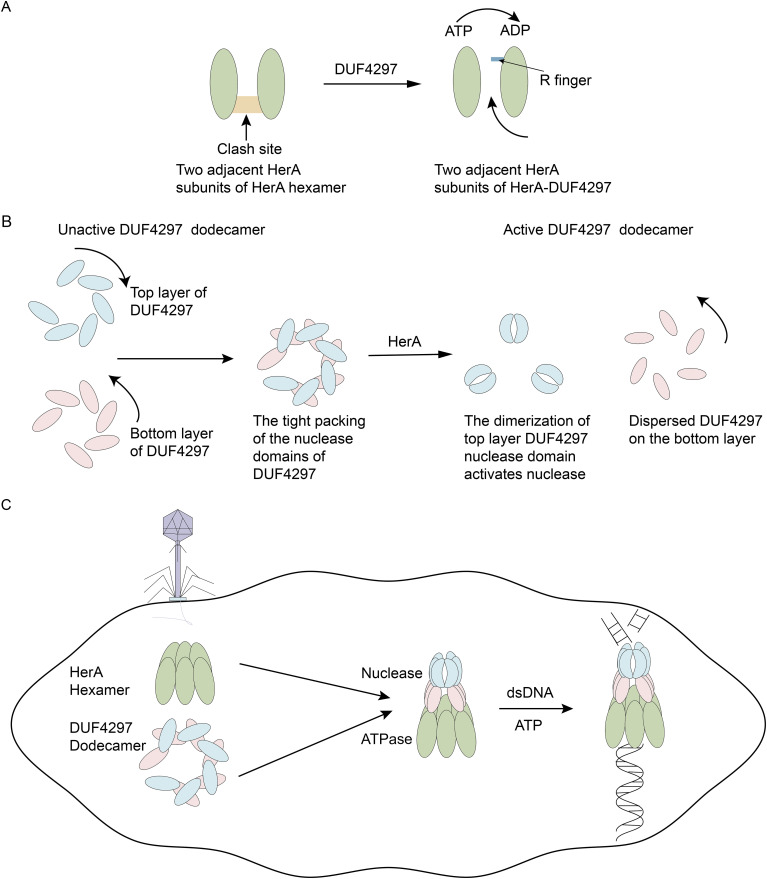 Figure 1
Peer Reviews
No public reviews on file for this paper yet. If you reviewed it on a platform where reviews are public (OpenReview, ICLR, NeurIPS, ICML), you can paste yours below so the community can read it here.
Videos
No videos yet. Explain this paper in a talk, walkthrough, or lecture? Add one.
Taxonomy
TopicsBacteriophages and microbial interactions · Cytomegalovirus and herpesvirus research · CRISPR and Genetic Engineering