Supplementary Surveillance of Poliovirus Circulation in the Russian Federation: Results of a Study on Migrant Children of “Risk Group”
Olga E. Ivanova, Yulia M. Mikhailova, Nadezhda S. Morozova, Alina V. Chirova, Evgeniya A. Cherepanova, Lyudmila N. Golitsyna, Olga Y. Baikova, Elizaveta V. Yakovchuk, Evgenia V. Karpova, Liubov I. Kozlovskaya

TL;DR
This study tracked poliovirus in migrant children in Russia to detect hidden virus spread and prevent outbreaks.
Contribution
The study provides updated data on poliovirus and non-polio enterovirus circulation in migrant children, a key risk group.
Findings
PV3 was the most common poliovirus type detected among migrant children.
Five children excreted epidemic-risk PV2, prompting additional immunization.
Non-polio enteroviruses, especially betacoxsakie species, were frequently identified.
Abstract
The detection of “silent” poliovirus (PV) circulation among clinically healthy populations is an important component of supplementary surveillance for poliomyelitis. Migrants from countries or regions where polio is endemic, affected by outbreaks, or at risk may contribute to the introduction of PVs of epidemic significance: wild poliovirus type 1, vaccine-derived polioviruses (VDPVs), or poliovirus type 2 into polio-free countries. Migrant children, refugees under 5 years of age, are considered a “risk group” in Russia and are subject to testing for PVs. During 2014–2023, guided by the algorithm of virological and molecular investigation of acute flaccid paralysis cases recommended by the WHO, 51,548 migrant children, arriving from 40 countries, were examined. Among 4% of children excreting various cytopathogenic viruses, polio excretors accounted for 20.8%. Among the PVs, PV3 was…
Genes, proteins, chemicals, diseases, species, mutations and cell lines named across the full text — each resolved to its canonical identifier and authoritative record.
Click any figure to enlarge with its caption.
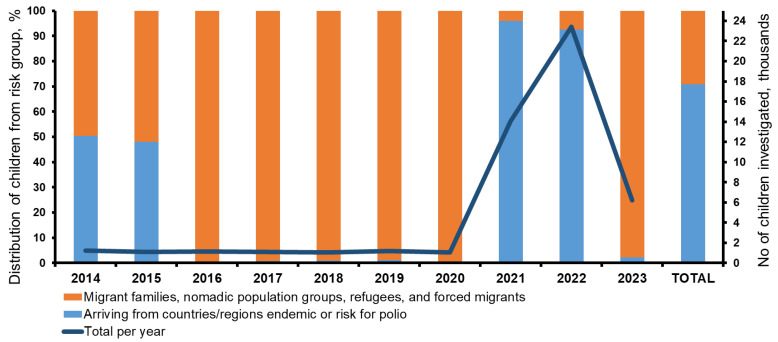 Figure 1
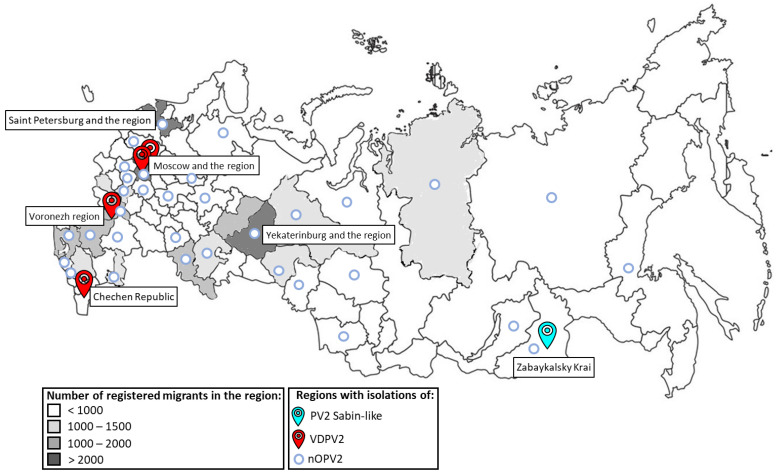 Figure 2
Peer Reviews
No public reviews on file for this paper yet. If you reviewed it on a platform where reviews are public (OpenReview, ICLR, NeurIPS, ICML), you can paste yours below so the community can read it here.
Videos
No videos yet. Explain this paper in a talk, walkthrough, or lecture? Add one.
Taxonomy
TopicsViral Infections and Immunology Research · Viral gastroenteritis research and epidemiology