Preparation of Polystyrene Nanoparticles with Environmental Relevance Using a Gradual Degradation Method
Hisayuki Nakatani, Mika Asano, Masaki Sakamoto, Suguru Motokucho, Anh Thi Ngoc Dao, Hee-Jin Kim, Mitsuharu Yagi, Yusaku Kyozuka

TL;DR
This study tracks how polystyrene particles degrade over time in environmental conditions, revealing dynamic changes in size and structure.
Contribution
The study introduces a gradual degradation method to simulate environmental breakdown of polystyrene, revealing new insights into nanoparticle evolution.
Findings
Polystyrene nanoparticle sizes fluctuated dynamically over time, forming distinct peaks below 200 nm.
Surface peeling was observed initially, followed by core size reduction and eventual fragmentation of flakes.
The initial morphology of polystyrene influenced degradation patterns, indicating multiple breakdown mechanisms.
Abstract
This study investigates the environmental degradation of polystyrene (PS) microparticles and flakes using a gradual degradation method. The concentration of SO4•− decreased exponentially, simulating the environmental conditions. The nanofragment size of PS particles evolved dynamically, fluctuating from below 250 nm at 3 days to 300–500 nm at 6 days, then forming two peaks below 200 nm at 9 days, before shifting to a single peak below 100 nm at 12 days. At 15 days, the distribution expanded to two peaks between 500 nm and 200 nm. The polydispersity index (PDI) varied unpredictably, and fragments below 100 nm fluctuated between 10 and 50 nm independent of time. SEM analysis revealed an initial peeling process, with the outermost layer peeling off. The core size of the PS particles decreased rapidly from 11,000 nm to 2500 nm within 6 days and stabilized at 1000 nm after 9 days. The PS…
Genes, proteins, chemicals, diseases, species, mutations and cell lines named across the full text — each resolved to its canonical identifier and authoritative record.
Click any figure to enlarge with its caption.
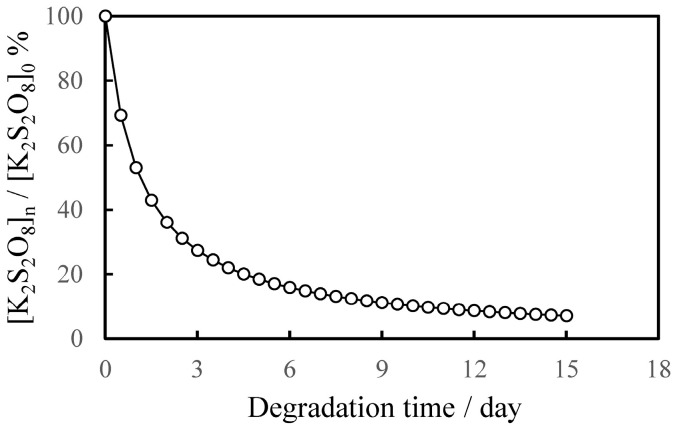 Figure 1
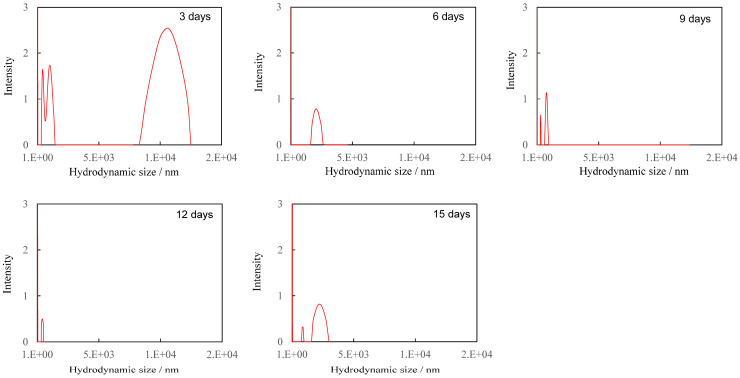 Figure 2
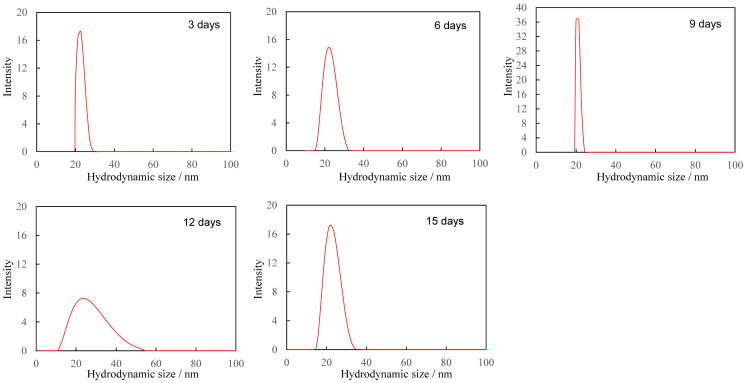 Figure 3
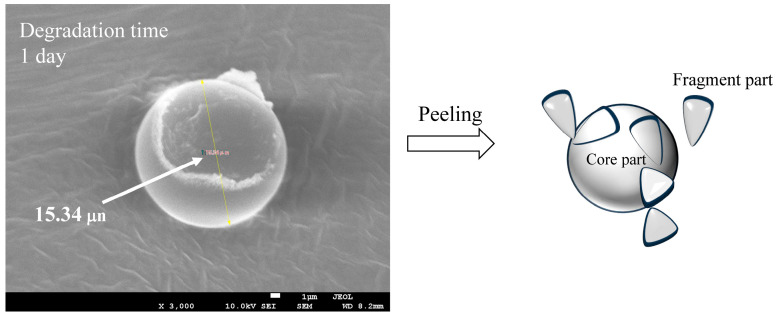 Figure 4
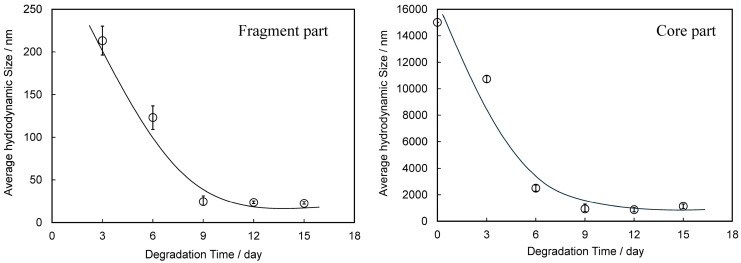 Figure 5
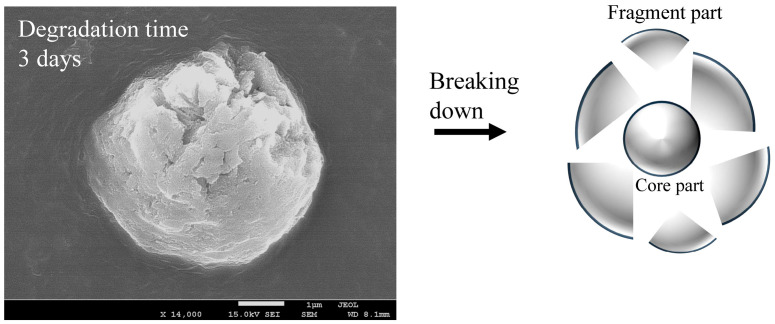 Figure 6
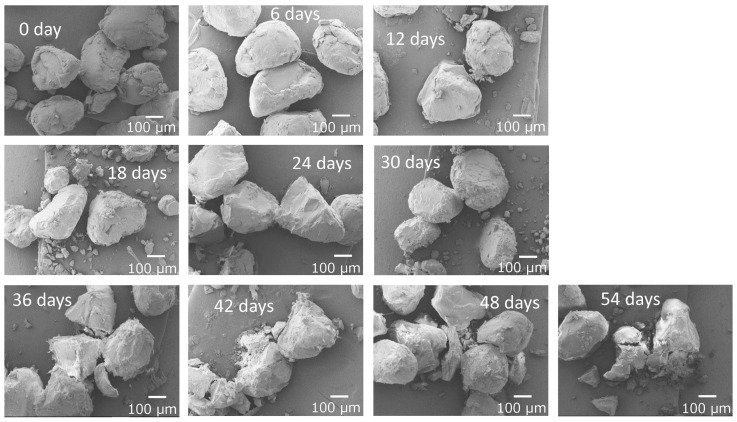 Figure 7
Peer Reviews
No public reviews on file for this paper yet. If you reviewed it on a platform where reviews are public (OpenReview, ICLR, NeurIPS, ICML), you can paste yours below so the community can read it here.
Videos
No videos yet. Explain this paper in a talk, walkthrough, or lecture? Add one.
Taxonomy
TopicsMicroplastics and Plastic Pollution · Recycling and Waste Management Techniques · Graphene and Nanomaterials Applications