Occurrence of Hemotropic Mycoplasmas in Commercial Pig Herds in Southeastern Brazil
Daniele Soares Fialho, Agostinho Sérgio Scofano, Karyne dos Santos Marins da Silva, Katielle Ribeiro da Silva, Lara Celeste Araujo do Carmo Cordeiro, Nathalie Costa da Cunha, Elmiro Rosendo do Nascimento, Thomas Salles Dias

TL;DR
This study found that a significant portion of pigs in Brazil's Espírito Santo region are infected with Mycoplasma suis, a bacteria that affects red blood cells and can lead to health and production issues.
Contribution
The study reports the prevalence of M. suis in commercial pig farms in Brazil and identifies limitations in current diagnostic methods.
Findings
31.49% of pig blood samples tested positive for hemoplasmas, with 13.94% specifically infected with M. suis.
Infection rates were significantly higher in sows compared to other pig categories.
The study suggests the presence of other hemotropic Mycoplasma species due to discrepancies in genus and species prevalence.
Abstract
Mycoplasma suis infects pig red blood cells and is linked to anemia, weakened immunity, and production losses. Infected animals may remain subclinical carriers, contributing to pathogen dissemination. This study aimed to investigate the prevalence of M. suis in commercial pig farms in the state of Espírito Santo, Brazil. A total of 416 blood samples from 55 farms were analyzed using conventional PCR targeting the hemotropic Mycoplasmas (16S rRNA) and a species-specific PCR for M. suis (23S rRNA). Among the samples, 131 (31.49%) tested positive for hemoplasmas and 58 (13.94%) for M. suis with a significantly higher frequency in sows (p < 0.01). The Metropolitan microregion showed the highest prevalence (23.53%). The discrepancy between the prevalence for the genus and the species suggests the possible presence of other hemotropic Mycoplasma species and highlights the limitations of 16S…
Genes, proteins, chemicals, diseases, species, mutations and cell lines named across the full text — each resolved to its canonical identifier and authoritative record.
Click any figure to enlarge with its caption.
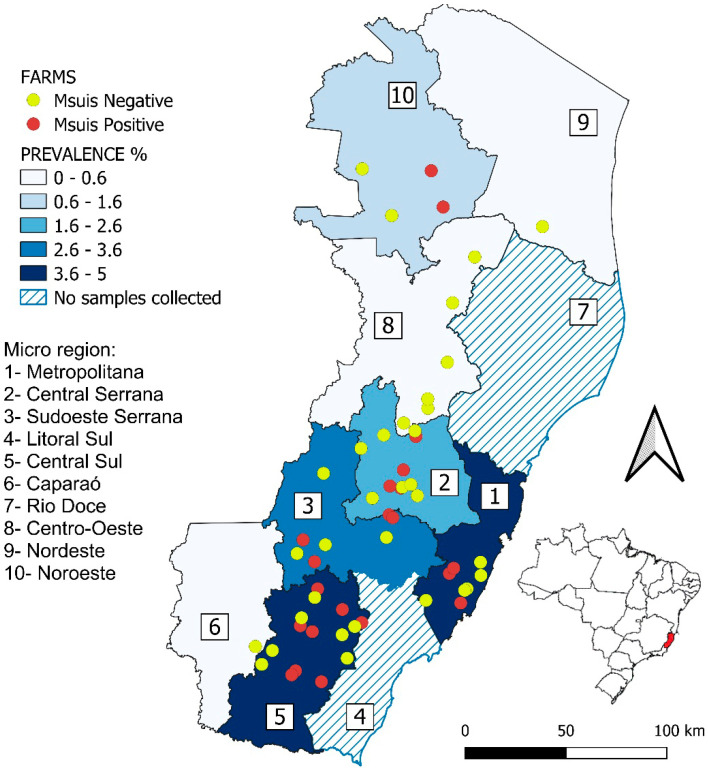 Figure 1
- —Fundação de Amparo à Pesquisa e Inovação do Espírito Santo
- —Secretaria de Estado de Agricultura, Abastecimento, Aquicultura e Pesca do Espírito Santo
Peer Reviews
No public reviews on file for this paper yet. If you reviewed it on a platform where reviews are public (OpenReview, ICLR, NeurIPS, ICML), you can paste yours below so the community can read it here.
Videos
No videos yet. Explain this paper in a talk, walkthrough, or lecture? Add one.
Taxonomy
TopicsMicrobial infections and disease research · Vector-borne infectious diseases · Herpesvirus Infections and Treatments
1. Introduction
Swine production plays a crucial role in the Brazilian economy, with Brazil ranking as the fourth largest producer and exporter of pork worldwide [1]. The sector has undergone significant modernization, adopting advanced technological practices to improve productivity and ensure herd health. Nevertheless, the presence of infectious diseases remains a major challenge to sustainable production. Among the pathogens that negatively impact the sector, hemotropic Mycoplasmas, particularly Mycoplasma suis, represent a significant threat to animal health and production efficiency [2,3,4,5].
Hemoplasmas have been reported affecting both production and companion animals across different regions of the world [6]. Subclinical infections are frequently observed and may result in reduced weight gain, decreased feed efficiency, and increased susceptibility to secondary infections [7,8]. Hemoplasmas can act as opportunistic agents, exacerbating clinical conditions in immunosuppressed animals or those under environmental stress [9]. Mycoplasma suis is a pleomorphic, cell wall-deficient microorganism that parasitizes porcine erythrocytes, potentially causing hemolytic anemia, jaundice, fever, and lethargy. In acute cases, these signs may progress to severe hemolytic anemia, while chronic infections are characterized by moderate anemia, vasculitis due to vascular damage, hemorrhagic diathesis, infertility, and immunosuppression [2,7,10]. Infection with M. suis is associated with chronic anemia, immune system impairment, and negative impacts on swine reproduction and growth [2]. Furthermore, pigs infected with M. suis may remain chronic carriers even after the resolution of clinical signs [5]. These consequences directly compromise zootechnical performance, resulting in significant economic losses for producers.
Molecular diagnosis has been widely employed for the identification of hemoplasmas in swine, with the 16S rRNA gene being commonly targeted in PCR assays due to its conservation across different bacterial species [9,11]. Despite its effectiveness for genus-level screening, the high similarity between species such as M. suis and M. parvum may compromise test specificity [12,13]. To overcome this limitation, the 23S rRNA gene has been utilized as an alternative target, offering greater discriminatory power between closely related species, particularly for the specific detection of M. suis [13,14].
Investigating the prevalence of M. suis in commercial pig farms is essential to understand the agent’s distribution and the associated risk factors. In this context, studying the prevalence and impacts of M. suis infection is of great importance for Brazilian swine production. Continuous herd health monitoring, combined with the use of molecular diagnostic tools, may assist in the development of more effective sanitary policies, reducing economic losses and promoting sustainable production. Understanding the infection dynamics and the factors influencing its spread is crucial to mitigate its effects and to ensure animal productivity and welfare. Thus, the aim of this study was to investigate the prevalence of M. suis in commercial swine farms from the state of Espírito Santo, Brazil.
2. Materials and Methods
2.1. Farm Selection and Sampling Design
A total of 55 commercial swine farms located in the state of Espírito Santo, Brazil, were included in this study. Participation was voluntary, with prior informed consent obtained from all producers. All participants signed a written informed consent form after receiving detailed information regarding the research objectives, data confidentiality, and their right to withdraw from participation at any time. Farm selection was based on a previous survey using records available from the Agricultural Integration System of the Institute of Agricultural and Forestry Defense of Espírito Santo (IDAF-ES), covering approximately 72.4% of the officially registered commercial swine farms in the state. The territorial division of the state into microregions, based on municipal specificities, was adopted to facilitate more efficient planning of future sanitary actions.
To determine the required sample size, an estimated total population of 241,550 pigs was considered [15]. Statistical calculations were performed using Epi Info™ version 7.2.5 software (Centers for Disease Control and Prevention, Atlanta, GA, USA), applying a 50% expected prevalence, a 95% confidence level, and a 5% margin of error. Based on these criteria, the minimum required number of blood samples was estimated at 384. In total, 416 blood samples were collected, ranging from 3 to 10 animals per farm according to herd size, through proportional stratified sampling. Inclusion criteria encompassed sows in culling phase—either mid-gestation or at the end of the farrowing period—and finishing pigs ready for slaughter. Animals with low body weight or undergoing medical treatment were excluded from the sampling to avoid potential biases in the health and microbiological status of the population.
2.2. Sample Collection and Processing
The selection of pigs for blood sampling was performed randomly within the herds. Samples were collected in EDTA-containing tubes and kept frozen until laboratory processing. Genomic DNA extraction was carried out using the Wizard^®^ Genomic DNA Purification Kit (Promega), following the manufacturer’s instructions. The extracted DNA was stored at –20 °C until further use in PCR analyses.
2.3. Polymerase Chain Reaction (PCR)
The detection of the hemotropic Mycoplasma was performed by conventional PCR, using the primers HemMycop16S-322s (5′-GCCCATATTCCTACGGGAAGCAGCAGT-3′) and HemMyco16S-938as (5′-CTCCACCACTTGTTCAGGTCCCCGTC-3′), as described by Varanat et al. [16]. The thermocycling conditions were as follows: initial denaturation at 94 °C for 4 min, followed by 30 cycles of 94 °C for 30 s, 68 °C for 45 s, and 72 °C for 45 s, with a final extension at 72 °C for 5 min and subsequent storage at 4 °C. The expected amplicon size was 600 bp.
Samples tested positive for the hemotropic Mycoplasma were subjected to a second PCR assay for the species-specific identification of M. suis, using the primers MS_23SF1 (5′-GAAGTTTGAGCGAGAGCACAG-3′) and MS_23SR3 (5′-AGGGCTTAAGTTAGAAGCTTCAGC-3′), according to Thongmeesee et al. [13]. The thermocycling conditions were as follows: 94 °C for 4 min, followed by 30 cycles of 94 °C for 30 s, 64 °C for 45 s, and 72 °C for 45 s, with a final extension at 72 °C for 5 min and subsequent storage at 4 °C. The expected product size was 909 bp.
Amplified products were analyzed by electrophoresis on 1.5% agarose gels, stained with ethidium bromide, and visualized under ultraviolet (UV) light. Fragment identification was performed by comparison with a 100 bp molecular weight marker (Ludwig, Brazil).
2.4. Statistical Analyses
The prevalence of hemotropic Mycoplasma and M. suis was calculated based on the total number of positive samples. The association between animal category (sow or finisher pig) and positivity for M. suis was evaluated using Pearson’s Chi-square test (χ^2^), with a significance level of 5% (p < 0.05). Observed and expected frequencies were analyzed to determine the contribution of each group to the association. The geographical distribution of positive cases was described by microregion, with infection rates (%) calculated for each area of the state of Espírito Santo.
3. Results
Of the 416 blood samples analyzed, 131 were positive for hemoplasmas, resulting in a prevalence of 31.49%. Among these samples positive for the genus, 58 tested positive for the species M. suis, corresponding to a prevalence of 13.94% of the total samples and 44.27% of the samples positive for the genus (Table 1). Of the 55 farms evaluated, 21 (38.18%) had at least one positive sample for M. suis, indicating the presence of the agent in a significant proportion of the production units.
The geographic distribution of the 55 rural properties sampled in Espírito Santo and their respective M. suis status are presented in Figure 1. The Metropolitan microregion showed the highest prevalence for M. suis (23.53%). The Southeast Serrana (15.94%) and Central South (14.48%) microregions also presented high prevalences. The Northwest (11.11%) and Central Serrana (10.14%) microregions showed moderate prevalence rates. In contrast, the Caparaó, Central-West, and Northeast microregions did not record any positive cases (Table 2).
The association between animal category (sow or piglet) and Mycoplasma suis positivity was statistically significant (χ^2^ = 10.55; p = 0.00116; df = 1), indicating that infection rates differed between the groups (Table 3). The prevalence of M. suis was significantly higher in sows (16.87%; 56/332) compared to piglets (2.38%; 2/84).
4. Discussion
The prevalence of hemoplasmas observed in this study was relatively high, at the animal level, indicating widespread circulation of these agents in the herds analyzed. Cruz et al. [17] reported a similar prevalence (31.9%) in highly technical farms in the Southeastern region of Brazil, which supports the significant presence of these microorganisms even in intensive production systems. Additionally, Gatto et al. [12] described even higher rates, with hemoplasmas detected in over 79% of samples from commercial properties in the Southern region of the country, reinforcing the consistency of these findings across different production contexts.
Although this study did not assess clinical or production outcomes, nor investigate other potential pathogens, the prevalence of M. suis detected was notably lower than expected and contrasted with findings from previous studies. For instance, in China, Zhongyang et al. [18] observed an average seroprevalence of 33.3% for M. suis with higher incidence in adult pigs, such as sows and breeders. Ngo et al. [19] reported even higher prevalence (86.6%) in farms with a history of reproductive failures in Vietnam. Similarly, Brissonnier et al. [20] detected M. suis DNA in 53% of the samples analyzed in South Korea, with none of the farms evaluated being free of infection. These data confirm that M. suis is frequently identified as the primary agent involved in hemotropic infections in swine across different production contexts and geographical regions.
The low prevalence of M. suis observed in this study, despite the considerable detection of the Mycoplasma genus through screening PCR, raises the possibility of the presence of other hemotropic Mycoplasma species. Among them, Mycoplasma parvum stands out, a less studied species but already identified in swine herds and associated with subclinical infections, with a tropism for the erythrocyte plasma membrane [17]. Recent studies, such as Ade et al. [21], demonstrated the circulation of M. parvum in clinically healthy pigs in Germany, with a prevalence of up to 36% in finishing pigs and 25% in sows.
This difficulty in differentiating M. suis from other hemotrophic Mycoplasma species may be partly attributed to the limitations of molecular methods based exclusively on the 16S rRNA gene, which was used in the initial screening. Although commonly employed due to its high sensitivity and ability to detect Mycoplasma at the genus level, the 16S rRNA gene shows high sequence similarity among closely related species, such as M. suis and M. parvum, reducing diagnostic specificity [13]. To address this limitation, more specific molecular targets such as the 23S rRNA gene have been recommended, as they allow for better discrimination between genetically similar species [13,22]. In this study, the use of the 23S rRNA gene increased diagnostic specificity for M. suis, but it may have reduced sensitivity compared to broader genus-level detection methods. Such methodological differences, along with environmental and sanitary factors, likely contribute to the variability in M. suis prevalence reported across studies.
The observed frequencies were higher than expected in sows and lower in piglets. This pattern suggests greater susceptibility or exposure of sows to the infection, which aligns with studies reporting a higher prevalence of M. suis in adult pigs [18,23,24]. This higher prevalence in sows may be associated with multiple factors. Adult animals remain in the production system for longer, increasing their cumulative exposure to the pathogen and vectors. Additionally, physiological stress, particularly during the peripartum period, is a known factor that favors the reactivation of chronic infections, as demonstrated by Hoelzle et al. [2] and supported by more recent studies [9,25]. Evidence suggests that M. suis may persist in the body even after treatment and be reactivated during periods of immunosuppression, as observed by Stadler et al. [8]. This behavior reinforces the role of sows as important reservoirs, with the potential to spread the agent within the herd, especially during critical phases of production.
The low prevalence of M. suis in piglets may be associated with lower environmental exposure, the presence of maternal antibodies acquired via colostrum, or a short window of infection detection during sampling, as observed by Stadler et al. [24]. Studies suggest that infections in piglets may remain subclinical or latent, only becoming clinically apparent after immunological challenges or stress, such as weaning and changes in the environment [2,20,24].
Some limitations that should be considered when interpreting the results. Firstly, no clinical or productive data were collected from the animals, which limits the ability to establish correlations between M. suis infection and clinical outcomes or production losses. Secondly, the molecular investigation was restricted to M. suis after the initial genus-level screening; therefore, other hemoplasma species, such as M. parvum, may have been present in the population but remained undetected due to the specificity of the second PCR step. Additionally, although the 23S rRNA gene was used to increase diagnostic specificity, it may have reduced overall sensitivity compared to broader detection strategies. Finally, the cross-sectional nature of the sampling provides only a snapshot of the infection dynamics, without capturing seasonal or temporal variations. These limitations highlight the need for future studies with longitudinal designs, the inclusion of clinical data, and broader molecular panels to better understand the epidemiological and pathogenic role of hemotropic Mycoplasma species in swine herds.
Considering these findings and limitations, there is a reinforcement of the need for sanitary surveillance, particularly targeting sows, which present a higher risk of infection and perpetuation of the agent in the herd. Control strategies based on serological and molecular monitoring, associated with improved management practices and stress reduction, are essential for the effective prevention and control of M. suis in swine production.
5. Conclusions
The low prevalence of M. suis observed in this study, in contrast to the high detection of the Mycoplasma genus, may reflect methodological limitations, especially related to the use of less specific molecular targets, such as the 16S rRNA gene. The use of the 23S rRNA gene proved effective for species identification, although with possibly reduced sensitivity. The results reinforce the importance of sows as the primary carriers of the infection and highlight the need for continuous sanitary surveillance strategies, combined with the use of more precise diagnostic tools, to ensure the effective control of the infection and sustainability in swine production.
The reference list from the paper itself. Each links out to its DOI / PubMed record.
- 1Associação Brasileira de Proteína Animal–ABPA Relatório Annual ABPA Sao Paolo, Brazil 2024 Available online: https://abpa-br.org/wp-content/uploads/2024/04/ABPA-Relatorio-Anual-2024_capa_frango.pdf(accessed on 14 April 2025)
- 2Hoelzle L.E. Haemotrophic Mycoplasmas: Recent Advances in Mycoplasma suis Vet. Microbiol.200813021522610.1016/j.vetmic.2007.12.02318358641 · doi ↗ · pubmed ↗
- 3Yuan C.L. Liang A.B. Yao C.B. Yang Z.B. Zhu J.G. Cui L. Yu F. Zhu N.Y. Yang X.W. Hua X.G. Prevalence of Mycoplasma suis (Eperythrozoon suis) Infection in Swine and Swine-Farm Workers in Shanghai, China Am. J. Vet. Res.20097089089410.2460/ajvr.70.7.89019566474 · doi ↗ · pubmed ↗
- 4Groebel K. Hoelzle K. Wittenbrink M.M. Ziegler U. Hoelzle L.E. Mycoplasma suis Invades Porcine Erythrocytes Infect. Immun.20097757658410.1128/IAI.00773-0819015255 PMC 2632055 · doi ↗ · pubmed ↗
- 5Ritzmann M. Grimm J. Heinritzi K. Hoelzle K. Hoelzle L.E. Prevalence of Mycoplasma suis in Slaughter Pigs, with Correlation of PCR Results to Hematological Findings Vet. Microbiol.2009133849110.1016/j.vetmic.2008.06.01518687536 · doi ↗ · pubmed ↗
- 6Wang X. Cui Y. Zhang Y. Shi K. Yan Y. Jian F. Zhang L. Wang R. Ning C. Molecular Characterization of Hemotropic Mycoplasmas (Mycoplasma ovis and ‘Candidatus Mycoplasma haemovis’) in Sheep and Goats in China BMC Vet. Res.20171314210.1186/s 12917-017-1062-z 28549435 PMC 5446696 · doi ↗ · pubmed ↗
- 7Messick J.B. Hemotrophic Mycoplasmas (Hemoplasmas): A Review and New Insights into Pathogenic Potential Vet. Clin. Pathol.20043321310.1111/j.1939-165X.2004.tb 00342.x 15048620 · doi ↗ · pubmed ↗
- 8Stadler J. Ade J. Hermanns W. Ritzmann M. Wentzel S. Hoelzle K. Hoelzle L.E. Clinical, Haematological and Pathomorphological Findings in Mycoplasma suis-Infected Pigs BMC Vet. Res.20211721410.1186/s 12917-021-02919-534112157 PMC 8193878 · doi ↗ · pubmed ↗