Accessing the Impacts of the Calculated Panel Reactive Antibody Value on a Lung Transplant Waitlist: A Latin American Experience
Samuel Lucas dos Santos, Flavio Pola dos Reis, Luis Gustavo Abdalla, Lucas Matos Fernandes, Elissa Ayumi Okuno, Priscila Cilene Leon Bueno Camargo, Rafael Medeiros Carraro, Silvia Vidal Campos, Ricardo Henrique Oliveira Braga Teixeira, Paulo Manuel Pêgo-Fernandes

TL;DR
This study from Brazil shows that higher calculated panel-reactive antibody (cPRA) levels in lung transplant candidates are linked to longer wait times and higher mortality, suggesting the need for policy changes to improve access for sensitized patients.
Contribution
The study provides new insights into the impact of cPRA on lung transplant waitlist outcomes in a Latin American population.
Findings
Higher cPRA values correlate with longer median waitlist times for lung transplant candidates.
Candidates with cPRA > 50% had significantly higher waitlist mortality.
The group with cPRA > 75% had the lowest transplant rate at 37.5%.
Abstract
Backgorund\Objectives: Lung transplantation is the definitive treatment for select patients with end-stage pulmonary diseases. However, immunologic sensitization, as measured by calculated panel-reactive antibody (cPRA), poses significant challenges to transplant access and outcomes. This study aimed to evaluate the impact of cPRA on lung transplantation waitlist dynamics in a single-center cohort in Brazil, focusing on its association with waitlist mortality, delisting, and transplantation. Methods: A retrospective cohort study was conducted including all lung transplant candidates listed in our institution between January 2012 and December 2022. Candidates were stratified by cPRA values at listing into five groups: 0%, 0.1–25%, 25.1–50%, 50.1–75%, and 75.1–100%. Primary outcomes included lung transplantation, with secondary outcomes of waitlist mortality and delisting due to clinical…
Genes, proteins, chemicals, diseases, species, mutations and cell lines named across the full text — each resolved to its canonical identifier and authoritative record.
Click any figure to enlarge with its caption.
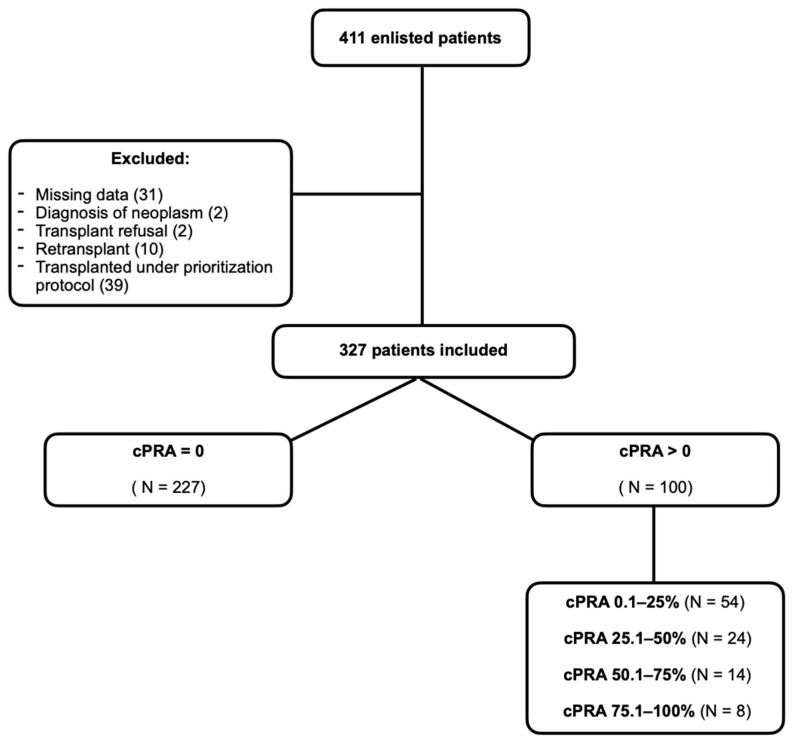 Figure 1
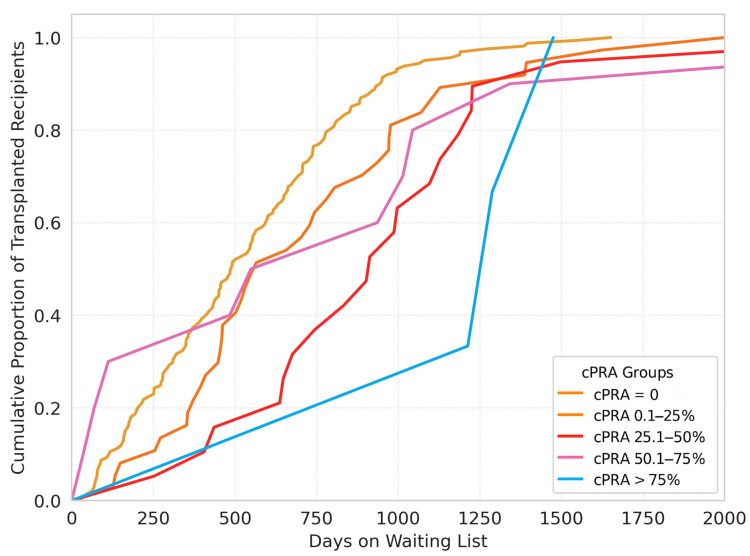 Figure 2
Peer Reviews
No public reviews on file for this paper yet. If you reviewed it on a platform where reviews are public (OpenReview, ICLR, NeurIPS, ICML), you can paste yours below so the community can read it here.
Videos
No videos yet. Explain this paper in a talk, walkthrough, or lecture? Add one.
Taxonomy
TopicsTransplantation: Methods and Outcomes · Renal Transplantation Outcomes and Treatments · Organ Transplantation Techniques and Outcomes