Application of Electroencephalography (EEG) in Combat Sports—Review of Findings, Perspectives, and Limitations
James Chmiel, Jarosław Nadobnik

TL;DR
EEG can track brain changes in combat sports athletes, showing both risks from head impacts and benefits from training, but more standardized research is needed.
Contribution
This review consolidates EEG findings in combat sports, highlighting both brain impairments and adaptations while identifying barriers to clinical translation.
Findings
Chronic combat sports participation is linked to reduced alpha/theta power and disrupted brain network topology.
Elite athletes show neural efficiency with elevated resting alpha power and streamlined cortico-muscular coupling.
Acute head impacts increase delta and beta power, while judo chokes cause temporary slow-wave bursts without lasting damage.
Abstract
Introduction: Combat sport athletes are exposed to repetitive head impacts yet also develop distinct performance-related brain adaptations. Electroencephalography (EEG) provides millisecond-level insight into both processes; however, findings are dispersed across decades of heterogeneous studies. This mechanistic review consolidates and interprets EEG evidence to elucidate how participation in combat sports shapes brain function and to identify research gaps that impede clinical translation. Methods: A structured search was conducted in March 2025 across PubMed/MEDLINE, Scopus, Cochrane Library, ResearchGate, Google Scholar, and related databases for English-language clinical studies published between January 1980 and March 2025. Eligible studies recorded raw resting or task-related EEG in athletes engaged in boxing, wrestling, judo, karate, taekwondo, kickboxing, or mixed martial arts.…
Genes, proteins, chemicals, diseases, species, mutations and cell lines named across the full text — each resolved to its canonical identifier and authoritative record.
Click any figure to enlarge with its caption.
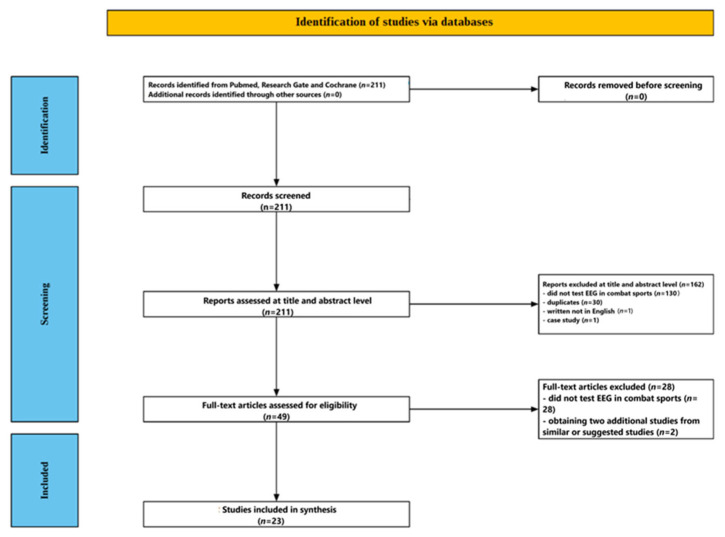 Figure 1
Peer Reviews
No public reviews on file for this paper yet. If you reviewed it on a platform where reviews are public (OpenReview, ICLR, NeurIPS, ICML), you can paste yours below so the community can read it here.
Videos
No videos yet. Explain this paper in a talk, walkthrough, or lecture? Add one.
Taxonomy
TopicsEEG and Brain-Computer Interfaces · Heart Rate Variability and Autonomic Control · Psychosomatic Disorders and Their Treatments