Mental health disorders among children with special health needs: A population-based cohort study using linked administrative data from Manitoba, Canada
Jennifer E. Enns, Caroline Reid-Westoby, Gilles R. Detillieux, Marni Brownell, Nathan C. Nickel, Anne Gadermann, Astrid Guttmann, Teresa Bennett, Eric Duku, Barry Forer, Monique Gagné Petteni, Katholiki Georgiades, Martin Guhn, Ana Hanlon-Dearman, Brenda T. Poon, Magdalena Janus

TL;DR
Children with special health needs in kindergarten are more likely to be diagnosed with mental health disorders by age 16, according to a study using Manitoba data.
Contribution
This study identifies kindergarten SHN categories as early predictors of mental health disorders in children.
Findings
Children with SHN had a 41.0% chance of a mental health disorder by age 16.
Behavioral impairment in kindergarten was the strongest predictor (OR 3.27).
Adjusting for sociodemographic factors did not change the results.
Abstract
An estimated 15–22% of Canadian kindergarten-age children have a special health need (SHN), defined as a clinical diagnosis, a functional need requiring special accommodation at school, or a health condition leading to increased needs. Children with SHN may be more likely to experience mental health disorders than their peers without SHN, placing them at risk for further health and academic challenges. Our objective was to determine the odds of children with SHN identified in kindergarten being diagnosed with a mental health disorder by age 16. In this retrospective cohort study using population-based, linked administrative data, we identified children with SHN born 1995–2020 in Manitoba, Canada, and enrolled in kindergarten from 2006–2011. The SHN designation is derived from the Early Development Instrument. We measured prevalence of common childhood mental health disorders (ADHD,…
Genes, proteins, chemicals, diseases, species, mutations and cell lines named across the full text — each resolved to its canonical identifier and authoritative record.
Click any figure to enlarge with its caption.
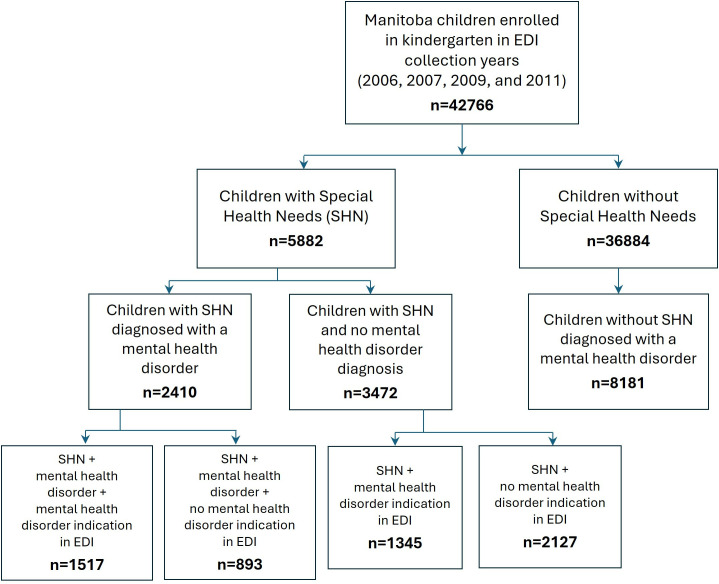 Figure 1
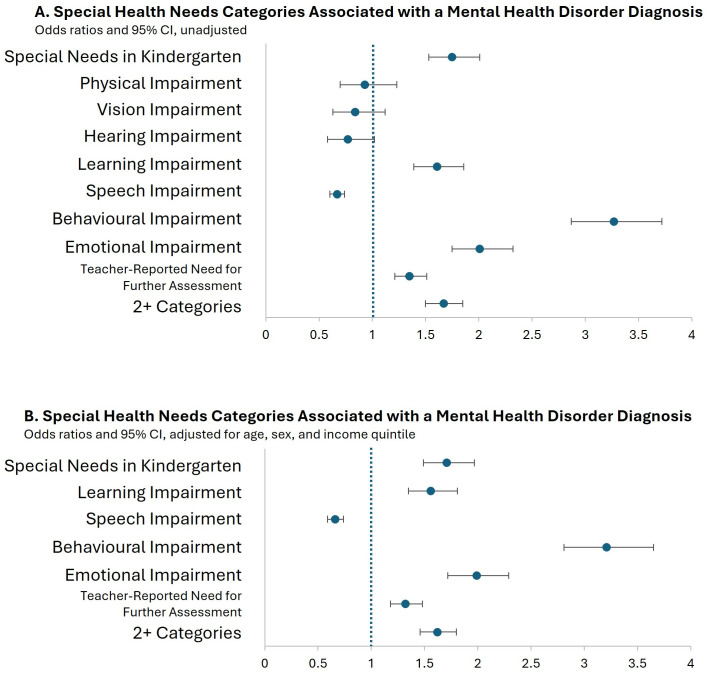 Figure 2
 Figure 3
 Figure 4
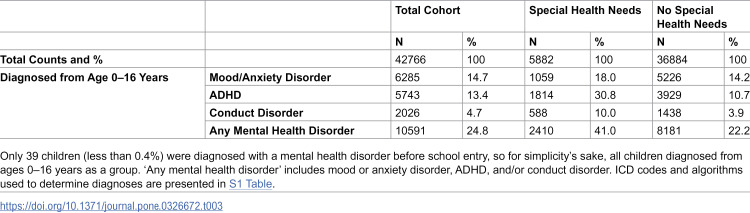 Figure 5
Peer Reviews
No public reviews on file for this paper yet. If you reviewed it on a platform where reviews are public (OpenReview, ICLR, NeurIPS, ICML), you can paste yours below so the community can read it here.
Videos
No videos yet. Explain this paper in a talk, walkthrough, or lecture? Add one.
Taxonomy
TopicsChild and Adolescent Psychosocial and Emotional Development · Infant Development and Preterm Care · Child and Adolescent Health