Preprocedural 3D Transesophageal Echocardiography for the Prediction of Device Deformation Morphology and Peri-Device Leaks After Transcatheter Left Atrial Appendage Occlusion with the AmplatzerTM Device
Annemarie Kirschfink, Andreas Puetz, Michael Frick, Rami Al-Khusein, Pieterjan van Rijckeghem, Anas Alnaimi, Kinan Kneizeh, Felix Vogt, Nikolaus Marx, Ertunc Altiok, Jörg Schroeder

TL;DR
This study shows that 3D transesophageal echocardiography can help predict device deformation and leaks after heart procedures.
Contribution
The study introduces 3D TEE eccentricity as a novel predictor for device sizing in LAA occlusion.
Findings
3D TEE eccentricity ≤1.29 was a specific predictor for excluding 'strawberry' type device deformation.
Peri-device leaks were most common in 'square' and 'strawberry' device deformation types.
The 'tire' type device deformation had the lowest incidence of leaks after six months.
Abstract
Background/Objectives: Percutaneous left atrial appendage occlusion (LAAO) has become an alternative to oral anticoagulation in selected patients with atrial fibrillation. The results of transcatheter LAAO were evaluated by conventional cardiac angiography (CCA), fluoroscopy, and 2D and 3D transesophageal echocardiography (TEE). Methods: In 47 consecutive patients (76 ± 8 years), LAAO was performed with the AmplatzerTM device. CCA and 2D and 3D TEE were performed for LAA measurements. The eccentricity of the device landing zone was assessed by 3D TEE as the ratio of the maximal and minimal diameters. The device size was selected depending on the CCA maximal diameter. The postprocedural device lobe morphology was classified by fluoroscopy as “square” type (sign of undersizing), “tire” type (optimal deformation), and “strawberry” type (sign of oversizing). After 6 months, TEE was repeated…
Genes, proteins, chemicals, diseases, species, mutations and cell lines named across the full text — each resolved to its canonical identifier and authoritative record.
Click any figure to enlarge with its caption.
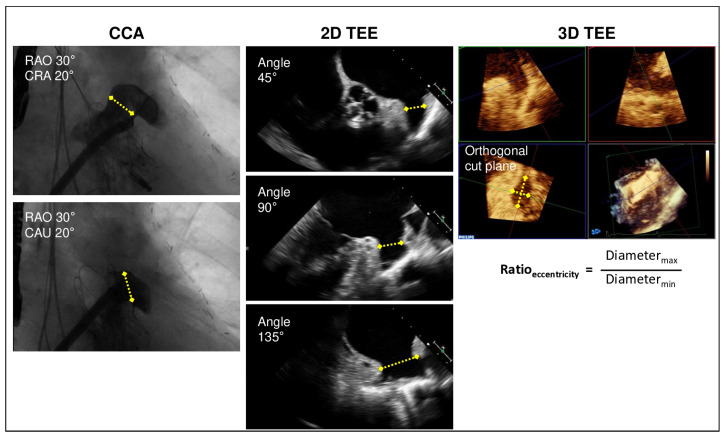 Figure 1
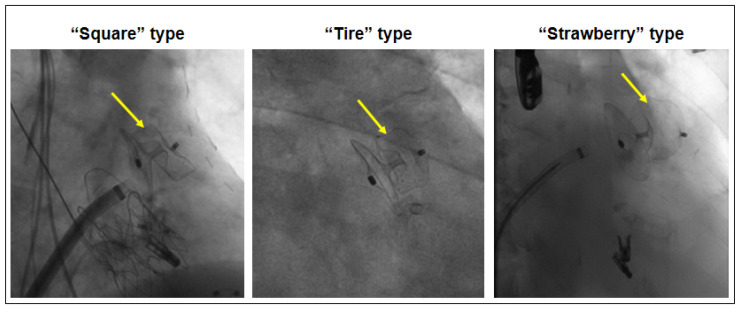 Figure 2
Peer Reviews
No public reviews on file for this paper yet. If you reviewed it on a platform where reviews are public (OpenReview, ICLR, NeurIPS, ICML), you can paste yours below so the community can read it here.
Videos
No videos yet. Explain this paper in a talk, walkthrough, or lecture? Add one.
Taxonomy
TopicsAtrial Fibrillation Management and Outcomes · Cardiac Valve Diseases and Treatments · Cardiac Arrhythmias and Treatments