The Rapid Sense of Direction (R-SOD) Scale: A Brief Self-Report Tool to Identify Developmental Topographical Disorientation (DTD)
Tejdeep Jaswal, Ford Burles, Giuseppe Iaria

TL;DR
This paper introduces a four-item self-report tool to quickly identify developmental topographical disorientation in the general population.
Contribution
A brief, reliable, and validated four-item scale for identifying developmental topographical disorientation.
Findings
The four-item R-SOD scale retains the original SBSOD scale's internal consistency and sensitivity to sex differences.
The R-SOD scale effectively identifies individuals with developmental topographical disorientation.
The R-SOD scale correlates with computerized spatial ability tasks similarly to the original SBSOD scale.
Abstract
Background/Objectives: Developmental Topographical Disorientation (DTD) refers to a condition in which individuals report getting lost in very familiar surroundings, since childhood, with no other cognitive complaints, and no brain injuries or neurological disorders. While the cognitive and neurological mechanisms underlying DTD are being investigated, to date, there is no tool available to the public and health practitioners for identifying this lifelong condition. Methods: Here, we used a decade of data (N = 3794) collected in healthy and DTD individuals to produce a short and reliable measure of self-reported sense of direction that could point to the presence of DTD. Results: We adopted a measure of internal consistency (Cronbach’s alpha) and identified four items of the well-known Santa Barbara Sense of Direction (SBSOD) Scale that retain its original strong internal consistency.…
Genes, proteins, chemicals, diseases, species, mutations and cell lines named across the full text — each resolved to its canonical identifier and authoritative record.
Click any figure to enlarge with its caption.
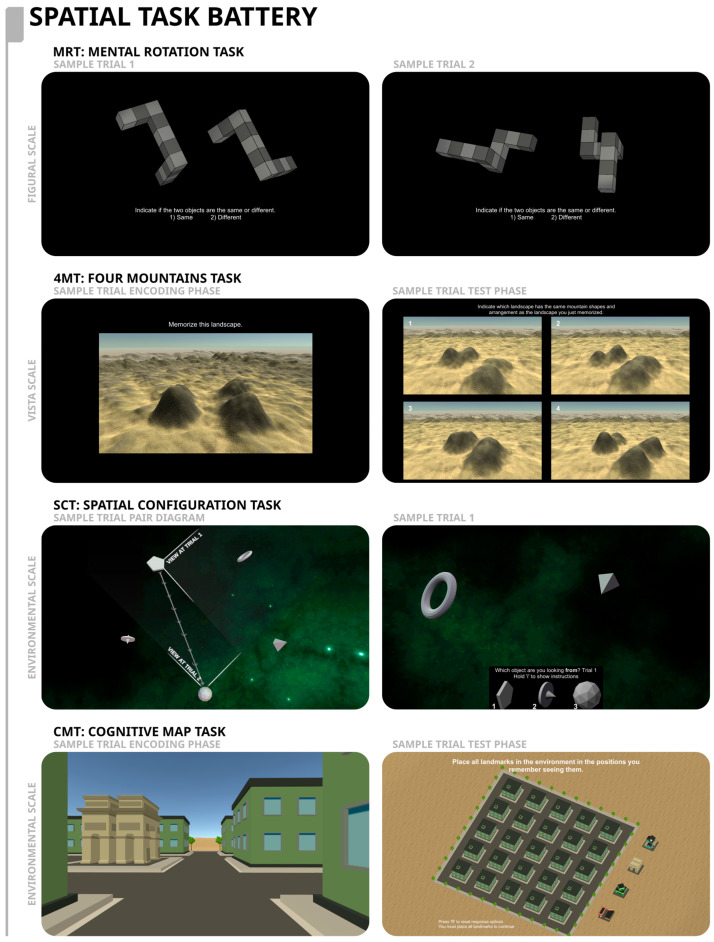 Figure 1
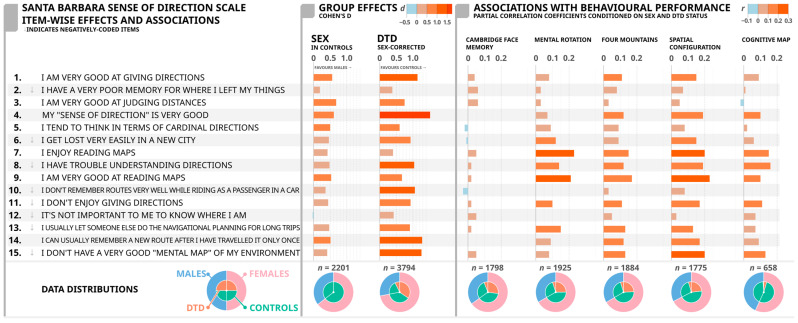 Figure 2
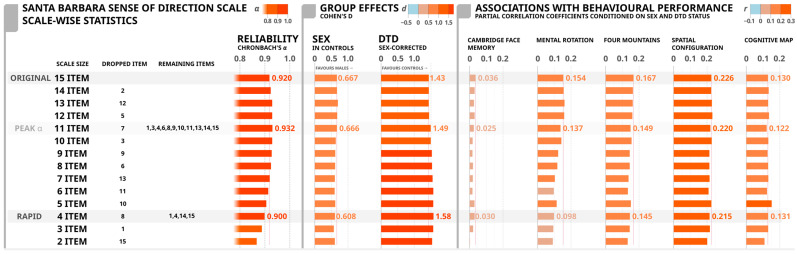 Figure 3
 Figure 4
Peer Reviews
No public reviews on file for this paper yet. If you reviewed it on a platform where reviews are public (OpenReview, ICLR, NeurIPS, ICML), you can paste yours below so the community can read it here.
Videos
No videos yet. Explain this paper in a talk, walkthrough, or lecture? Add one.
Taxonomy
TopicsSpatial Cognition and Navigation · Child and Animal Learning Development · Science Education and Pedagogy