Nucleus Basalis of Meynert Volume and Cognitive Impairment in Parkinson’s Disease Before and After Deep Brain Stimulation of the Subthalamic Nucleus
Vibuthi Sisodia, Yarit Wiggerts, Anouk A. Boogaard, Arthur W. G. Buijink, Rozemarije A. Holewijn, Bart E. K. S. Swinnen, Gert J. Geurtsen, Rick Schuurman, Rob M. A. de Bie

TL;DR
This study finds that a smaller nucleus basalis of Meynert is linked to Parkinson’s disease dementia but not to cognitive decline after brain stimulation.
Contribution
The study identifies a specific association between NBM volume and Parkinson’s disease dementia, not previously confirmed in this context.
Findings
Smaller NBM volume was significantly associated with Parkinson’s disease dementia at baseline.
No link was found between NBM volume and cognitive decline after subthalamic nucleus DBS.
NBM volume did not correlate with baseline cognitive scores or changes in neuropsychological performance.
Abstract
Objectives: To investigate whether a smaller volume of the nucleus basalis of Meynert (NBM) is associated with (1) preoperative cognitive impairment and (2) cognitive decline six months after deep brain stimulation (DBS) of the subthalamic nucleus (STN) in patients with Parkinson’s disease (PD), using detailed neuropsychological assessment (NPA). Methods: PD patients from the GALAXY and DBS-MODE study were included if they had a preoperative MRI and NPA. NBM volume was measured using voxel-based morphometry. Regression analyses were conducted to assess associations between NBM volume and (1) global NPA scores at baseline, (2) baseline cognitive categories (i.e., normal cognition, mild cognitive impairment (MCI) and Parkinson’s disease dementia (PDD)), (3) change in NPA score and (4) cognitive decline based on the reliability change index six months after STN DBS. Results: For 129…
Genes, proteins, chemicals, diseases, species, mutations and cell lines named across the full text — each resolved to its canonical identifier and authoritative record.
Click any figure to enlarge with its caption.
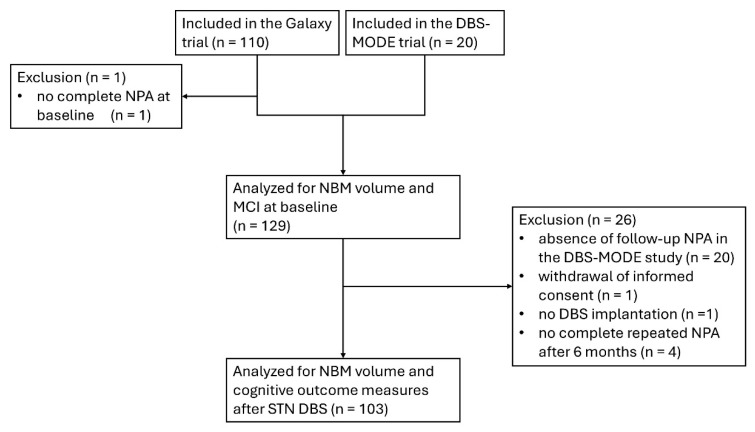 Figure 1
Peer Reviews
No public reviews on file for this paper yet. If you reviewed it on a platform where reviews are public (OpenReview, ICLR, NeurIPS, ICML), you can paste yours below so the community can read it here.
Videos
No videos yet. Explain this paper in a talk, walkthrough, or lecture? Add one.
Taxonomy
TopicsNeurological disorders and treatments · Parkinson's Disease Mechanisms and Treatments · Neuroscience and Neuropharmacology Research