Nonlinear Imaging Detection of Organ Fibrosis in Minute Samples for Early Stage Utilizing Dual-Channel Two-Photon and Second-Harmonic Excitation
Bo-Song Yu, Qing-Di Cheng, Yi-Zhou Liu, Rui Zhang, Da-Wei Li, Ai-Min Wang, Li-Shuang Feng, Xiao Jia

TL;DR
A new dual-channel imaging system detects fibrosis in tiny samples without staining, offering rapid and accurate diagnosis for early-stage lung and kidney disease.
Contribution
A dual-channel nonlinear optical imaging system enables label-free, high-resolution detection of fibrosis at the ECM microstructure scale.
Findings
Collagen can be rapidly detected via spontaneous fluorescence at 780 nm.
Collagen fibril distribution is precisely mapped using Second Harmonic Generation at 820 nm.
The system detects trace fibrosis in a 5-day mouse model and visualizes elastic fibers for staging diagnosis.
Abstract
Histopathological staining remains the fibrosis diagnostic gold standard yet suffers from staining artifacts and variability. Nonlinear optical techniques (e.g., spontaneous fluorescence, Second Harmonic Generation) enhance accuracy but struggle with rapid trace-level detection of fibrosis. To address these limitations, a dual-channel nonlinear optical imaging system with excitation wavelengths at 780 nm and 820 nm was developed, enabling simultaneous spontaneous fluorescence and second-harmonic generation imaging through grid localization. This study applies dual-modality nonlinear imaging to achieve label-free, high-resolution visualization of pulmonary and renal fibrosis at the ECM microstructure scale. Through leveraging this system, it is demonstrated that collagen can be rapidly detected via spontaneous fluorescence at 780 nm, whereas the spatial distribution of collagen fibrils…
Genes, proteins, chemicals, diseases, species, mutations and cell lines named across the full text — each resolved to its canonical identifier and authoritative record.
Click any figure to enlarge with its caption.
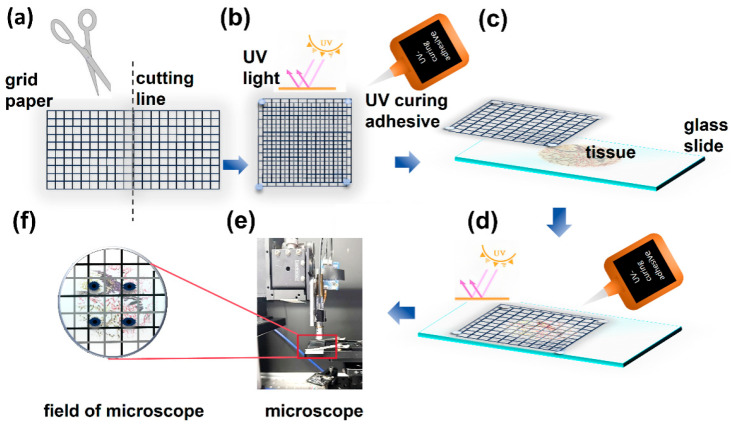 Figure 1
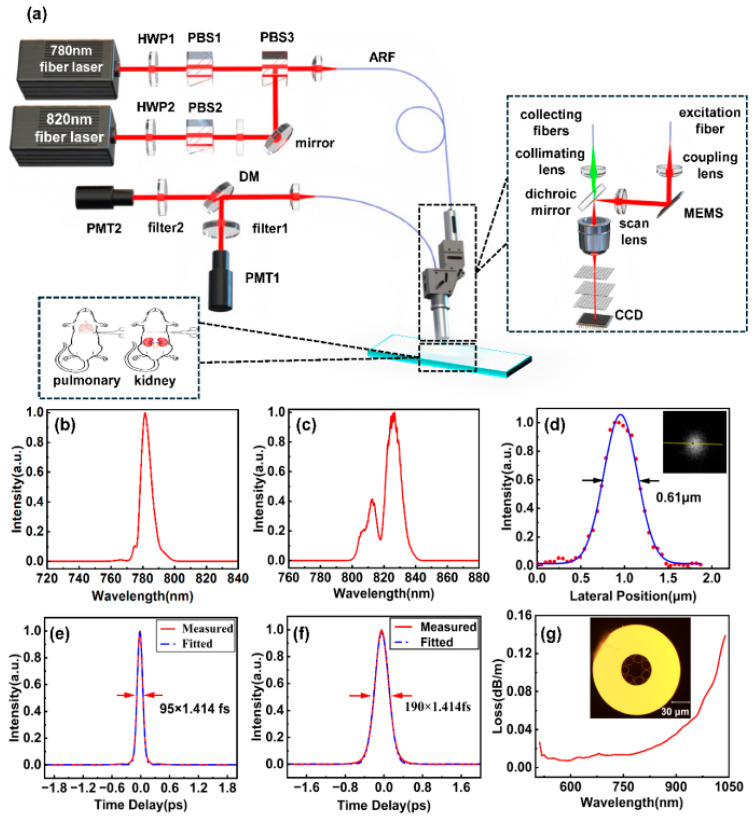 Figure 2
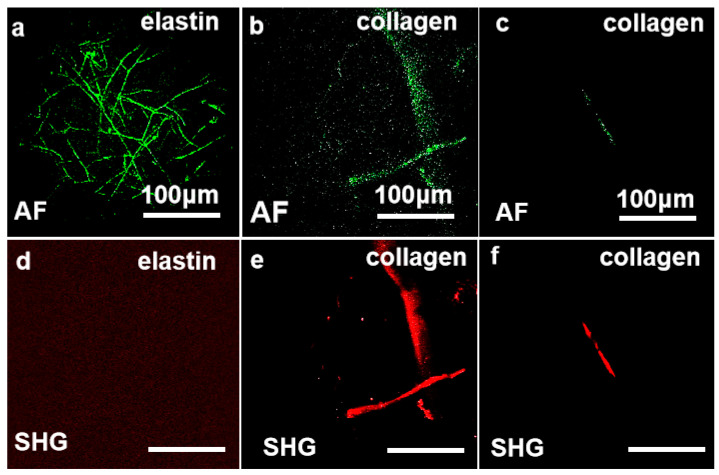 Figure 3
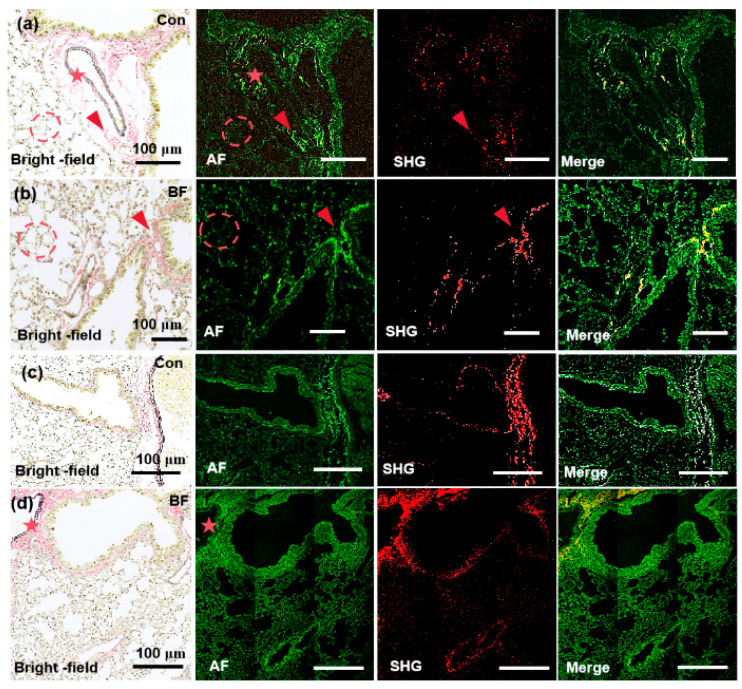 Figure 4
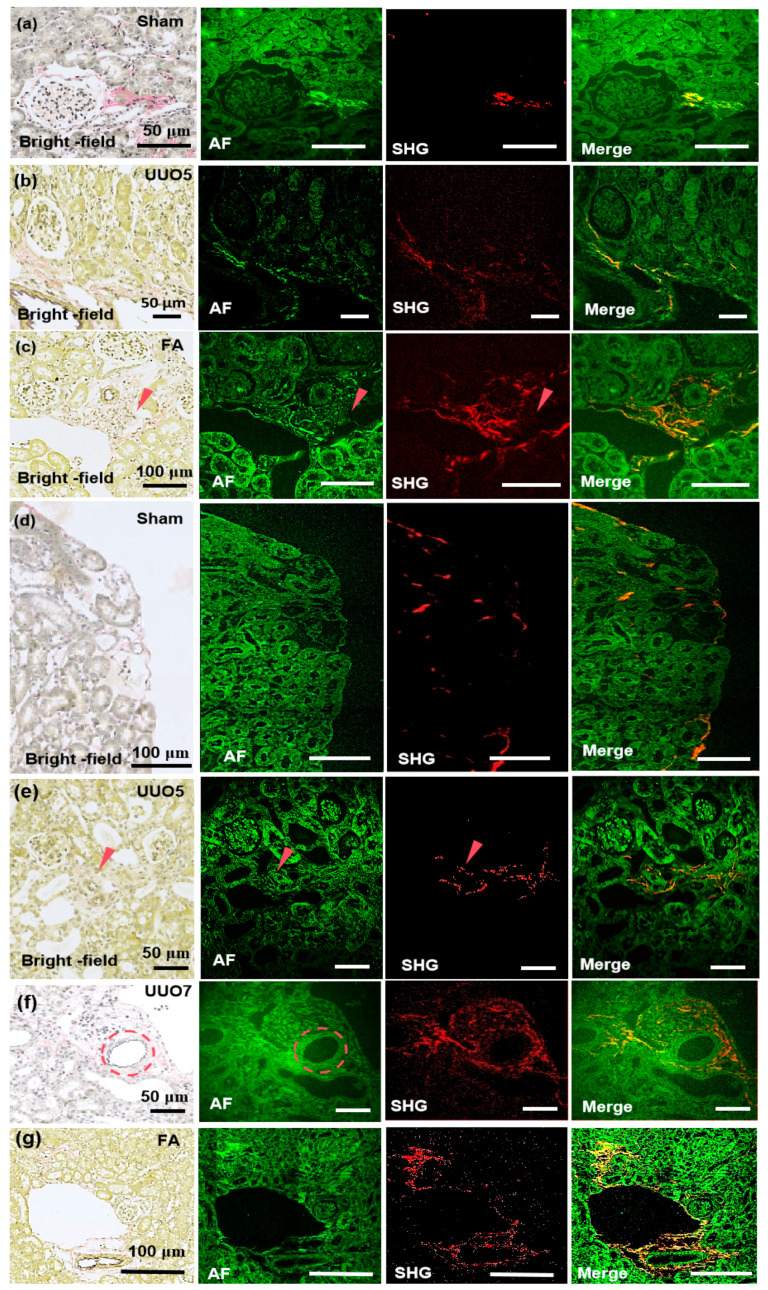 Figure 5
Peer Reviews
No public reviews on file for this paper yet. If you reviewed it on a platform where reviews are public (OpenReview, ICLR, NeurIPS, ICML), you can paste yours below so the community can read it here.
Videos
No videos yet. Explain this paper in a talk, walkthrough, or lecture? Add one.
Taxonomy
TopicsSpectroscopy Techniques in Biomedical and Chemical Research · Photoacoustic and Ultrasonic Imaging · Optical Imaging and Spectroscopy Techniques