The Consequence of the Presence of Ribonucleotide for ds-DNA’s Electronic Properties: Preliminary Theoretical Studies
Boleslaw T. Karwowski

TL;DR
This study explores how ribonucleotides in DNA affect its electronic properties, suggesting they may influence DNA repair and replication processes.
Contribution
This is the first report on the electronic properties of short ds-DNA fragments with ribonucleoside inserts.
Findings
Ribonucleosides in DNA favor 3′,5′-phosphodiester bond cleavage after electron transfer.
Single-strand breaks exhibit low ionisation potential and high electron affinity, making them endpoints for electrons and holes.
Proton-coupled electron transfer occurs after bond migration, suggesting roles in DNA repair and replication.
Abstract
The genome is continuously exposed to different harmful factors whose activity causes different types of lesions. On the other hand, during the DNA replication process, a ribonucleoside (rN) can be inserted more frequently than the occurrence of DNA damage in the genome. Notably, it can be expected that their presence and chemical lability change the electronic properties of the double helix. In this study, a short ds-oligo with a single rN was taken into consideration. The ground-state molecular geometry was obtained at the M06-2x/D95* level of theory in the aqueous phase, while the energy and vertical and adiabatic electron affinity and ionisation potential were obtained at M06-2x/6-31++G**. The obtained results indicate that the 3′,5′-phosphodiester bond cleavage is favourable after the adiabatic cation and anion states are achieved by ds-DNA. Moreover, the lowest ionisation…
Genes, proteins, chemicals, diseases, species, mutations and cell lines named across the full text — each resolved to its canonical identifier and authoritative record.
Click any figure to enlarge with its caption.
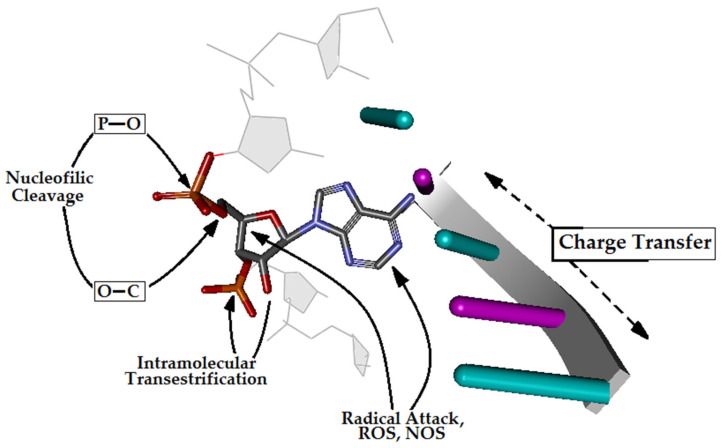 Figure 1
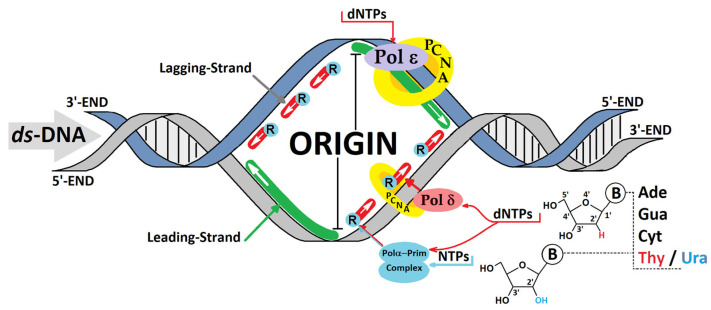 Figure 2
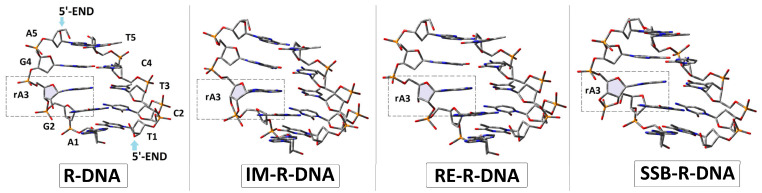 Figure 3
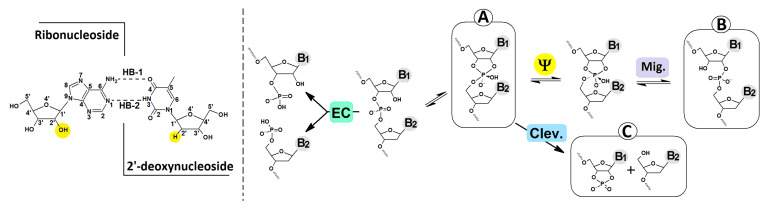 Figure 4
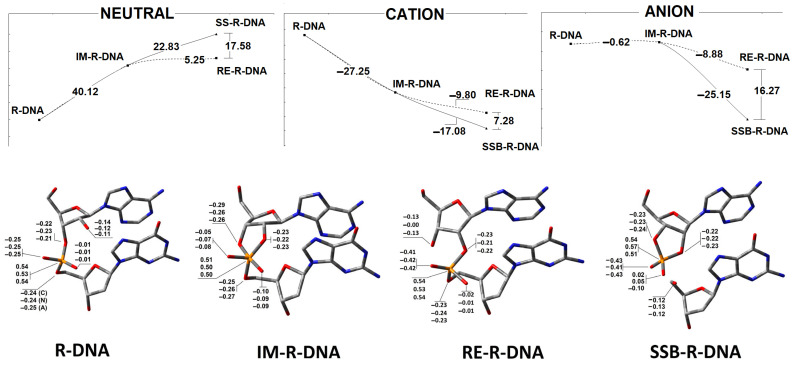 Figure 5
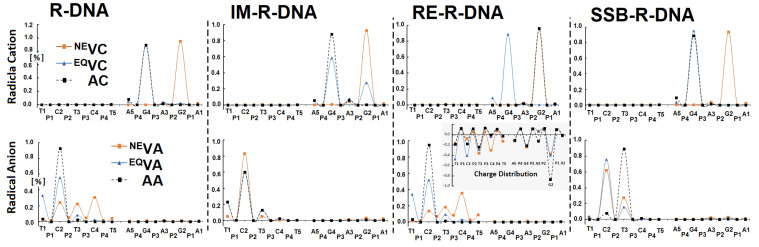 Figure 6
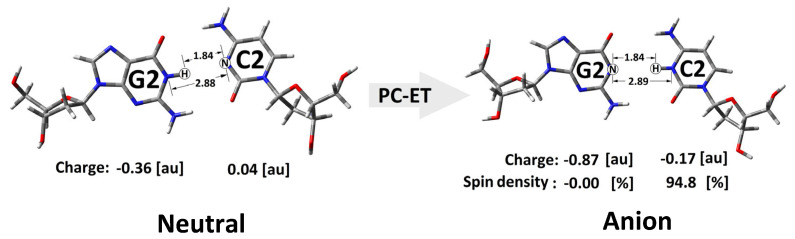 Figure 7
Peer Reviews
No public reviews on file for this paper yet. If you reviewed it on a platform where reviews are public (OpenReview, ICLR, NeurIPS, ICML), you can paste yours below so the community can read it here.
Videos
No videos yet. Explain this paper in a talk, walkthrough, or lecture? Add one.
Taxonomy
TopicsDNA and Nucleic Acid Chemistry · Advanced biosensing and bioanalysis techniques · Muon and positron interactions and applications