Alcohol vs. Cocaine: Impulsivity and Alexithymia in Substance Use Disorder
Alessio Mosca, Giovanna Bubbico, Clara Cavallotto, Stefania Chiappini, Rita Allegretti, Andrea Miuli, Carlotta Marrangone, Nicola Ciraselli, Mauro Pettorruso, Giovanni Martinotti

TL;DR
This study compares impulsivity and emotional regulation in people with alcohol and cocaine use disorders, finding that emotional difficulties are more common in alcohol users and those using multiple substances.
Contribution
The study highlights the role of alexithymia in alcohol use disorder and poly-substance use, suggesting a need for emotion-focused treatment approaches.
Findings
Impulsivity levels were similar between alcohol and cocaine users.
Alexithymia scores were higher in alcohol users and poly-substance users compared to cocaine-only users.
Emotion-focused interventions may improve treatment outcomes for individuals with co-occurring substance use.
Abstract
Substance Use Disorders (SUDs) are frequently associated with impairments in emotional regulation and behavioural control. Among the most prevalent substances of abuse, alcohol and cocaine are known to exert distinct effects on neuropsychological functioning. This study aimed to compare individuals with Alcohol Use Disorder (AUD) and Cocaine Use Disorder (CUD) in terms of impulsivity and alexithymia, and to examine the clinical implications of poly-substance use involving both alcohol and cocaine. Participants completed standardized psychometric assessments, including the Barratt Impulsiveness Scale (BIS-11), the Brief Psychiatric Rating Scale (BPRS), and the Toronto Alexithymia Scale (TAS-20). Group comparisons were conducted using non-parametric tests, and logistic regression models were applied to control for demographic covariates. The findings showed that impulsivity levels were…
Genes, proteins, chemicals, diseases, species, mutations and cell lines named across the full text — each resolved to its canonical identifier and authoritative record.
Click any figure to enlarge with its caption.
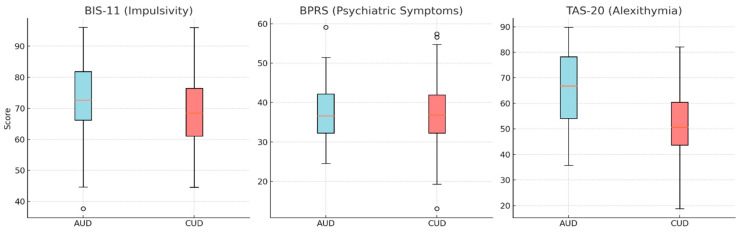 Figure 1
Peer Reviews
No public reviews on file for this paper yet. If you reviewed it on a platform where reviews are public (OpenReview, ICLR, NeurIPS, ICML), you can paste yours below so the community can read it here.
Videos
No videos yet. Explain this paper in a talk, walkthrough, or lecture? Add one.
Taxonomy
TopicsPsychosomatic Disorders and Their Treatments · Obsessive-Compulsive Spectrum Disorders · Anxiety, Depression, Psychometrics, Treatment, Cognitive Processes