Optimization of Scanning Protocol for AI-Integrated Assessment of HER2 Dual Bright-Field In-Situ Hybridization Application in Breast Cancer
Nilay Bakoglu Malinowski, Takashi Ohnishi, Emine Cesmecioglu, Dara S. Ross, Tetsuya Tsukamoto, Yukako Yagi

TL;DR
This study identifies optimal scanning protocols for an AI system that automates HER2 testing in breast cancer, improving accuracy and reliability.
Contribution
The study introduces optimized scanning protocols for AI-based Dual bright-field in situ hybridization analysis of HER2 in breast cancer.
Findings
Scanning protocols A1, A2, B2, and B3 showed consistent HER2 results compared to manual FISH.
Protocol C failed due to nuclei detection issues in six cases.
AI performance was best at 0.12 µm/pixel and 0.17 µm/pixel with extended focus.
Abstract
Accurately determining HER2 status is essential for breast cancer treatment. We developed an AI-integrated in-house application for automated Dual bright-field (BF) in situ hybridization (ISH) analysis on whole slide images (WSIs), although optimal scanning conditions remain unclear. We evaluated scanners and optimized scanning protocols for clinical application. Ten de-identified invasive breast carcinoma cases, with HER2 immunohistochemistry and FISH results, were analyzed using three scanners and six scanning protocols. WSIs scanned by Scanner ‘A’ have 0.12 µm/pixel with 0.95 NA (A1) and 1.2 NA (A2); Scanner ‘B’ have 0.08 µm/pixel (B1); 0.17 µm/pixel (B2); and 0.17 µm/pixel with extended focus (1.4 µm step size and three layers) (B3); Scanner ‘C’ has 0.26 µm/pixel (C1) resolution. Results showed scanning protocols A1, A2, B2, and B3 yielded HER2 gene amplification status and ASCO/CAP…
Genes, proteins, chemicals, diseases, species, mutations and cell lines named across the full text — each resolved to its canonical identifier and authoritative record.
Click any figure to enlarge with its caption.
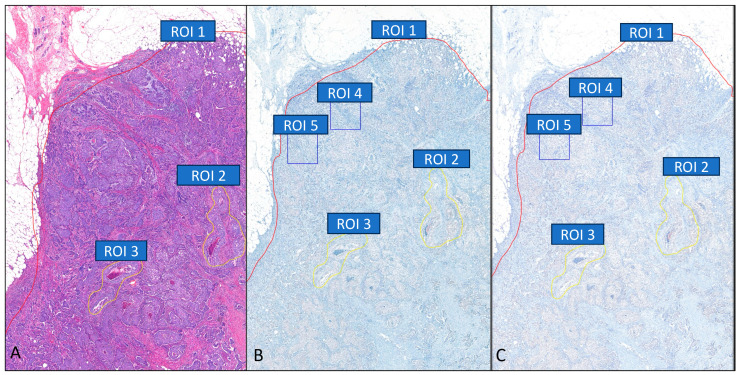 Figure 1
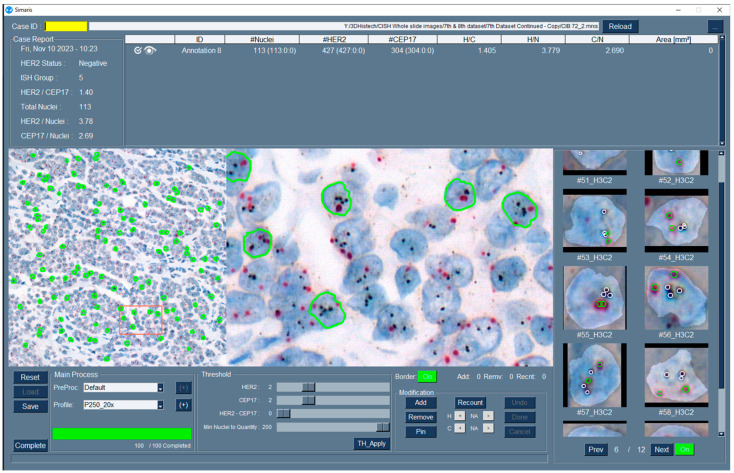 Figure 2
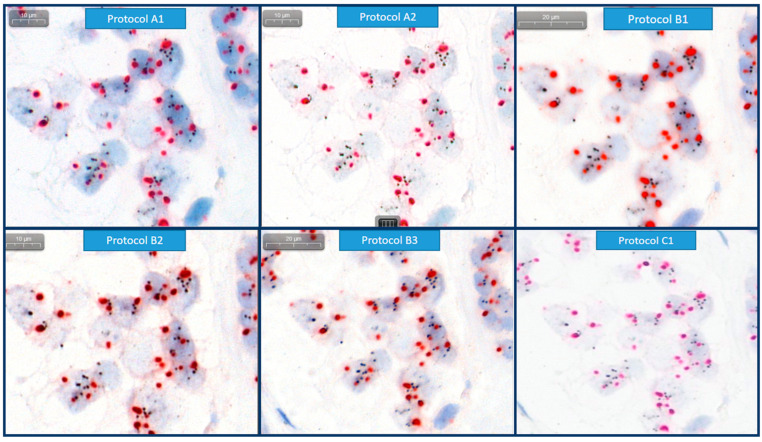 Figure 3
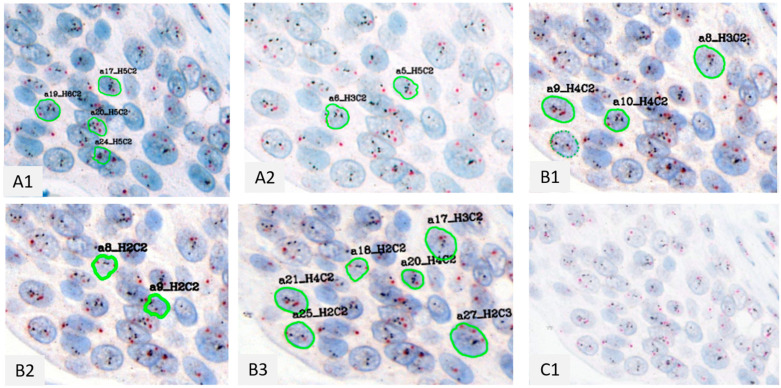 Figure 4
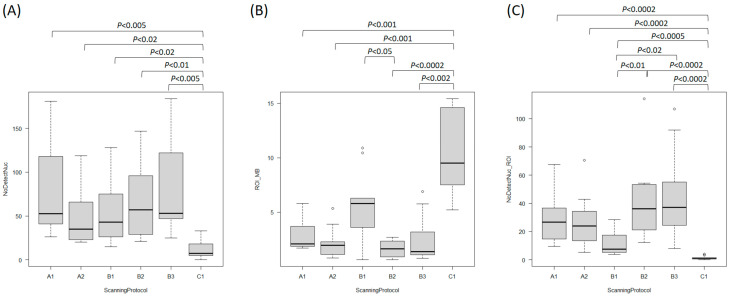 Figure 5
Peer Reviews
No public reviews on file for this paper yet. If you reviewed it on a platform where reviews are public (OpenReview, ICLR, NeurIPS, ICML), you can paste yours below so the community can read it here.
Videos
No videos yet. Explain this paper in a talk, walkthrough, or lecture? Add one.
Taxonomy
TopicsHER2/EGFR in Cancer Research · Advanced Biosensing Techniques and Applications · Cell Image Analysis Techniques