When Politics Gets Personal: Students’ Conversational Strategies as Everyday Identity Work
Toralf (Tony) Zschau, Hosuk Lee, Jason Miller

TL;DR
This study examines how university students navigate politically charged conversations by managing their identities to avoid conflict.
Contribution
The paper introduces four conversational strategies as identity management tools in politically polarized discussions.
Findings
Students use disengagement, negotiation, context adaptation, and information processing to manage political conversations.
These strategies aim to reduce social and cognitive risks associated with political disagreement.
While helpful in avoiding conflict, these strategies may hinder deeper cross-ideological engagement.
Abstract
Political polarization in the United States has made conversations across ideological divides increasingly difficult to navigate. This study explores how students at a regional university in the southern U.S. experience and manage these challenges. Based on in-depth interviews with 30 students from diverse social and political backgrounds, we identify four key conversational strategies: disengagement, negotiation, context adaptation, and information processing. Rather than viewing these as surface-level techniques, we argue they represent deeper identity management processes aimed at reducing the social and cognitive risks of political disagreement. Drawing on Self-Categorization Theory and Identity Control Theory, we show how these strategies reflect efforts to maintain identity coherence and manage relational stakes when political identity becomes salient. Our findings suggest that…
Genes, proteins, chemicals, diseases, species, mutations and cell lines named across the full text — each resolved to its canonical identifier and authoritative record.
Click any figure to enlarge with its caption.
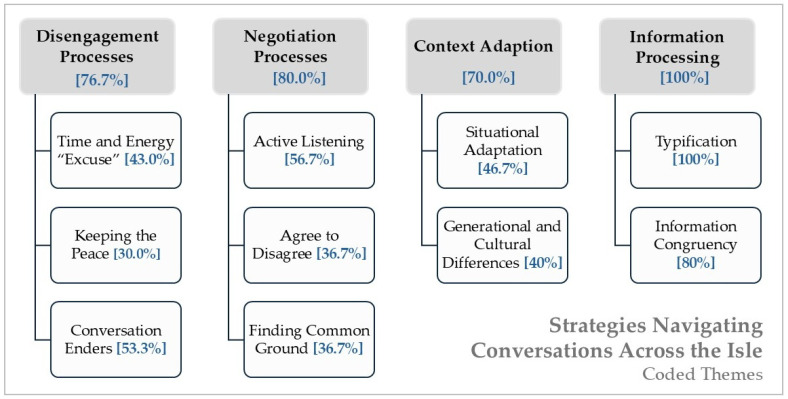 Figure 1
Peer Reviews
No public reviews on file for this paper yet. If you reviewed it on a platform where reviews are public (OpenReview, ICLR, NeurIPS, ICML), you can paste yours below so the community can read it here.
Videos
No videos yet. Explain this paper in a talk, walkthrough, or lecture? Add one.
Taxonomy
TopicsSocial Media and Politics · Social and Intergroup Psychology · Rhetoric and Communication Studies