Ability of Linezolid to Combat Staphylococcus aureus and Pseudomonas aeruginosa Isolated from Polymicrobial Wound Infections
Samar A. Ahmed, Vy T. Luu, Teresa C. Oyono Nsuga, Steven E. Burgos, Eugene Kreys, Jered Arquiette, Justin R. Lenhard

TL;DR
This study examines how linezolid affects Staphylococcus aureus in the presence of Pseudomonas aeruginosa in wound infections, finding it more reliable than clindamycin.
Contribution
The study compares linezolid and clindamycin's antistaphylococcal activity in mixed infections and evaluates linezolid's effect on host defense peptides.
Findings
Linezolid's maximum S. aureus killing (Emax) was less affected by P. aeruginosa compared to clindamycin.
Clindamycin's potency paradoxically increased in all experiments with P. aeruginosa.
Linezolid did not consistently enhance host defense peptides against P. aeruginosa.
Abstract
Background/Objectives: The optimal therapy for polymicrobial wound infections is poorly defined. We sought to characterize the ability of linezolid to combat mixed cultures of Staphylococcus aureus and Pseudomonas aeruginosa. Methods: The antistaphylococcal activity of linezolid was assessed in 24-h time-killing experiments that used S. aureus and P. aeruginosa isolated from polymicrobial wound infections. Clindamycin was also evaluated as a comparator. A Hill-type mathematical model was used to assess the maximum killing of S. aureus (Emax). The ability of linezolid to potentiate the activity of host defense peptides against P. aeruginosa was evaluated using LL-37. Results: In the presence of P. aeruginosa, the Emax of linezolid decreased in 5/9 co-culture experiments and increased in 4/9 co-culture experiments in comparison to linezolid against S. aureus alone. The potency of…
Genes, proteins, chemicals, diseases, species, mutations and cell lines named across the full text — each resolved to its canonical identifier and authoritative record.
Click any figure to enlarge with its caption.
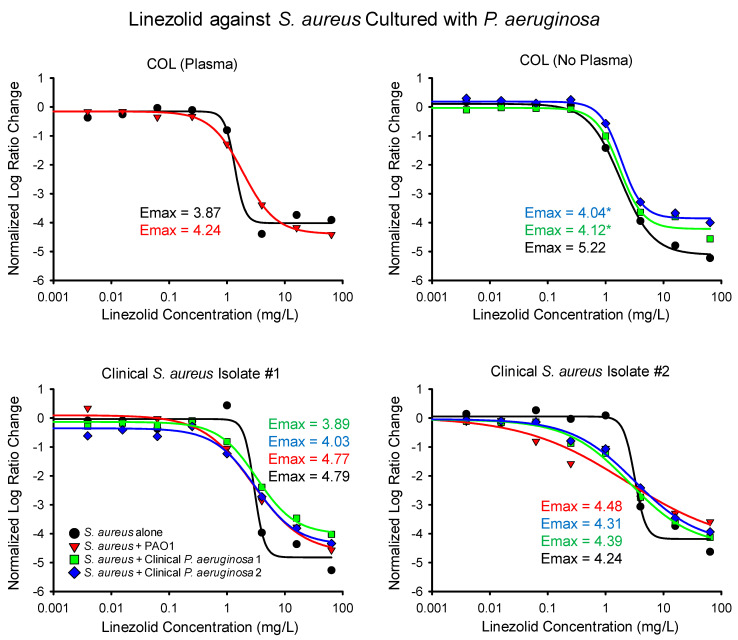 Figure 1
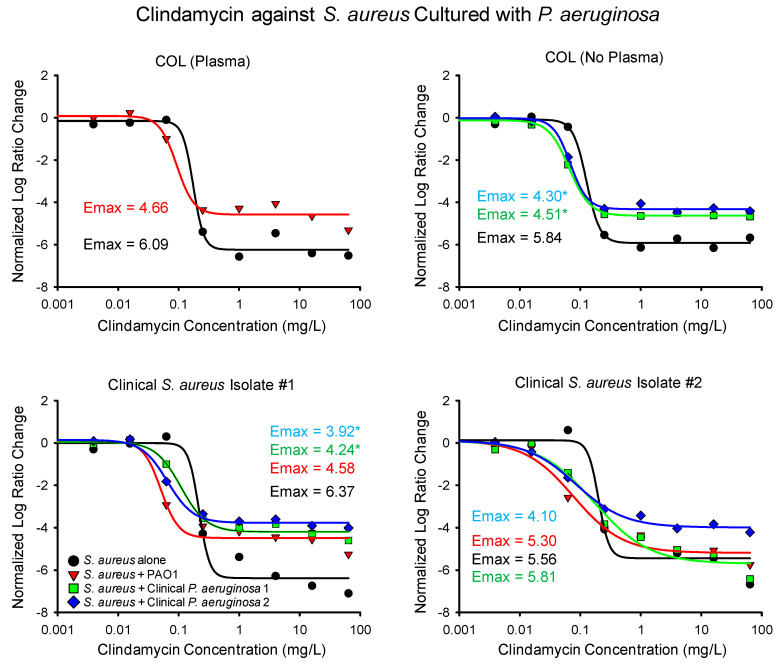 Figure 2
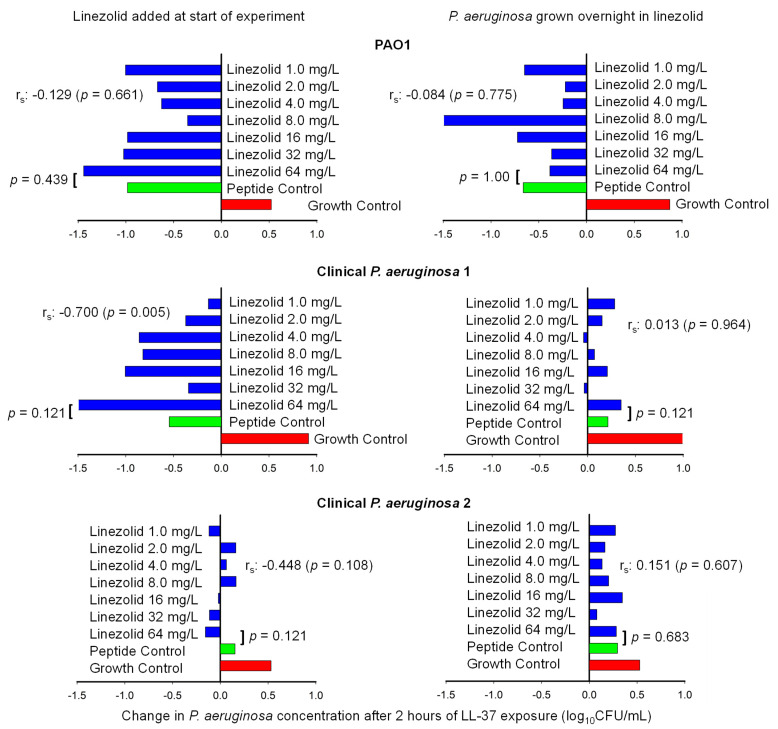 Figure 3
Peer Reviews
No public reviews on file for this paper yet. If you reviewed it on a platform where reviews are public (OpenReview, ICLR, NeurIPS, ICML), you can paste yours below so the community can read it here.
Videos
No videos yet. Explain this paper in a talk, walkthrough, or lecture? Add one.
Taxonomy
TopicsAntimicrobial Peptides and Activities · Bacterial biofilms and quorum sensing · Antimicrobial Resistance in Staphylococcus