Determination of the latent geometry of atorvastatin pharmacokinetics by transfer entropy to identify bottlenecks
Paola Lecca, Angela Re

TL;DR
This paper introduces a method to determine the latent geometry of a pharmacokinetic network using transfer entropy, helping identify bottlenecks in drug processes like atorvastatin.
Contribution
A novel method to calculate network geometry from time series data using transfer entropy and spectral graph embedding.
Findings
Transfer entropy can be used to compute the distance matrix of a network from time series data.
Spectral graph embedding helps identify the optimal latent geometry of the network.
The method was successfully applied to the pharmacokinetics of atorvastatin.
Abstract
In mathematics, a physical network (e.g. biological network, social network, IT network, communication network) is usually represented by a graph. The determination of the metric space (also referred to as latent geometry) of the graph and the disposition of its nodes on it provide important information on the reaction propensity and consequently on the possible presence of bottlenecks in a system of interacting molecules, such as it happens in pharmacokinetics. To determine the latent geometry and the coordinates of nodes, it is necessary to have the dissimilarity or distance matrix of the network, an input that is not always easy to measure in experiments. The main result of this study is the mathematical and computational procedure for determining the distance/dissimilarity matrix between nodes and for identifying the latent network geometry from experimental time series of node…
Genes, proteins, chemicals, diseases, species, mutations and cell lines named across the full text — each resolved to its canonical identifier and authoritative record.
Click any figure to enlarge with its caption.
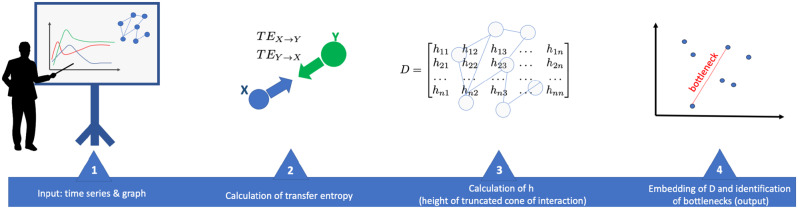 Fig. 7
Peer Reviews
No public reviews on file for this paper yet. If you reviewed it on a platform where reviews are public (OpenReview, ICLR, NeurIPS, ICML), you can paste yours below so the community can read it here.
Videos
No videos yet. Explain this paper in a talk, walkthrough, or lecture? Add one.
Taxonomy
TopicsComputational Drug Discovery Methods · Bioinformatics and Genomic Networks · Metabolomics and Mass Spectrometry Studies
Introduction
A popular way in data science to describe a graph is the dissimilarity matrix. Its entries are the pairwise distinctions between the nodes of the graph. The dissimilarity matrix is a square \documentclass[12pt]{minimal} \usepackage{amsmath} \usepackage{wasysym} \usepackage{amsfonts} \usepackage{amssymb} \usepackage{amsbsy} \usepackage{mathrsfs} \usepackage{upgreek} \setlength{\oddsidemargin}{-69pt} \begin{document}$$N \times N$$\end{document} matrix (where \documentclass[12pt]{minimal} \usepackage{amsmath} \usepackage{wasysym} \usepackage{amsfonts} \usepackage{amssymb} \usepackage{amsbsy} \usepackage{mathrsfs} \usepackage{upgreek} \setlength{\oddsidemargin}{-69pt} \begin{document}$$N$$\end{document} is the number of nodes) with the \documentclass[12pt]{minimal} \usepackage{amsmath} \usepackage{wasysym} \usepackage{amsfonts} \usepackage{amssymb} \usepackage{amsbsy} \usepackage{mathrsfs} \usepackage{upgreek} \setlength{\oddsidemargin}{-69pt} \begin{document}$$ij$$\end{document} -th element equal to the value of a chosen measure of distinction between the node \documentclass[12pt]{minimal} \usepackage{amsmath} \usepackage{wasysym} \usepackage{amsfonts} \usepackage{amssymb} \usepackage{amsbsy} \usepackage{mathrsfs} \usepackage{upgreek} \setlength{\oddsidemargin}{-69pt} \begin{document}$$i$$\end{document} and the node \documentclass[12pt]{minimal} \usepackage{amsmath} \usepackage{wasysym} \usepackage{amsfonts} \usepackage{amssymb} \usepackage{amsbsy} \usepackage{mathrsfs} \usepackage{upgreek} \setlength{\oddsidemargin}{-69pt} \begin{document}$$j$$\end{document} . The measure of distinction is context specific, since it depends on the network under study (e.g. biological, social, IT, or market network), and the interactions between nodes which we want to focus on (e.g. chemical affinity in biochemical networks, co-expression in gene networks, statistical correlation, etc.). A special type of dissimilarity matrix is the distance matrix, whose entries are the distances between the nodes in a metric space.
The dissimilarity matrix is the simplest form in which a graph can be handled with computational procedures and therefore the knowledge of it is of considerable importance. It is not always possible to know this matrix as direct experimental data; thus the development and application of computational methods that calculate the matrix from the experimental data that can most commonly and easily be collected are necessary. The dissimilarity/distance matrix of a graph contains important information about the structure of the graph and the presence of any bottlenecks in the system of interactions described by the arcs. The objectives of this study are precisely to propose a method for calculating the distance matrix of a graph from the time series describing the dynamics of its nodes and, to identify of possible bottlenecks in the dynamics of the graph by embedding the distance matrix in a metric space. Our solution is to derive the dissimilarity between interacting nodes by using the transfer entropy. In the interaction between a node \documentclass[12pt]{minimal} \usepackage{amsmath} \usepackage{wasysym} \usepackage{amsfonts} \usepackage{amssymb} \usepackage{amsbsy} \usepackage{mathrsfs} \usepackage{upgreek} \setlength{\oddsidemargin}{-69pt} \begin{document}$$X$$\end{document} and a node \documentclass[12pt]{minimal} \usepackage{amsmath} \usepackage{wasysym} \usepackage{amsfonts} \usepackage{amssymb} \usepackage{amsbsy} \usepackage{mathrsfs} \usepackage{upgreek} \setlength{\oddsidemargin}{-69pt} \begin{document}$$Y$$\end{document} , the transfer entropy from \documentclass[12pt]{minimal} \usepackage{amsmath} \usepackage{wasysym} \usepackage{amsfonts} \usepackage{amssymb} \usepackage{amsbsy} \usepackage{mathrsfs} \usepackage{upgreek} \setlength{\oddsidemargin}{-69pt} \begin{document}$$X$$\end{document} to \documentclass[12pt]{minimal} \usepackage{amsmath} \usepackage{wasysym} \usepackage{amsfonts} \usepackage{amssymb} \usepackage{amsbsy} \usepackage{mathrsfs} \usepackage{upgreek} \setlength{\oddsidemargin}{-69pt} \begin{document}$$Y$$\end{document} is the amount of information that node \documentclass[12pt]{minimal} \usepackage{amsmath} \usepackage{wasysym} \usepackage{amsfonts} \usepackage{amssymb} \usepackage{amsbsy} \usepackage{mathrsfs} \usepackage{upgreek} \setlength{\oddsidemargin}{-69pt} \begin{document}$$X$$\end{document} transmits to node \documentclass[12pt]{minimal} \usepackage{amsmath} \usepackage{wasysym} \usepackage{amsfonts} \usepackage{amssymb} \usepackage{amsbsy} \usepackage{mathrsfs} \usepackage{upgreek} \setlength{\oddsidemargin}{-69pt} \begin{document}$$Y$$\end{document} and which causes the variability of the quantitative features related to node \documentclass[12pt]{minimal} \usepackage{amsmath} \usepackage{wasysym} \usepackage{amsfonts} \usepackage{amssymb} \usepackage{amsbsy} \usepackage{mathrsfs} \usepackage{upgreek} \setlength{\oddsidemargin}{-69pt} \begin{document}$$Y$$\end{document} (e.g. concentration, reaction propensity) [1]. The embedding of the dissimilarity matrix in a space makes it possible to find the position coordinates of the nodes in that space and to interpret dissimilarity as the distance between nodes defined by the metric of the space. The analysis of the distances between nodes in the metric space that most accurately represents the latent geometry of the network allows the identification of bottlenecks in the dynamics of the interactions of the network nodes. Here by “bottlenecks” we mean interactions between nodes located at large distances, which by virtue of this take longer or have to overcome significant energy thresholds to take place. For example, clusters of nodes placed at a short distance from each other in the metric space describing the network’s geometry and activated by nodes placed at a great distance from them define a structure that could highlight possible bottlenecks in the kinetics and dynamics (see Fig. 1).Fig. 1. The spatial distance of the nodes located in the metric space describing the latent geometry of the network can be thought of as a measure of the propensity of interaction between in nodes, so that interactions between neighbouring nodes are characterised by a higher propensity than interactions between nodes that are far apart. When, as in (A), a node interacts with one or more nodes of a cluster located at a great distance from it and results in the staggered activation of interactions between the nodes of the cluster, the arc(s) connecting this node to the nodes of the cluster may identify bottlenecks for the chemical reaction system. In fact, the occurrence of reactions between the cluster nodes depends on the activity of the low-propensity interaction between the source node and the cluster nodes located at a great distance from it. Reactions that can be assumed to be bottlenecks for network dynamics can be those due to interactions between network modules as shown in (B)
We illustrate our method on a biochemical network representing the pharmacokinetics of atorvastatin, a medication to reduce blood levels of lipids called triglycerides and cholesterol. This medication may help avoid health issues (such as heart attacks, strokes, and chest pain) brought on by fats obstructing blood vessels. Indeed, cardiovascular diseases remain the leading cause of death globally despite the current standard of care. Atherosclerosis, along with its clinical manifestations, such as myocardial infarction and ischaemic stroke, leads to a major burden on life expectancy, quality of life, and societal costs [2]. Dyslipidaemia is a major risk factor for atherosclerotic cardiovascular disease, with one-third of ischaemic heart disease being attributable to high cholesterol.
The theoretical study we propose in this article is intended as a contribution to the analysis of bottlenecks. Bottleneck analysis is indeed a useful technique for detecting inefficiencies and streamlining procedures in drug pharmacokinetics analysis and design. Concentrating on the parts of a pharmacokinetic network that experience bottlenecks can help increase drug efficiency, potentially minimise side effects, and ultimately improve the medicine’s quality. The identification and analysis of bottlenecks in biological networks, although recognised as being of fundamental importance, is still in its infancy. To the best of our knowledge, the identification of bottlenecks is carried out on the basis of centrality measurements, a priori knowledge of the kinetics or dynamics of the network (e.g. on the kinetic parameters of reactions, or on chemical binding affinities, or on statistical measures such as the correlation between nodes), dynamic sensitivity analysis, and phase space analysis, as we can find in [3–12]. The latent geometry of the network is not taken into account for the characterisation of interactions such as bottlenecks. The innovative contribution of this study is precisely the characterisation of an interaction as a bottleneck through the distance of the participating nodes in the network metric space, which is the structure that, unlike standard centrality measures, contains the laws of evolution of a network over time.
Precisely because the metric space and the dynamics of a network are intimately connected [13, 14], as the former determines the latter, which in turn can modify the structure of the former, in this study we derive the latent metric from the time series of the nodes in the network. From the time series we calculate the transfer entropy, which we interpret as a measure of the information volume related to the interaction propensity of the nodes. From this volume we calculate the distance between nodes, which is the input of graph embedding procedures for the identification of the network’s latent geometry. The bottlenecks, defined as interactions that are crucial for the functioning of the entire network, but which occur between nodes located at a significantly large distance, are thus identified through a procedure that takes into account the topology, the latent geometry of the network and the dynamic data expressed by the time series of the nodes.
The main advantage of the method we propose is that it does not implement iterative procedures, typical for example of sensitivity analysis, nor the exploration of the phase space, which is particularly complex if the data is affected by experimental error or non-negligible variances. Furthermore, our method does not require prior knowledge beyond experimental time series data.
The article is organized as follows: in Section “Related work” we report the main current literature relevant to the bottleneck identification in systems biology and bioinformatics; in Section “Atorvastatin pharmacokinetics” we present atorvastatin, its pharmacokinetics and recent literature supporting the current knowledge of the mechanisms of action and metabolism of the drug. In the Section we also present the experimental data that we use in our study (Sub-section “Data”). In Section “Methods” we introduce the concepts and definitions of the transfer entropy theory and its use for the calculation of distances between nodes of the atorvastatin network. In the same section we give brief hints on the embedding of a graph in flat and curved metric spaces. In Section “Results” we present the results of the study, i.e. the identification of the network’s latent geometry and the identification of bottlenecks interactions, and in Section “Discussion”, we comment on the results. Finally, Sections “Conclusions” is devoted to the concluding remarks, and “Appendix: Network latent geometry” gives some hints and literature references on the embedding of graphs.
Related work
Besides the pharmacokinetics-oriented case study here employed, bottleneck identification is useful in systems-level study of cellular information processing [15], as well as in industrial biotechnology for production of chemicals, enzymes, antibiotics, and healthcare products [16]. Many historical attempts to identify bottlenecks have been at best semi-empirical. However, given the development of genetic and protein engineering tools, the question arises as to how one might rationally seek to identify the most promising gene or gene products to modify for the purpose of interest [17, 18].
An established approach adopted in bottleneck detection relies on sensitivity analysis, either under steady state conditions or under dynamic conditions, often in combination with models of metabolic pathways [9, 19]. The former approach is usually carried out by methods such as biochemical systems theory [20] and metabolic control analysis [21–23], whereas dynamic sensitivity analysis [24] by methods such as the Green’s function matrix analysis [25] and the impulse parametric sensitivity analysis [26] and its extension to account for pathway-level perturbations in dynamical pathway-based parametric sensitivity analysis [27].
The study of connectivity patterns in networks through edge centralities [28, 29] such as edge betweenness [30], edge closeness, edge eigenvector centrality, and nearest-neighbour edge centrality [31, 32] are deemed useful indicators for the identification of bottlenecks in network models and in real-world networks [33]. Furthermore, several statistical [34–37] and machine learning [38, 39] models have been developed, with the objective of identifying bottleneck locations.
Finally, there exist extensive studies in various disciplines, e.g. urban planning, traffic complexity, sustainable production system management [40], or routing in computer networks, focusing on bottlenecks identification and their spatio-temporal dynamics [41, 42] that could be borrowed in life sciences. Some of them explored the occurrences of congestion, including the kinematic wave theory [43, 44], the cellular automaton models [45, 46], and the three-phase traffic theory [47]. Attention has also been paid to understanding the bottleneck formation for the known causes, including the queue model [48], the lane-changing model [49], and the cell transmission model [50].
Atorvastatin pharmacokinetics
Hydroxymethylglutaryl-coenzyme A (HMG-CoA) reductase inhibitors, commonly known as statins, are cornerstone of drug therapy for atherosclerotic cardiovascular disease. Most of the benefits of statin therapy are due to the lowering of serum total cholesterol levels, with the level of low-density lipoprotein cholesterol decreased and the level of high-density lipoprotein cholesterol increased [51]. Statins reduce the risk of major vascular events such as coronary deaths or myocardial infarctions, strokes in patients with known atherosclerotic cardiovascular disease [52–54] as well as in patients who are at increased risk but have not yet manifested a vascular event [55, 56]. Although generally smoothly tolerated by the organism, statins are associated with adverse drug reactions in a small subset of patients, including statin-related myotoxicity [57–60]. The clinical spectrum of statin-induced myotoxicity varies greatly from asymptomatic elevations of creatine kinase (CK) without muscle pain, to muscle pain or weakness with raised CK levels, myositis with biopsy-proven muscle inflammation, and, finally, rhabdomyolysis with muscle symptoms, high CK, and potential for acute kidney injury [61, 62]. Risk factors include higher statin dose, comedications, and potentially increased circulating levels of statin lactone species, which are considered more myotoxic, as well as genetic factors [63, 64].
Among statins, atorvastatin (AS) is the guideline-recommended first-line lipid-lowering drug. Atorvastatin is administered orally as a calcium salt in the active acid form with a clinical dosage ranging commonly from 10 to 80 mg/day. AS is rapidly absorbed, reaching peak plasma concentration within 4 h in immediate-release formulations [65]. AS is transported systemically either through passive diffusion or actively assisted by endogenous carriers such as members of the organic anion-transporting polypeptide (OATP) family [66, 67]. Bio-transformation of the pharmacologically active AS occurs in the liver. The liver-specific OATP family members [68] OATP1B1 [67, 69, 70], which is encoded by gene SLCO1B1, OATP2B1 [66, 71], which is encoded by gene SLCO2B1, and OATP1B3 [72] regulate the uptake of AS into hepatocytes, increasing the amount of drug available for metabolism by liver enzymes. The reduced AS hepatic uptake and the consequently reduced hepatic formation of its active metabolites can decrease their therapeutic efficacy and promote the onset of adverse reactions such as rhabdomyolysis or myopathy [73]. Less than 1% of atorvastatin and derivatives are eliminated in urine [74], which points at AS excretion mainly by hepatobiliary mechanisms. AS is actively exported out of the hepatocytes into the bile by the ATP-dependent multidrug resistance gene 1 (MDR1, ABCB1) transporter [75, 76], and by the multidrug resistance-associated protein 2 (MRP2, ABCC2) [70].
Active AS is transformed to its corresponding inactive lactone form (ASL) by different UDP-glucuronosyltransferase (UGT) enzymes, the most important of which is UGT1A3 [77, 78]. Both AS and ASL are further metabolized into their para- and ortho-hydroxy-metabolites, ASpOH, ASoOH, ASLpOH and ASLoOH, by cytochrome P450 (CYP) enzymes, mainly CYP3A4 and CYP3A5, and, to a lower extent, CYP2C8 [79–81]. The main metabolite, 2-hydroxy-atorvastatin, is pharmacologically active and significantly contributes to the inhibitory activity on HMG-CoA reductase. The lactone forms of atorvastatin and its metabolites can also be hydrolyzed back into their corresponding acid forms either non-enzymatically or by paraoxonases [82–84]. Genetic polymorphisms in the genes coding for these proteins involved in the absorption, distribution, metabolism, and excretion processes have been extensively investigated [67, 85–87], mainly through association studies using non-compartmental pharmacokinetic analysis on healthy volunteers after single dose administration [63, 88–90].
Quantitative structure-activity relationship (QSAR) [91, 92], that is a computational modelling method for unveiling the relationships between structural properties of chemical compounds and their physicochemical and biological properties, is widely used in computer-aided drug design. A combination of molecular modelling techniques including three-dimensional quantitative structure-activity relationship (3D-QSAR), molecular docking and molecular dynamics simulation was employed to explore the feasibility of atorvastatin analogues as HMG-CoA reductase inhibitors [93].
Considerable progress has been made towards predicting pharmacokinetic behaviour from in vitro information on the interaction between atorvastatin and enzymes and atorvastatin and additional compounds [94, 95]. However, data on in vitro human drug metabolism could be deemed in lack of appropriate depth for instructing the implementation of in vivo studies in humans. Furthermore, in vitro studies are limited in the fact that they do not account for inter-subject variability.
The informative value of the data routinely generated during in vitro atorvastatin studies on its physicochemical properties such as permeability, solubility, lipophilicity [96, 97] and biological properties such as receptor binding, and metabolic stability [98, 99] is usually exploited in mechanistic and physiologically based pharmacokinetic (PBPK) models in the context of simulations and predictions of absorption, distribution, metabolism and excretion processes in virtual patient populations [100]. PBPK models integrate experimentally based information and mechanistic framework of physiological and biological processes using implicit and explicit assumptions by relying on drug-, system- and trial design-related parameters. PBPK models are positioned as a valuable tool for the characterization of complex pharmacokinetic/pharmacodynamics (PK/PD) processes and its extrapolation in special sub-groups of the population [100]. Several PBPK models of AS have been published in the recent years [97], which have been often carried out within the Simcyp PBPK simulator [101]. PBPK models address different aspects of the PK/PD properties of AS such as dose selection, exploration of drug-drug interactions. PBPK models have been applied to quantitatively predict drug-drug interaction (DDI) effects. For instance, the PBPK model for atorvastatin and its two hydroxy-metabolites, 2-hydroxy-atorvastatin acid and atorvastatin lactone [102], aimed at predicting the pharmacokinetic profiles and DDI effects by examining different DDI scenarios, where atorvastatin was coadministered with a CYP3A4 inhibitor (itraconazole, clarithromycin, or cimetidine), or CYP3A4 inducer (rifampin or phenytoin). The model developed in [103] integrated the model introduced in [102] by accounting for the active uptake mediated by OATP1B3 and for the biliary excretion of AS. Another atorvastatin PBPK model was developed using in vitro and human pharmacokinetic data by considering the contribution of both metabolizing enzymes and transporters to the disposition of the drug [104]. The PBPK model was used to simulate statin pharmacokinetic in subjects with varying SLCO1B1 polymorphism or in subjects co-administered with various CYP enzymes and/or transporter inhibitors. As shown in the previously mentioned PBPK models, AS disposition is determined by cytochrome P450 (CYP) 3A4 and polypeptides (OATPs). Since drugs that affect gastric emptying, including dulaglutide, affect atorvastatin pharmacokinetics, a recent PBPK model sought to include gastric acid-mediated lactone equilibration of atorvastatin to predict atorvastatin acid, lactone, and their major metabolites [105]. More recently, a PBPK model for atorvastatin and its metabolites was developed to predict their pharmacokinetics upon administration of solid oral dosage of AS calcium salt at several dosage levels in single and multiple dosing schedules [106]. Differently from previous models, this model accounts also for AS solubility-limited absorption in the attempt to improve clinical trial design and real-life administration schedules.
Data
We considered atorvastatin metabolite concentrations in the time-series experiment on primary human hepatocytes of three individuals as reported by Bucher et al. in [107], where atorvastatin acid and lactone (AS and ASL) and corresponding para- and ortho-hydroxy-metabolites (acids: ASpOH and ASoOH; lactones: ASLpOH and ASLoOH) have been measured at the defined time points with mean and standard deviation ( \documentclass[12pt]{minimal} \usepackage{amsmath} \usepackage{wasysym} \usepackage{amsfonts} \usepackage{amssymb} \usepackage{amsbsy} \usepackage{mathrsfs} \usepackage{upgreek} \setlength{\oddsidemargin}{-69pt} \begin{document}$$n = 3$$\end{document} ) from measurements per liquid chromatography/mass spectrometry (LC-MS/MS). The data refer to the nodes of the simplified scheme of interactions in Figure 2. Figures 3, 4, 5 show the behaviours of the time series in [107] whose number of points was augmented with a cubic spline interpolation method of Forsythe, Malcolm, and Moler (FMM) [108]. The spline interpolation was applied to both the experimental measurements and the magnitude of the error bars, given by an average value over three measurements per individual and the standard deviation, respectively. Cubic splines traverse all the data points, ensure a certain level of precision, mitigate - to a certain degree - the amplitude of fluctuations due to stochastic effects and/or experimental uncertainties, and provide smooth functions. Specifically, cubic splines are continuous from the zeroth to the second derivative. This is a property required for a time curve to describe kinetics. The interpolation obtained here contains all the experimental time points. The time series data refer to the nodes of the simplified scheme of interaction in Fig. 2.Fig. 2. Simplified scheme of the intracellular model of atorvastatin metabolism in primary human hepatocytes [107]. The model includes AS and ASL, and their para- and ortho-hydroxy-metabolites, ASpOH and ASoOH, ASLpOH and ASLoOH. AS and ASL are hydroxylated to the corresponding metabolites by CYP3A4. Compound AS is converted via an unstable glucuronide-intermediate (ASG) to ASL mediated by UGT1A3Fig. 3Atorvastatin metabolite intracellular concentrations in the time-series experiment on primary human hepatocytes of Individual 1 from LC-MS/MS measurements as in [107]. The experimental points (in red) as well as the width of the error bars have been interpolated with the spline FMM method [108]Fig. 4. Atorvastatin metabolite intracellular concentrations in the time-series experiment on primary human hepatocytes of Individual 2 from LC-MS/MS measurements as in [107]. The experimental points (in red) as well as the width of the error bars have been interpolated with the spline FMM method [108]Fig. 5. Atorvastatin metabolite intracellular concentrations in the time-series experiment on primary human hepatocytes of Individual 3 from LC-MS/MS measurements as in [107]. The experimental points (in red) as well as the width of the error bars have been interpolated with the spline FMM method [108]
The computational procedure proposed in this study uses the graph of the interaction network and the time series of its components as input data. The procedure can be applied to both direct and indirect graphs (and multigraphs).
Methods
We first briefly introduce some fundamental quantities of the information theory related to the concept of transfer entropy useful for understanding the steps of the application we make in this study. The reader can find in [109-116] a more comprehensive review of modern approaches of information theory in various applicative domains. We then present the procedure for deriving distances between nodes from the transfer entropy, and a short summary of the graph embedding for the identification of latent geometry.
Transfer entropy
Consider a random variable \documentclass[12pt]{minimal} \usepackage{amsmath} \usepackage{wasysym} \usepackage{amsfonts} \usepackage{amssymb} \usepackage{amsbsy} \usepackage{mathrsfs} \usepackage{upgreek} \setlength{\oddsidemargin}{-69pt} \begin{document}$$X$$\end{document} drawn from a sample space \documentclass[12pt]{minimal} \usepackage{amsmath} \usepackage{wasysym} \usepackage{amsfonts} \usepackage{amssymb} \usepackage{amsbsy} \usepackage{mathrsfs} \usepackage{upgreek} \setlength{\oddsidemargin}{-69pt} \begin{document}$${S_X}$$\end{document} . The amount of information associated with the event \documentclass[12pt]{minimal} \usepackage{amsmath} \usepackage{wasysym} \usepackage{amsfonts} \usepackage{amssymb} \usepackage{amsbsy} \usepackage{mathrsfs} \usepackage{upgreek} \setlength{\oddsidemargin}{-69pt} \begin{document}$$X = x$$\end{document} is
\documentclass[12pt]{minimal} \usepackage{amsmath} \usepackage{wasysym} \usepackage{amsfonts} \usepackage{amssymb} \usepackage{amsbsy} \usepackage{mathrsfs} \usepackage{upgreek} \setlength{\oddsidemargin}{-69pt} \begin{document}$$I(X = x) = - \mathop {\log }\nolimits_2 \Pr (X = x).$$\end{document}The random variables X and Y might be either independent or dependent on one another. One random variable includes information about another in the situation of dependency. The mutual information \documentclass[12pt]{minimal} \usepackage{amsmath} \usepackage{wasysym} \usepackage{amsfonts} \usepackage{amssymb} \usepackage{amsbsy} \usepackage{mathrsfs} \usepackage{upgreek} \setlength{\oddsidemargin}{-69pt} \begin{document}$$I(X,Y)$$\end{document} quantifies the amount of information that \documentclass[12pt]{minimal} \usepackage{amsmath} \usepackage{wasysym} \usepackage{amsfonts} \usepackage{amssymb} \usepackage{amsbsy} \usepackage{mathrsfs} \usepackage{upgreek} \setlength{\oddsidemargin}{-69pt} \begin{document}$$X$$\end{document} has about \documentclass[12pt]{minimal} \usepackage{amsmath} \usepackage{wasysym} \usepackage{amsfonts} \usepackage{amssymb} \usepackage{amsbsy} \usepackage{mathrsfs} \usepackage{upgreek} \setlength{\oddsidemargin}{-69pt} \begin{document}$$Y$$\end{document} (or vice versa)
\documentclass[12pt]{minimal} \usepackage{amsmath} \usepackage{wasysym} \usepackage{amsfonts} \usepackage{amssymb} \usepackage{amsbsy} \usepackage{mathrsfs} \usepackage{upgreek} \setlength{\oddsidemargin}{-69pt} \begin{document}$$\eqalign{ I(X(t),Y(t)) = & \sum\limits_{\scriptstyle {x_t} \in {S_X}, \atop \scriptstyle {y_t} \in {S_Y}} {\Pr } (X(t) = {x_t},Y(t) = {y_t}) \cr & {\log _2}{{\Pr (X(t) = {x_t},Y(t) = {y_t})} \over {\Pr (X(t) = {x_t})\Pr (Y(t) = {y_t})}}. \cr} $$\end{document}Since, according to Equation (2), the mutual information is symmetric, i.e., \documentclass[12pt]{minimal} \usepackage{amsmath} \usepackage{wasysym} \usepackage{amsfonts} \usepackage{amssymb} \usepackage{amsbsy} \usepackage{mathrsfs} \usepackage{upgreek} \setlength{\oddsidemargin}{-69pt} \begin{document}$$I(X,Y) = I(Y,X)$$\end{document} , it cannot be used for causal inference. If the present of one variable (effect) is determined by the past of another variable (cause), the causal direction (direction of information flow) from the cause to the effect can be inferred. By introducing a time-lag parameter \documentclass[12pt]{minimal} \usepackage{amsmath} \usepackage{wasysym} \usepackage{amsfonts} \usepackage{amssymb} \usepackage{amsbsy} \usepackage{mathrsfs} \usepackage{upgreek} \setlength{\oddsidemargin}{-69pt} \begin{document}$$\tau $$\end{document} in any of the variables \documentclass[12pt]{minimal} \usepackage{amsmath} \usepackage{wasysym} \usepackage{amsfonts} \usepackage{amssymb} \usepackage{amsbsy} \usepackage{mathrsfs} \usepackage{upgreek} \setlength{\oddsidemargin}{-69pt} \begin{document}$$X$$\end{document} and \documentclass[12pt]{minimal} \usepackage{amsmath} \usepackage{wasysym} \usepackage{amsfonts} \usepackage{amssymb} \usepackage{amsbsy} \usepackage{mathrsfs} \usepackage{upgreek} \setlength{\oddsidemargin}{-69pt} \begin{document}$$Y$$\end{document} , one can create an asymmetric measure known as time-delayed mutual information, that is
\documentclass[12pt]{minimal} \usepackage{amsmath} \usepackage{wasysym} \usepackage{amsfonts} \usepackage{amssymb} \usepackage{amsbsy} \usepackage{mathrsfs} \usepackage{upgreek} \setlength{\oddsidemargin}{-69pt} \begin{document}$$\eqalign{ I(X(t + \tau ),Y(t)) = & \sum\limits_{\scriptstyle {x_t},\;{x_{t + \tau }} \in {S_X}, \hfill \atop \scriptstyle {y_t} \in {S_Y} \hfill} {\Pr (X(t + \tau ) = {x_{t + \tau }},Y(t) = {y_t}) \times } \cr & \times {\log _2}{{\Pr (X(t + \tau ) = {x_{t + \tau }},Y(t) = {y_t})} \over {\Pr (X(t + \tau ) = {x_{t + \tau }})\Pr (Y(t) = {y_t})}} \cr} $$\end{document}The joint entropy and the conditional entropy for two random variables \documentclass[12pt]{minimal} \usepackage{amsmath} \usepackage{wasysym} \usepackage{amsfonts} \usepackage{amssymb} \usepackage{amsbsy} \usepackage{mathrsfs} \usepackage{upgreek} \setlength{\oddsidemargin}{-69pt} \begin{document}$$X$$\end{document} an \documentclass[12pt]{minimal} \usepackage{amsmath} \usepackage{wasysym} \usepackage{amsfonts} \usepackage{amssymb} \usepackage{amsbsy} \usepackage{mathrsfs} \usepackage{upgreek} \setlength{\oddsidemargin}{-69pt} \begin{document}$$Y$$\end{document} , drawn from sample spaces \documentclass[12pt]{minimal} \usepackage{amsmath} \usepackage{wasysym} \usepackage{amsfonts} \usepackage{amssymb} \usepackage{amsbsy} \usepackage{mathrsfs} \usepackage{upgreek} \setlength{\oddsidemargin}{-69pt} \begin{document}$${S_X}$$\end{document} and \documentclass[12pt]{minimal} \usepackage{amsmath} \usepackage{wasysym} \usepackage{amsfonts} \usepackage{amssymb} \usepackage{amsbsy} \usepackage{mathrsfs} \usepackage{upgreek} \setlength{\oddsidemargin}{-69pt} \begin{document}$${S_Y}$$\end{document} respectively, are
\documentclass[12pt]{minimal} \usepackage{amsmath} \usepackage{wasysym} \usepackage{amsfonts} \usepackage{amssymb} \usepackage{amsbsy} \usepackage{mathrsfs} \usepackage{upgreek} \setlength{\oddsidemargin}{-69pt} \begin{document}$$\eqalign{ H(X(t),Y(t)) = - \sum\limits_{\scriptstyle {x_t} \in {S_X}, \atop \scriptstyle {y_t} \in {S_Y}} {\Pr } & (X(t) = {x_t},Y(t) = {y_t}){\log _2} \cr \Pr & (X(t) = {x_t},Y(t) = {y_t}) \cr} $$\end{document}and
\documentclass[12pt]{minimal} \usepackage{amsmath} \usepackage{wasysym} \usepackage{amsfonts} \usepackage{amssymb} \usepackage{amsbsy} \usepackage{mathrsfs} \usepackage{upgreek} \setlength{\oddsidemargin}{-69pt} \begin{document}$$\eqalign{ H(X(t)|Y(t)) = - \sum\limits_{\scriptstyle {x_t} \in {S_X}, \atop \scriptstyle {y_t} \in {S_Y}} {\Pr } & (X(t) = {x_t},Y(t) = {y_t}){\log _2} \cr \Pr & (X(t) = {x_t}|Y(t) = {y_t}). \cr} $$\end{document}The transfer entropy (TE) from \documentclass[12pt]{minimal} \usepackage{amsmath} \usepackage{wasysym} \usepackage{amsfonts} \usepackage{amssymb} \usepackage{amsbsy} \usepackage{mathrsfs} \usepackage{upgreek} \setlength{\oddsidemargin}{-69pt} \begin{document}$$Y$$\end{document} to \documentclass[12pt]{minimal} \usepackage{amsmath} \usepackage{wasysym} \usepackage{amsfonts} \usepackage{amssymb} \usepackage{amsbsy} \usepackage{mathrsfs} \usepackage{upgreek} \setlength{\oddsidemargin}{-69pt} \begin{document}$$X$$\end{document} is the difference between the entropy of \documentclass[12pt]{minimal} \usepackage{amsmath} \usepackage{wasysym} \usepackage{amsfonts} \usepackage{amssymb} \usepackage{amsbsy} \usepackage{mathrsfs} \usepackage{upgreek} \setlength{\oddsidemargin}{-69pt} \begin{document}$$X(t + \tau )$$\end{document} conditioned on \documentclass[12pt]{minimal} \usepackage{amsmath} \usepackage{wasysym} \usepackage{amsfonts} \usepackage{amssymb} \usepackage{amsbsy} \usepackage{mathrsfs} \usepackage{upgreek} \setlength{\oddsidemargin}{-69pt} \begin{document}$$X(t)$$\end{document} and that conditioned on both \documentclass[12pt]{minimal} \usepackage{amsmath} \usepackage{wasysym} \usepackage{amsfonts} \usepackage{amssymb} \usepackage{amsbsy} \usepackage{mathrsfs} \usepackage{upgreek} \setlength{\oddsidemargin}{-69pt} \begin{document}$$X(t)$$\end{document} and \documentclass[12pt]{minimal} \usepackage{amsmath} \usepackage{wasysym} \usepackage{amsfonts} \usepackage{amssymb} \usepackage{amsbsy} \usepackage{mathrsfs} \usepackage{upgreek} \setlength{\oddsidemargin}{-69pt} \begin{document}$$Y(t)$$\end{document} [117], i.e. the TE from \documentclass[12pt]{minimal} \usepackage{amsmath} \usepackage{wasysym} \usepackage{amsfonts} \usepackage{amssymb} \usepackage{amsbsy} \usepackage{mathrsfs} \usepackage{upgreek} \setlength{\oddsidemargin}{-69pt} \begin{document}$$Y$$\end{document} to \documentclass[12pt]{minimal} \usepackage{amsmath} \usepackage{wasysym} \usepackage{amsfonts} \usepackage{amssymb} \usepackage{amsbsy} \usepackage{mathrsfs} \usepackage{upgreek} \setlength{\oddsidemargin}{-69pt} \begin{document}$$X$$\end{document} is
\documentclass[12pt]{minimal} \usepackage{amsmath} \usepackage{wasysym} \usepackage{amsfonts} \usepackage{amssymb} \usepackage{amsbsy} \usepackage{mathrsfs} \usepackage{upgreek} \setlength{\oddsidemargin}{-69pt} \begin{document}$$\begin{aligned} {\text{T}}{{\text{E}}_{Y \to X}} & = I(X(t + \tau ) = {x_{t + \tau }},Y(t) = {y_t}|X(t) = {x_t}) \\ & \, = H(X(t + \tau )|X(t)) - H(X(t + \tau )|X(t),Y(t)) \\ \end{aligned} $$\end{document}that is
\documentclass[12pt]{minimal} \usepackage{amsmath} \usepackage{wasysym} \usepackage{amsfonts} \usepackage{amssymb} \usepackage{amsbsy} \usepackage{mathrsfs} \usepackage{upgreek} \setlength{\oddsidemargin}{-69pt} \begin{document}$${\rm{T}}{{\rm{E}}_{Y \to X}} = \left\{ {\sum\limits_{\scriptstyle {x_{t + \tau }},{x_t} \in {S_X}, \atop \scriptstyle {y_t} \in {S_Y}} C ({X_t},{x_{t + \tau }},{y_t})\;{{\log }_2}{\eqalign{\Pr (X(t + \tau ) & = {x_{t + \tau }}|X(t) \cr & = {x_t},Y(t) = {y_t}) \cr} \over \matrix{\Pr [X(t + \tau ) \hfill \cr = {x_{t + \tau }}|X(t) = {x_t}] \hfill \cr} }} \right\}.$$\end{document}where \documentclass[12pt]{minimal} \usepackage{amsmath} \usepackage{wasysym} \usepackage{amsfonts} \usepackage{amssymb} \usepackage{amsbsy} \usepackage{mathrsfs} \usepackage{upgreek} \setlength{\oddsidemargin}{-69pt} \begin{document}$$\tau $$\end{document} is a time lag, \documentclass[12pt]{minimal} \usepackage{amsmath} \usepackage{wasysym} \usepackage{amsfonts} \usepackage{amssymb} \usepackage{amsbsy} \usepackage{mathrsfs} \usepackage{upgreek} \setlength{\oddsidemargin}{-69pt} \begin{document}$$C({x_t},{x_{t + \tau }},{y_t}) \equiv \Pr (X(t + \tau )$$\end{document} \documentclass[12pt]{minimal} \usepackage{amsmath} \usepackage{wasysym} \usepackage{amsfonts} \usepackage{amssymb} \usepackage{amsbsy} \usepackage{mathrsfs} \usepackage{upgreek} \setlength{\oddsidemargin}{-69pt} \begin{document}$$= {x_{t + \tau }},X(t) = {x_t},Y(t) = {y_t})$$\end{document} . TE quantifies the reduction in uncertainty associated with predicting \documentclass[12pt]{minimal} \usepackage{amsmath} \usepackage{wasysym} \usepackage{amsfonts} \usepackage{amssymb} \usepackage{amsbsy} \usepackage{mathrsfs} \usepackage{upgreek} \setlength{\oddsidemargin}{-69pt} \begin{document}$$X(t + \tau )$$\end{document} from both \documentclass[12pt]{minimal} \usepackage{amsmath} \usepackage{wasysym} \usepackage{amsfonts} \usepackage{amssymb} \usepackage{amsbsy} \usepackage{mathrsfs} \usepackage{upgreek} \setlength{\oddsidemargin}{-69pt} \begin{document}$$X(t)$$\end{document} and \documentclass[12pt]{minimal} \usepackage{amsmath} \usepackage{wasysym} \usepackage{amsfonts} \usepackage{amssymb} \usepackage{amsbsy} \usepackage{mathrsfs} \usepackage{upgreek} \setlength{\oddsidemargin}{-69pt} \begin{document}$$Y(t)$$\end{document} in comparison to predicting it from \documentclass[12pt]{minimal} \usepackage{amsmath} \usepackage{wasysym} \usepackage{amsfonts} \usepackage{amssymb} \usepackage{amsbsy} \usepackage{mathrsfs} \usepackage{upgreek} \setlength{\oddsidemargin}{-69pt} \begin{document}$$X(t)$$\end{document} alone. A positive \documentclass[12pt]{minimal} \usepackage{amsmath} \usepackage{wasysym} \usepackage{amsfonts} \usepackage{amssymb} \usepackage{amsbsy} \usepackage{mathrsfs} \usepackage{upgreek} \setlength{\oddsidemargin}{-69pt} \begin{document}$${\text{T}}{{\text{E}}_{Y \to X}}$$\end{document} suggests that the past of \documentclass[12pt]{minimal} \usepackage{amsmath} \usepackage{wasysym} \usepackage{amsfonts} \usepackage{amssymb} \usepackage{amsbsy} \usepackage{mathrsfs} \usepackage{upgreek} \setlength{\oddsidemargin}{-69pt} \begin{document}$$Y$$\end{document} provides some knowledge about \documentclass[12pt]{minimal} \usepackage{amsmath} \usepackage{wasysym} \usepackage{amsfonts} \usepackage{amssymb} \usepackage{amsbsy} \usepackage{mathrsfs} \usepackage{upgreek} \setlength{\oddsidemargin}{-69pt} \begin{document}$${x_{t + \tau }}$$\end{document} that the past of \documentclass[12pt]{minimal} \usepackage{amsmath} \usepackage{wasysym} \usepackage{amsfonts} \usepackage{amssymb} \usepackage{amsbsy} \usepackage{mathrsfs} \usepackage{upgreek} \setlength{\oddsidemargin}{-69pt} \begin{document}$$X$$\end{document} does not, indicating that \documentclass[12pt]{minimal} \usepackage{amsmath} \usepackage{wasysym} \usepackage{amsfonts} \usepackage{amssymb} \usepackage{amsbsy} \usepackage{mathrsfs} \usepackage{upgreek} \setlength{\oddsidemargin}{-69pt} \begin{document}$$Y$$\end{document} has a causal influence on \documentclass[12pt]{minimal} \usepackage{amsmath} \usepackage{wasysym} \usepackage{amsfonts} \usepackage{amssymb} \usepackage{amsbsy} \usepackage{mathrsfs} \usepackage{upgreek} \setlength{\oddsidemargin}{-69pt} \begin{document}$$X$$\end{document} . Because a follower agent follows the motion of a leader but not the other way around, a leader may more precisely predict the motion of a follower. A follower, on the other hand, cannot forecast a leader with such accuracy. Usually, net TE from \documentclass[12pt]{minimal} \usepackage{amsmath} \usepackage{wasysym} \usepackage{amsfonts} \usepackage{amssymb} \usepackage{amsbsy} \usepackage{mathrsfs} \usepackage{upgreek} \setlength{\oddsidemargin}{-69pt} \begin{document}$$Y$$\end{document} to \documentclass[12pt]{minimal} \usepackage{amsmath} \usepackage{wasysym} \usepackage{amsfonts} \usepackage{amssymb} \usepackage{amsbsy} \usepackage{mathrsfs} \usepackage{upgreek} \setlength{\oddsidemargin}{-69pt} \begin{document}$$X$$\end{document} is considered as \documentclass[12pt]{minimal} \usepackage{amsmath} \usepackage{wasysym} \usepackage{amsfonts} \usepackage{amssymb} \usepackage{amsbsy} \usepackage{mathrsfs} \usepackage{upgreek} \setlength{\oddsidemargin}{-69pt} \begin{document}$${\text{NT}}{{\text{E}}_{Y \to X}} = {\text{T}}{{\text{E}}_{Y \to X}} - {\text{T}}{{\text{E}}_{X \to Y}}$$\end{document} . As a result, a positive \documentclass[12pt]{minimal} \usepackage{amsmath} \usepackage{wasysym} \usepackage{amsfonts} \usepackage{amssymb} \usepackage{amsbsy} \usepackage{mathrsfs} \usepackage{upgreek} \setlength{\oddsidemargin}{-69pt} \begin{document}$${\text{NT}}{{\text{E}}_{Y \to X}}$$\end{document} shows that \documentclass[12pt]{minimal} \usepackage{amsmath} \usepackage{wasysym} \usepackage{amsfonts} \usepackage{amssymb} \usepackage{amsbsy} \usepackage{mathrsfs} \usepackage{upgreek} \setlength{\oddsidemargin}{-69pt} \begin{document}$$X$$\end{document} follows \documentclass[12pt]{minimal} \usepackage{amsmath} \usepackage{wasysym} \usepackage{amsfonts} \usepackage{amssymb} \usepackage{amsbsy} \usepackage{mathrsfs} \usepackage{upgreek} \setlength{\oddsidemargin}{-69pt} \begin{document}$$Y$$\end{document} .
Transfer entropy as volume of information
Considering that two nodes cannot communicate across an indefinite distance, we define an optimal distance at which all information can be exchanged between two nodes \documentclass[12pt]{minimal} \usepackage{amsmath} \usepackage{wasysym} \usepackage{amsfonts} \usepackage{amssymb} \usepackage{amsbsy} \usepackage{mathrsfs} \usepackage{upgreek} \setlength{\oddsidemargin}{-69pt} \begin{document}$$X$$\end{document} and \documentclass[12pt]{minimal} \usepackage{amsmath} \usepackage{wasysym} \usepackage{amsfonts} \usepackage{amssymb} \usepackage{amsbsy} \usepackage{mathrsfs} \usepackage{upgreek} \setlength{\oddsidemargin}{-69pt} \begin{document}$$Y$$\end{document} in both directions (from \documentclass[12pt]{minimal} \usepackage{amsmath} \usepackage{wasysym} \usepackage{amsfonts} \usepackage{amssymb} \usepackage{amsbsy} \usepackage{mathrsfs} \usepackage{upgreek} \setlength{\oddsidemargin}{-69pt} \begin{document}$$X$$\end{document} to \documentclass[12pt]{minimal} \usepackage{amsmath} \usepackage{wasysym} \usepackage{amsfonts} \usepackage{amssymb} \usepackage{amsbsy} \usepackage{mathrsfs} \usepackage{upgreek} \setlength{\oddsidemargin}{-69pt} \begin{document}$$Y$$\end{document} and vice versa). To this purpose, we introduce a cross section, defined as the area measured around \documentclass[12pt]{minimal} \usepackage{amsmath} \usepackage{wasysym} \usepackage{amsfonts} \usepackage{amssymb} \usepackage{amsbsy} \usepackage{mathrsfs} \usepackage{upgreek} \setlength{\oddsidemargin}{-69pt} \begin{document}$$X$$\end{document} within which the presence of node \documentclass[12pt]{minimal} \usepackage{amsmath} \usepackage{wasysym} \usepackage{amsfonts} \usepackage{amssymb} \usepackage{amsbsy} \usepackage{mathrsfs} \usepackage{upgreek} \setlength{\oddsidemargin}{-69pt} \begin{document}$$Y$$\end{document} causes interaction phenomena between the two bodies. Let us assume, for simplicity’s sake, that the cross section is circular. We consider the interaction to be maximally probable and effective when the circles define the bases of a truncated cone. In this way, ideally in this representation, the maximum contact area for interaction is exposed (see Fig. 6A, B and C).Fig. 6. The area of an imaginary circle centred in particle \documentclass[12pt]{minimal} \usepackage{amsmath} \usepackage{wasysym} \usepackage{amsfonts} \usepackage{amssymb} \usepackage{amsbsy} \usepackage{mathrsfs} \usepackage{upgreek} \setlength{\oddsidemargin}{-69pt} \begin{document}$$X$$\end{document} with radius \documentclass[12pt]{minimal} \usepackage{amsmath} \usepackage{wasysym} \usepackage{amsfonts} \usepackage{amssymb} \usepackage{amsbsy} \usepackage{mathrsfs} \usepackage{upgreek} \setlength{\oddsidemargin}{-69pt} \begin{document}$${r_X}$$\end{document} quantifies the reaction propensity of particle \documentclass[12pt]{minimal} \usepackage{amsmath} \usepackage{wasysym} \usepackage{amsfonts} \usepackage{amssymb} \usepackage{amsbsy} \usepackage{mathrsfs} \usepackage{upgreek} \setlength{\oddsidemargin}{-69pt} \begin{document}$$X$$\end{document} , i.e. the amount of information the particle is able to transmit to particle \documentclass[12pt]{minimal} \usepackage{amsmath} \usepackage{wasysym} \usepackage{amsfonts} \usepackage{amssymb} \usepackage{amsbsy} \usepackage{mathrsfs} \usepackage{upgreek} \setlength{\oddsidemargin}{-69pt} \begin{document}$$Y$$\end{document} . A similar definition is given for the area of the circle centred in \documentclass[12pt]{minimal} \usepackage{amsmath} \usepackage{wasysym} \usepackage{amsfonts} \usepackage{amssymb} \usepackage{amsbsy} \usepackage{mathrsfs} \usepackage{upgreek} \setlength{\oddsidemargin}{-69pt} \begin{document}$$Y$$\end{document} and having radius \documentclass[12pt]{minimal} \usepackage{amsmath} \usepackage{wasysym} \usepackage{amsfonts} \usepackage{amssymb} \usepackage{amsbsy} \usepackage{mathrsfs} \usepackage{upgreek} \setlength{\oddsidemargin}{-69pt} \begin{document}$${r_Y}$$\end{document} . The interaction between the particles is successful if the orthogonal projection of one circle onto the other has a maximum area. In (A) the case is shown where the orthogonal projection of the circle of \documentclass[12pt]{minimal} \usepackage{amsmath} \usepackage{wasysym} \usepackage{amsfonts} \usepackage{amssymb} \usepackage{amsbsy} \usepackage{mathrsfs} \usepackage{upgreek} \setlength{\oddsidemargin}{-69pt} \begin{document}$$X$$\end{document} onto \documentclass[12pt]{minimal} \usepackage{amsmath} \usepackage{wasysym} \usepackage{amsfonts} \usepackage{amssymb} \usepackage{amsbsy} \usepackage{mathrsfs} \usepackage{upgreek} \setlength{\oddsidemargin}{-69pt} \begin{document}$$Y$$\end{document} (grey shaded area)has no maximum area, equal to the area of the circle of \documentclass[12pt]{minimal} \usepackage{amsmath} \usepackage{wasysym} \usepackage{amsfonts} \usepackage{amssymb} \usepackage{amsbsy} \usepackage{mathrsfs} \usepackage{upgreek} \setlength{\oddsidemargin}{-69pt} \begin{document}$$X$$\end{document} . In (B), on the other hand, the case is shown where the circles centred in the two parcels are arranged parallel to each other so that the area of the orthogonal projection of the circle of \documentclass[12pt]{minimal} \usepackage{amsmath} \usepackage{wasysym} \usepackage{amsfonts} \usepackage{amssymb} \usepackage{amsbsy} \usepackage{mathrsfs} \usepackage{upgreek} \setlength{\oddsidemargin}{-69pt} \begin{document}$$X$$\end{document} onto the circle of \documentclass[12pt]{minimal} \usepackage{amsmath} \usepackage{wasysym} \usepackage{amsfonts} \usepackage{amssymb} \usepackage{amsbsy} \usepackage{mathrsfs} \usepackage{upgreek} \setlength{\oddsidemargin}{-69pt} \begin{document}$$Y$$\end{document} is maximum. The configuration in (B) makes it possible to define a truncated cone volume as in figure (C) and to derive from it the distance h between the particles under the condition of maximum transmission efficiency of information between the two
The height \documentclass[12pt]{minimal} \usepackage{amsmath} \usepackage{wasysym} \usepackage{amsfonts} \usepackage{amssymb} \usepackage{amsbsy} \usepackage{mathrsfs} \usepackage{upgreek} \setlength{\oddsidemargin}{-69pt} \begin{document}$$h$$\end{document} of the truncated cone quantifies the distance at which the interaction node \documentclass[12pt]{minimal} \usepackage{amsmath} \usepackage{wasysym} \usepackage{amsfonts} \usepackage{amssymb} \usepackage{amsbsy} \usepackage{mathrsfs} \usepackage{upgreek} \setlength{\oddsidemargin}{-69pt} \begin{document}$$X$$\end{document} and node \documentclass[12pt]{minimal} \usepackage{amsmath} \usepackage{wasysym} \usepackage{amsfonts} \usepackage{amssymb} \usepackage{amsbsy} \usepackage{mathrsfs} \usepackage{upgreek} \setlength{\oddsidemargin}{-69pt} \begin{document}$$Y$$\end{document} is maximally efficient. We set the volume \documentclass[12pt]{minimal} \usepackage{amsmath} \usepackage{wasysym} \usepackage{amsfonts} \usepackage{amssymb} \usepackage{amsbsy} \usepackage{mathrsfs} \usepackage{upgreek} \setlength{\oddsidemargin}{-69pt} \begin{document}$$V$$\end{document} of the truncated cone as in Eq. (7).
\documentclass[12pt]{minimal} \usepackage{amsmath} \usepackage{wasysym} \usepackage{amsfonts} \usepackage{amssymb} \usepackage{amsbsy} \usepackage{mathrsfs} \usepackage{upgreek} \setlength{\oddsidemargin}{-69pt} \begin{document}$$V = \left\{ {\begin{array}{*{20}{c}}{T{E_{X \to Y}}}&{{\text{if}}\,T{E_{X \to Y}} \ne 0\,{\text{and}}\,T{E_{Y \to X}} = 0} \\ {T{E_{Y \to X}}}&{{\text{if}}\,T{E_{Y \to X}} \ne 0\,{\text{and}}\,T{E_{X \to Y}} = 0} \\ {T{E_{X \to Y}} + T{E_{Y \to X}}}& {{\text{if}}\,T{E_{Y \to X}} \ne 0\,{\text{and}}\,T{E_{X \to Y}} \ne 0.} \end{array}} \right.$$\end{document}The null value of TE is statistically determined if the p-value is greater than 10%. We chose the highest significance threshold of those commonly used in a statistical test, since the data we used have a low sample size and are affected by a large variance. In this way we increase the sensitivity of the statistical test on the TE value.
In Box 1 we see, for example, the transfer entropy calculated by the R library function RTransferEntropy [110, 118] for the AS and ASL time series for Individual 1. We point out that in our model, in the case in which both the transfer entropies are different from zero the volume is defined as the sum of the transfer entropy, and not as the net transfer entropy, because our intention is precisely to calculate the volume as the size of the region containing both flows of information, i.e. what \documentclass[12pt]{minimal} \usepackage{amsmath} \usepackage{wasysym} \usepackage{amsfonts} \usepackage{amssymb} \usepackage{amsbsy} \usepackage{mathrsfs} \usepackage{upgreek} \setlength{\oddsidemargin}{-69pt} \begin{document}$$X$$\end{document} transmits to \documentclass[12pt]{minimal} \usepackage{amsmath} \usepackage{wasysym} \usepackage{amsfonts} \usepackage{amssymb} \usepackage{amsbsy} \usepackage{mathrsfs} \usepackage{upgreek} \setlength{\oddsidemargin}{-69pt} \begin{document}$$Y$$\end{document} and what \documentclass[12pt]{minimal} \usepackage{amsmath} \usepackage{wasysym} \usepackage{amsfonts} \usepackage{amssymb} \usepackage{amsbsy} \usepackage{mathrsfs} \usepackage{upgreek} \setlength{\oddsidemargin}{-69pt} \begin{document}$$Y$$\end{document} transmits to \documentclass[12pt]{minimal} \usepackage{amsmath} \usepackage{wasysym} \usepackage{amsfonts} \usepackage{amssymb} \usepackage{amsbsy} \usepackage{mathrsfs} \usepackage{upgreek} \setlength{\oddsidemargin}{-69pt} \begin{document}$$X$$\end{document} .
In the case in which both \documentclass[12pt]{minimal} \usepackage{amsmath} \usepackage{wasysym} \usepackage{amsfonts} \usepackage{amssymb} \usepackage{amsbsy} \usepackage{mathrsfs} \usepackage{upgreek} \setlength{\oddsidemargin}{-69pt} \begin{document}$$T{E_{X \to Y}}$$\end{document} and \documentclass[12pt]{minimal} \usepackage{amsmath} \usepackage{wasysym} \usepackage{amsfonts} \usepackage{amssymb} \usepackage{amsbsy} \usepackage{mathrsfs} \usepackage{upgreek} \setlength{\oddsidemargin}{-69pt} \begin{document}$$T{E_{Y \to X}}$$\end{document} are not significantly different from zero, there is not interaction between \documentclass[12pt]{minimal} \usepackage{amsmath} \usepackage{wasysym} \usepackage{amsfonts} \usepackage{amssymb} \usepackage{amsbsy} \usepackage{mathrsfs} \usepackage{upgreek} \setlength{\oddsidemargin}{-69pt} \begin{document}$$X$$\end{document} and \documentclass[12pt]{minimal} \usepackage{amsmath} \usepackage{wasysym} \usepackage{amsfonts} \usepackage{amssymb} \usepackage{amsbsy} \usepackage{mathrsfs} \usepackage{upgreek} \setlength{\oddsidemargin}{-69pt} \begin{document}$$Y$$\end{document} . On the other hand, the volume of the truncated cone is given by
\documentclass[12pt]{minimal} \usepackage{amsmath} \usepackage{wasysym} \usepackage{amsfonts} \usepackage{amssymb} \usepackage{amsbsy} \usepackage{mathrsfs} \usepackage{upgreek} \setlength{\oddsidemargin}{-69pt} \begin{document}$$V = \frac{1}{3}\pi (r_X^2 + {r_X}{r_Y} + r_Y^2)h,$$\end{document}where \documentclass[12pt]{minimal} \usepackage{amsmath} \usepackage{wasysym} \usepackage{amsfonts} \usepackage{amssymb} \usepackage{amsbsy} \usepackage{mathrsfs} \usepackage{upgreek} \setlength{\oddsidemargin}{-69pt} \begin{document}$$h$$\end{document} , \documentclass[12pt]{minimal} \usepackage{amsmath} \usepackage{wasysym} \usepackage{amsfonts} \usepackage{amssymb} \usepackage{amsbsy} \usepackage{mathrsfs} \usepackage{upgreek} \setlength{\oddsidemargin}{-69pt} \begin{document}$${r_X}$$\end{document} , and \documentclass[12pt]{minimal} \usepackage{amsmath} \usepackage{wasysym} \usepackage{amsfonts} \usepackage{amssymb} \usepackage{amsbsy} \usepackage{mathrsfs} \usepackage{upgreek} \setlength{\oddsidemargin}{-69pt} \begin{document}$${r_Y}$$\end{document} are the height, and the radii of the bases as in in Fig. 6C. In this model, the areas of the circles of the truncated cone bases represent a measure of the nodes propensity to transmit their information, a concept that evokes the reaction propensity in the stochastic, molecular-level approaches of chemical kinetics [119]. Based on this representation, these area are estimated as time derivative of the transfer entropy since this quantity measures (and ranks) the rate of change in the flow of information and thus identifies the tendency of a node to be more or less promptly “communicative”.
Given the input time series of length \documentclass[12pt]{minimal} \usepackage{amsmath} \usepackage{wasysym} \usepackage{amsfonts} \usepackage{amssymb} \usepackage{amsbsy} \usepackage{mathrsfs} \usepackage{upgreek} \setlength{\oddsidemargin}{-69pt} \begin{document}$$n$$\end{document} for two species \documentclass[12pt]{minimal} \usepackage{amsmath} \usepackage{wasysym} \usepackage{amsfonts} \usepackage{amssymb} \usepackage{amsbsy} \usepackage{mathrsfs} \usepackage{upgreek} \setlength{\oddsidemargin}{-69pt} \begin{document}$$X$$\end{document} and \documentclass[12pt]{minimal} \usepackage{amsmath} \usepackage{wasysym} \usepackage{amsfonts} \usepackage{amssymb} \usepackage{amsbsy} \usepackage{mathrsfs} \usepackage{upgreek} \setlength{\oddsidemargin}{-69pt} \begin{document}$$Y$$\end{document} , we then formalize the definition of \documentclass[12pt]{minimal} \usepackage{amsmath} \usepackage{wasysym} \usepackage{amsfonts} \usepackage{amssymb} \usepackage{amsbsy} \usepackage{mathrsfs} \usepackage{upgreek} \setlength{\oddsidemargin}{-69pt} \begin{document}$${r_X}$$\end{document} and \documentclass[12pt]{minimal} \usepackage{amsmath} \usepackage{wasysym} \usepackage{amsfonts} \usepackage{amssymb} \usepackage{amsbsy} \usepackage{mathrsfs} \usepackage{upgreek} \setlength{\oddsidemargin}{-69pt} \begin{document}$${r_Y}$$\end{document} as follows:
\documentclass[12pt]{minimal} \usepackage{amsmath} \usepackage{wasysym} \usepackage{amsfonts} \usepackage{amssymb} \usepackage{amsbsy} \usepackage{mathrsfs} \usepackage{upgreek} \setlength{\oddsidemargin}{-69pt} \begin{document}$${r_X} = \frac{1}{n}\sum\limits_{i = 1}^n {\left| {\frac{\partial }{{\partial t}}{\text{T}}{{\text{E}}_{X \to Y}}(t)} \right|_{t = {t_i}}}\quad {\text{and}}\quad {r_Y} = \frac{1}{n}\sum\limits_{i = 1}^n {\left| {\frac{\partial }{{\partial t}}{\text{T}}{{\text{E}}_{Y \to X}}(t)} \right|_{t = {t_i}}}.$$\end{document}It should be noted that the formulae defining entropy transfer do not make it a function of time. However, by breaking the time-series arrays of chemical species concentrations into consequential subarrays over time, it is possible to calculate the amount of transfer entropy transmitted in the various time chunks relative to the subarrays. In this study we partitioned the 100 time point in chunks of 10 points.
Formula (9) returns a non-zero value if the time derivatives are different from 0. In the case in which the time derivative are null, \documentclass[12pt]{minimal} \usepackage{amsmath} \usepackage{wasysym} \usepackage{amsfonts} \usepackage{amssymb} \usepackage{amsbsy} \usepackage{mathrsfs} \usepackage{upgreek} \setlength{\oddsidemargin}{-69pt} \begin{document}$${r_X}$$\end{document} and \documentclass[12pt]{minimal} \usepackage{amsmath} \usepackage{wasysym} \usepackage{amsfonts} \usepackage{amssymb} \usepackage{amsbsy} \usepackage{mathrsfs} \usepackage{upgreek} \setlength{\oddsidemargin}{-69pt} \begin{document}$${r_Y}$$\end{document} are estimated as the absolute value of the angular coefficients \documentclass[12pt]{minimal} \usepackage{amsmath} \usepackage{wasysym} \usepackage{amsfonts} \usepackage{amssymb} \usepackage{amsbsy} \usepackage{mathrsfs} \usepackage{upgreek} \setlength{\oddsidemargin}{-69pt} \begin{document}$${m_X}$$\end{document} and \documentclass[12pt]{minimal} \usepackage{amsmath} \usepackage{wasysym} \usepackage{amsfonts} \usepackage{amssymb} \usepackage{amsbsy} \usepackage{mathrsfs} \usepackage{upgreek} \setlength{\oddsidemargin}{-69pt} \begin{document}$${m_Y}$$\end{document} , of the straight lines fitting \documentclass[12pt]{minimal} \usepackage{amsmath} \usepackage{wasysym} \usepackage{amsfonts} \usepackage{amssymb} \usepackage{amsbsy} \usepackage{mathrsfs} \usepackage{upgreek} \setlength{\oddsidemargin}{-69pt} \begin{document}$$X(t)$$\end{document} vs \documentclass[12pt]{minimal} \usepackage{amsmath} \usepackage{wasysym} \usepackage{amsfonts} \usepackage{amssymb} \usepackage{amsbsy} \usepackage{mathrsfs} \usepackage{upgreek} \setlength{\oddsidemargin}{-69pt} \begin{document}$$t$$\end{document} and \documentclass[12pt]{minimal} \usepackage{amsmath} \usepackage{wasysym} \usepackage{amsfonts} \usepackage{amssymb} \usepackage{amsbsy} \usepackage{mathrsfs} \usepackage{upgreek} \setlength{\oddsidemargin}{-69pt} \begin{document}$$Y(t)$$\end{document} vs \documentclass[12pt]{minimal} \usepackage{amsmath} \usepackage{wasysym} \usepackage{amsfonts} \usepackage{amssymb} \usepackage{amsbsy} \usepackage{mathrsfs} \usepackage{upgreek} \setlength{\oddsidemargin}{-69pt} \begin{document}$$t$$\end{document} , respectively, i.e.
\documentclass[12pt]{minimal} \usepackage{amsmath} \usepackage{wasysym} \usepackage{amsfonts} \usepackage{amssymb} \usepackage{amsbsy} \usepackage{mathrsfs} \usepackage{upgreek} \setlength{\oddsidemargin}{-69pt} \begin{document}$$\eqalign{ X(t) & = {m_X}t + {q_X},\quad {\rm{and}}\quad Y(t) \cr & = {m_Y}t + {q_Y},\quad {r_X} = \left| {{m_X}} \right|,{r_Y} = \left| {{m_Y}} \right|. \cr} $$\end{document}In fact, the time derivatives of the transfer entropy are zero when the two time series corresponding to the interacting nodes have a linear course in time. Therefore, in these cases, a measure of the reaction propensity is given through the rate of change of the time curve itself. Having the transfer entropy and radii, we derive \documentclass[12pt]{minimal} \usepackage{amsmath} \usepackage{wasysym} \usepackage{amsfonts} \usepackage{amssymb} \usepackage{amsbsy} \usepackage{mathrsfs} \usepackage{upgreek} \setlength{\oddsidemargin}{-69pt} \begin{document}$$h$$\end{document} from the Eq. (8) as
\documentclass[12pt]{minimal} \usepackage{amsmath} \usepackage{wasysym} \usepackage{amsfonts} \usepackage{amssymb} \usepackage{amsbsy} \usepackage{mathrsfs} \usepackage{upgreek} \setlength{\oddsidemargin}{-69pt} \begin{document}$$h = \frac{{3V}}{{\pi (r_X^2 + {r_X}{r_Y} + r_Y^2)}}.$$\end{document}Since the experimental points show a non-negligible variation from the range of variation of the time series, we considered it appropriate to estimate a range of variation for \documentclass[12pt]{minimal} \usepackage{amsmath} \usepackage{wasysym} \usepackage{amsfonts} \usepackage{amssymb} \usepackage{amsbsy} \usepackage{mathrsfs} \usepackage{upgreek} \setlength{\oddsidemargin}{-69pt} \begin{document}$$h$$\end{document} . To this end, for each time series we randomly sampled 100 time series curves belonging to the interval defined by the error bars. The variation intervals on \documentclass[12pt]{minimal} \usepackage{amsmath} \usepackage{wasysym} \usepackage{amsfonts} \usepackage{amssymb} \usepackage{amsbsy} \usepackage{mathrsfs} \usepackage{upgreek} \setlength{\oddsidemargin}{-69pt} \begin{document}$$h$$\end{document} , \documentclass[12pt]{minimal} \usepackage{amsmath} \usepackage{wasysym} \usepackage{amsfonts} \usepackage{amssymb} \usepackage{amsbsy} \usepackage{mathrsfs} \usepackage{upgreek} \setlength{\oddsidemargin}{-69pt} \begin{document}$${r_X}$$\end{document} and \documentclass[12pt]{minimal} \usepackage{amsmath} \usepackage{wasysym} \usepackage{amsfonts} \usepackage{amssymb} \usepackage{amsbsy} \usepackage{mathrsfs} \usepackage{upgreek} \setlength{\oddsidemargin}{-69pt} \begin{document}$${r_Y}$$\end{document} were then obtained as the standard error (SE) on the average of 100 estimates of the transfer entropies obtained from the 100 time series. If \documentclass[12pt]{minimal} \usepackage{amsmath} \usepackage{wasysym} \usepackage{amsfonts} \usepackage{amssymb} \usepackage{amsbsy} \usepackage{mathrsfs} \usepackage{upgreek} \setlength{\oddsidemargin}{-69pt} \begin{document}$$\Delta V$$\end{document} , \documentclass[12pt]{minimal} \usepackage{amsmath} \usepackage{wasysym} \usepackage{amsfonts} \usepackage{amssymb} \usepackage{amsbsy} \usepackage{mathrsfs} \usepackage{upgreek} \setlength{\oddsidemargin}{-69pt} \begin{document}$$\Delta {r_X}$$\end{document} , and \documentclass[12pt]{minimal} \usepackage{amsmath} \usepackage{wasysym} \usepackage{amsfonts} \usepackage{amssymb} \usepackage{amsbsy} \usepackage{mathrsfs} \usepackage{upgreek} \setlength{\oddsidemargin}{-69pt} \begin{document}$$\Delta {r_Y}$$\end{document} are the variation interval obtained from these simulations, the variation interval of \documentclass[12pt]{minimal} \usepackage{amsmath} \usepackage{wasysym} \usepackage{amsfonts} \usepackage{amssymb} \usepackage{amsbsy} \usepackage{mathrsfs} \usepackage{upgreek} \setlength{\oddsidemargin}{-69pt} \begin{document}$$h$$\end{document} is given by:
\documentclass[12pt]{minimal} \usepackage{amsmath} \usepackage{wasysym} \usepackage{amsfonts} \usepackage{amssymb} \usepackage{amsbsy} \usepackage{mathrsfs} \usepackage{upgreek} \setlength{\oddsidemargin}{-69pt} \begin{document}$$\Delta h = \frac{{3\sqrt {{{(V\Delta {r_X})}^2}{{(2{r_X} + {r_Y})}^2} + {{(V\Delta {r_Y})}^2}{{(2{r_Y} + {r_X})}^2} + {{(\Delta V)}^2}} }}{{\pi {{(r_X^2 + {r_X}{r_Y} + r_Y^2)}^2}}}.$$\end{document}The values of \documentclass[12pt]{minimal} \usepackage{amsmath} \usepackage{wasysym} \usepackage{amsfonts} \usepackage{amssymb} \usepackage{amsbsy} \usepackage{mathrsfs} \usepackage{upgreek} \setlength{\oddsidemargin}{-69pt} \begin{document}$$h$$\end{document} for each couple of nodes, \documentclass[12pt]{minimal} \usepackage{amsmath} \usepackage{wasysym} \usepackage{amsfonts} \usepackage{amssymb} \usepackage{amsbsy} \usepackage{mathrsfs} \usepackage{upgreek} \setlength{\oddsidemargin}{-69pt} \begin{document}$${h_{ij}}$$\end{document} , are arranged in the distance matrix \documentclass[12pt]{minimal} \usepackage{amsmath} \usepackage{wasysym} \usepackage{amsfonts} \usepackage{amssymb} \usepackage{amsbsy} \usepackage{mathrsfs} \usepackage{upgreek} \setlength{\oddsidemargin}{-69pt} \begin{document}$$D = \{ {h_{ij}}$$\end{document} }.
Graph embedding
In order to identify the geometry of the network defined by the distance matrix \documentclass[12pt]{minimal} \usepackage{amsmath} \usepackage{wasysym} \usepackage{amsfonts} \usepackage{amssymb} \usepackage{amsbsy} \usepackage{mathrsfs} \usepackage{upgreek} \setlength{\oddsidemargin}{-69pt} \begin{document}$$D$$\end{document} , we embed the network in three metric spaces: Euclidean, hyperbolic and spherical and calculated the stress, i.e the distortion of the distance caused by the embedding.
The embedding stress is defined as:
\documentclass[12pt]{minimal} \usepackage{amsmath} \usepackage{wasysym} \usepackage{amsfonts} \usepackage{amssymb} \usepackage{amsbsy} \usepackage{mathrsfs} \usepackage{upgreek} \setlength{\oddsidemargin}{-69pt} \begin{document}$${\text{Stress}} = \frac{1}{\Xi }\sqrt {\sum\limits_{ij} {{({h_{ij}} - h_{ij}^ * )}^2}}.$$\end{document}where \documentclass[12pt]{minimal} \usepackage{amsmath} \usepackage{wasysym} \usepackage{amsfonts} \usepackage{amssymb} \usepackage{amsbsy} \usepackage{mathrsfs} \usepackage{upgreek} \setlength{\oddsidemargin}{-69pt} \begin{document}$$\Xi $$\end{document} is the number of nodes, \documentclass[12pt]{minimal} \usepackage{amsmath} \usepackage{wasysym} \usepackage{amsfonts} \usepackage{amssymb} \usepackage{amsbsy} \usepackage{mathrsfs} \usepackage{upgreek} \setlength{\oddsidemargin}{-69pt} \begin{document}$$h_{ij}^ * $$\end{document} is node distance as in the space in which the graph has been embedded.
The embedding with the smallest stress value determines the optimal latent geometry for the network.
In this study, we use the embedding method developed by P. Lecca, and P. Lecca et al. whose theoretical foundations, implementation details, and use cases can be found in [14, 120-122]. We give here a brief summary of the embedding method.
Embedding in Euclidean space
The matrix \documentclass[12pt]{minimal} \usepackage{amsmath} \usepackage{wasysym} \usepackage{amsfonts} \usepackage{amssymb} \usepackage{amsbsy} \usepackage{mathrsfs} \usepackage{upgreek} \setlength{\oddsidemargin}{-69pt} \begin{document}$$U = [{u_1}{u_2} \ldots {u_m}]$$\end{document} of the graph Laplacian eigenvectors provides the embedding in a Euclidean space of dimension \documentclass[12pt]{minimal} \usepackage{amsmath} \usepackage{wasysym} \usepackage{amsfonts} \usepackage{amssymb} \usepackage{amsbsy} \usepackage{mathrsfs} \usepackage{upgreek} \setlength{\oddsidemargin}{-69pt} \begin{document}$$m$$\end{document} ( \documentclass[12pt]{minimal} \usepackage{amsmath} \usepackage{wasysym} \usepackage{amsfonts} \usepackage{amssymb} \usepackage{amsbsy} \usepackage{mathrsfs} \usepackage{upgreek} \setlength{\oddsidemargin}{-69pt} \begin{document}$$U$$\end{document} is a \documentclass[12pt]{minimal} \usepackage{amsmath} \usepackage{wasysym} \usepackage{amsfonts} \usepackage{amssymb} \usepackage{amsbsy} \usepackage{mathrsfs} \usepackage{upgreek} \setlength{\oddsidemargin}{-69pt} \begin{document}$$m \times m$$\end{document} matrix). According to increasing values of the respective eigenvalues, the eigenvectors are arranged in ascending order in a matrix, whose i*-th* row defines the coordinates of the node \documentclass[12pt]{minimal} \usepackage{amsmath} \usepackage{wasysym} \usepackage{amsfonts} \usepackage{amssymb} \usepackage{amsbsy} \usepackage{mathrsfs} \usepackage{upgreek} \setlength{\oddsidemargin}{-69pt} \begin{document}$${v_i}$$\end{document} in Euclidean space.
Embedding in constant curvature manifolds
The spectral decomposition of the matrix
\documentclass[12pt]{minimal} \usepackage{amsmath} \usepackage{wasysym} \usepackage{amsfonts} \usepackage{amssymb} \usepackage{amsbsy} \usepackage{mathrsfs} \usepackage{upgreek} \setlength{\oddsidemargin}{-69pt} \begin{document}$$C_{ij}^{U,k} = \cos (\sqrt k {d_{ij}}).$$\end{document}where \documentclass[12pt]{minimal} \usepackage{amsmath} \usepackage{wasysym} \usepackage{amsfonts} \usepackage{amssymb} \usepackage{amsbsy} \usepackage{mathrsfs} \usepackage{upgreek} \setlength{\oddsidemargin}{-69pt} \begin{document}$$\mathbb{U}$$\end{document} is a space of dimension \documentclass[12pt]{minimal} \usepackage{amsmath} \usepackage{wasysym} \usepackage{amsfonts} \usepackage{amssymb} \usepackage{amsbsy} \usepackage{mathrsfs} \usepackage{upgreek} \setlength{\oddsidemargin}{-69pt} \begin{document}$$n$$\end{document} , \documentclass[12pt]{minimal} \usepackage{amsmath} \usepackage{wasysym} \usepackage{amsfonts} \usepackage{amssymb} \usepackage{amsbsy} \usepackage{mathrsfs} \usepackage{upgreek} \setlength{\oddsidemargin}{-69pt} \begin{document}$$d$$\end{document} is a function such that \documentclass[12pt]{minimal} \usepackage{amsmath} \usepackage{wasysym} \usepackage{amsfonts} \usepackage{amssymb} \usepackage{amsbsy} \usepackage{mathrsfs} \usepackage{upgreek} \setlength{\oddsidemargin}{-69pt} \begin{document}$$d:U \times U \to {\mathbb{R}^ + }$$\end{document} , \documentclass[12pt]{minimal} \usepackage{amsmath} \usepackage{wasysym} \usepackage{amsfonts} \usepackage{amssymb} \usepackage{amsbsy} \usepackage{mathrsfs} \usepackage{upgreek} \setlength{\oddsidemargin}{-69pt} \begin{document}$$D = \{ {d_{ij}}\} = \{ d({u_i},{u_j})\} \} $$\end{document} denotes the node-to-node distance matrix, and \documentclass[12pt]{minimal} \usepackage{amsmath} \usepackage{wasysym} \usepackage{amsfonts} \usepackage{amssymb} \usepackage{amsbsy} \usepackage{mathrsfs} \usepackage{upgreek} \setlength{\oddsidemargin}{-69pt} \begin{document}$$k$$\end{document} the curvature of the space, is calculated.
To verify the possibility of an isometric embedding the theorem of Blumenthal [123] and Schoenberg [124] are used. This theorem states that if \documentclass[12pt]{minimal} \usepackage{amsmath} \usepackage{wasysym} \usepackage{amsfonts} \usepackage{amssymb} \usepackage{amsbsy} \usepackage{mathrsfs} \usepackage{upgreek} \setlength{\oddsidemargin}{-69pt} \begin{document}$$k < 0$$\end{document} , the space defined by \documentclass[12pt]{minimal} \usepackage{amsmath} \usepackage{wasysym} \usepackage{amsfonts} \usepackage{amssymb} \usepackage{amsbsy} \usepackage{mathrsfs} \usepackage{upgreek} \setlength{\oddsidemargin}{-69pt} \begin{document}$$U$$\end{document} can be isometrically embedded in \documentclass[12pt]{minimal} \usepackage{amsmath} \usepackage{wasysym} \usepackage{amsfonts} \usepackage{amssymb} \usepackage{amsbsy} \usepackage{mathrsfs} \usepackage{upgreek} \setlength{\oddsidemargin}{-69pt} \begin{document}$$\mathbb{H}_k^m$$\end{document} if and only if the number of positive, negative and zero eigenvalues of \documentclass[12pt]{minimal} \usepackage{amsmath} \usepackage{wasysym} \usepackage{amsfonts} \usepackage{amssymb} \usepackage{amsbsy} \usepackage{mathrsfs} \usepackage{upgreek} \setlength{\oddsidemargin}{-69pt} \begin{document}$${C^{U,k}}$$\end{document} is \documentclass[12pt]{minimal} \usepackage{amsmath} \usepackage{wasysym} \usepackage{amsfonts} \usepackage{amssymb} \usepackage{amsbsy} \usepackage{mathrsfs} \usepackage{upgreek} \setlength{\oddsidemargin}{-69pt} \begin{document}$$1,p$$\end{document} and \documentclass[12pt]{minimal} \usepackage{amsmath} \usepackage{wasysym} \usepackage{amsfonts} \usepackage{amssymb} \usepackage{amsbsy} \usepackage{mathrsfs} \usepackage{upgreek} \setlength{\oddsidemargin}{-69pt} \begin{document}$$n - p - 1$$\end{document} , respectively, where \documentclass[12pt]{minimal} \usepackage{amsmath} \usepackage{wasysym} \usepackage{amsfonts} \usepackage{amssymb} \usepackage{amsbsy} \usepackage{mathrsfs} \usepackage{upgreek} \setlength{\oddsidemargin}{-69pt} \begin{document}$$qp \leq m$$\end{document} . If \documentclass[12pt]{minimal} \usepackage{amsmath} \usepackage{wasysym} \usepackage{amsfonts} \usepackage{amssymb} \usepackage{amsbsy} \usepackage{mathrsfs} \usepackage{upgreek} \setlength{\oddsidemargin}{-69pt} \begin{document}$$k < 0$$\end{document} , the space spanned by \documentclass[12pt]{minimal} \usepackage{amsmath} \usepackage{wasysym} \usepackage{amsfonts} \usepackage{amssymb} \usepackage{amsbsy} \usepackage{mathrsfs} \usepackage{upgreek} \setlength{\oddsidemargin}{-69pt} \begin{document}$$U$$\end{document} can be isometrically embedded in \documentclass[12pt]{minimal} \usepackage{amsmath} \usepackage{wasysym} \usepackage{amsfonts} \usepackage{amssymb} \usepackage{amsbsy} \usepackage{mathrsfs} \usepackage{upgreek} \setlength{\oddsidemargin}{-69pt} \begin{document}$$\mathbb{H}_k^m$$\end{document} if and only if the number of positive, negative and zero eigenvalues of \documentclass[12pt]{minimal} \usepackage{amsmath} \usepackage{wasysym} \usepackage{amsfonts} \usepackage{amssymb} \usepackage{amsbsy} \usepackage{mathrsfs} \usepackage{upgreek} \setlength{\oddsidemargin}{-69pt} \begin{document}$${C^{U,k}}$$\end{document} is \documentclass[12pt]{minimal} \usepackage{amsmath} \usepackage{wasysym} \usepackage{amsfonts} \usepackage{amssymb} \usepackage{amsbsy} \usepackage{mathrsfs} \usepackage{upgreek} \setlength{\oddsidemargin}{-69pt} \begin{document}$$p,0$$\end{document} , and, \documentclass[12pt]{minimal} \usepackage{amsmath} \usepackage{wasysym} \usepackage{amsfonts} \usepackage{amssymb} \usepackage{amsbsy} \usepackage{mathrsfs} \usepackage{upgreek} \setlength{\oddsidemargin}{-69pt} \begin{document}$$n - p$$\end{document} , respectively, with \documentclass[12pt]{minimal} \usepackage{amsmath} \usepackage{wasysym} \usepackage{amsfonts} \usepackage{amssymb} \usepackage{amsbsy} \usepackage{mathrsfs} \usepackage{upgreek} \setlength{\oddsidemargin}{-69pt} \begin{document}$$p \leq m + 1$$\end{document} . If the curvature of embedding space is negative, Begelfor et al. [125] calculate the coordinates of node \documentclass[12pt]{minimal} \usepackage{amsmath} \usepackage{wasysym} \usepackage{amsfonts} \usepackage{amssymb} \usepackage{amsbsy} \usepackage{mathrsfs} \usepackage{upgreek} \setlength{\oddsidemargin}{-69pt} \begin{document}$$i$$\end{document} as
\documentclass[12pt]{minimal} \usepackage{amsmath} \usepackage{wasysym} \usepackage{amsfonts} \usepackage{amssymb} \usepackage{amsbsy} \usepackage{mathrsfs} \usepackage{upgreek} \setlength{\oddsidemargin}{-69pt} \begin{document}$${v_i} = \frac{1}{{\sqrt {1 - {{\left\| {{w_i}} \right\|}^2}} }}{U_m}\sqrt { - {\Sigma _m}} $$\end{document}where \documentclass[12pt]{minimal} \usepackage{amsmath} \usepackage{wasysym} \usepackage{amsfonts} \usepackage{amssymb} \usepackage{amsbsy} \usepackage{mathrsfs} \usepackage{upgreek} \setlength{\oddsidemargin}{-69pt} \begin{document}$${\Sigma _m}$$\end{document} is the diagonal matrix of the \documentclass[12pt]{minimal} \usepackage{amsmath} \usepackage{wasysym} \usepackage{amsfonts} \usepackage{amssymb} \usepackage{amsbsy} \usepackage{mathrsfs} \usepackage{upgreek} \setlength{\oddsidemargin}{-69pt} \begin{document}$$m$$\end{document} most negative eigenvalue of \documentclass[12pt]{minimal} \usepackage{amsmath} \usepackage{wasysym} \usepackage{amsfonts} \usepackage{amssymb} \usepackage{amsbsy} \usepackage{mathrsfs} \usepackage{upgreek} \setlength{\oddsidemargin}{-69pt} \begin{document}$${C^{U,k}}$$\end{document} and \documentclass[12pt]{minimal} \usepackage{amsmath} \usepackage{wasysym} \usepackage{amsfonts} \usepackage{amssymb} \usepackage{amsbsy} \usepackage{mathrsfs} \usepackage{upgreek} \setlength{\oddsidemargin}{-69pt} \begin{document}$${({w_1}\;{w_2}\; \ldots \;{w_n})^T} = {U_m}\sqrt { - {\Sigma _m}} $$\end{document} .
If the curvature is positive, the i- \documentclass[12pt]{minimal} \usepackage{amsmath} \usepackage{wasysym} \usepackage{amsfonts} \usepackage{amssymb} \usepackage{amsbsy} \usepackage{mathrsfs} \usepackage{upgreek} \setlength{\oddsidemargin}{-69pt} \begin{document}$$th$$\end{document} coordinates are
\documentclass[12pt]{minimal} \usepackage{amsmath} \usepackage{wasysym} \usepackage{amsfonts} \usepackage{amssymb} \usepackage{amsbsy} \usepackage{mathrsfs} \usepackage{upgreek} \setlength{\oddsidemargin}{-69pt} \begin{document}$${v_i} = \frac{1}{{\left\| {{w_i}} \right\|}}U\sqrt \Sigma.$$\end{document}If the conditions for an isometric embedding are not satisfied, the \documentclass[12pt]{minimal} \usepackage{amsmath} \usepackage{wasysym} \usepackage{amsfonts} \usepackage{amssymb} \usepackage{amsbsy} \usepackage{mathrsfs} \usepackage{upgreek} \setlength{\oddsidemargin}{-69pt} \begin{document}$$C$$\end{document} eigenvalue decomposition and the selection of the dominating \documentclass[12pt]{minimal} \usepackage{amsmath} \usepackage{wasysym} \usepackage{amsfonts} \usepackage{amssymb} \usepackage{amsbsy} \usepackage{mathrsfs} \usepackage{upgreek} \setlength{\oddsidemargin}{-69pt} \begin{document}$$m$$\end{document} eigenvectors are used.
Identification of bottlenecks
Once the metric space of the graph has been identified, measurements of h, \documentclass[12pt]{minimal} \usepackage{amsmath} \usepackage{wasysym} \usepackage{amsfonts} \usepackage{amssymb} \usepackage{amsbsy} \usepackage{mathrsfs} \usepackage{upgreek} \setlength{\oddsidemargin}{-69pt} \begin{document}$${r_X}$$\end{document} and \documentclass[12pt]{minimal} \usepackage{amsmath} \usepackage{wasysym} \usepackage{amsfonts} \usepackage{amssymb} \usepackage{amsbsy} \usepackage{mathrsfs} \usepackage{upgreek} \setlength{\oddsidemargin}{-69pt} \begin{document}$${r_Y}$$\end{document} are used to identify possible bottleneck interactions, according to the following criterion. In the metric space of the network, we characterise an interaction between \documentclass[12pt]{minimal} \usepackage{amsmath} \usepackage{wasysym} \usepackage{amsfonts} \usepackage{amssymb} \usepackage{amsbsy} \usepackage{mathrsfs} \usepackage{upgreek} \setlength{\oddsidemargin}{-69pt} \begin{document}$$X$$\end{document} and \documentclass[12pt]{minimal} \usepackage{amsmath} \usepackage{wasysym} \usepackage{amsfonts} \usepackage{amssymb} \usepackage{amsbsy} \usepackage{mathrsfs} \usepackage{upgreek} \setlength{\oddsidemargin}{-69pt} \begin{document}$$Y$$\end{document} as a possible bottleneck, if \documentclass[12pt]{minimal} \usepackage{amsmath} \usepackage{wasysym} \usepackage{amsfonts} \usepackage{amssymb} \usepackage{amsbsy} \usepackage{mathrsfs} \usepackage{upgreek} \setlength{\oddsidemargin}{-69pt} \begin{document}$${r_X}$$\end{document} or \documentclass[12pt]{minimal} \usepackage{amsmath} \usepackage{wasysym} \usepackage{amsfonts} \usepackage{amssymb} \usepackage{amsbsy} \usepackage{mathrsfs} \usepackage{upgreek} \setlength{\oddsidemargin}{-69pt} \begin{document}$${r_Y}$$\end{document} have “small” values and \documentclass[12pt]{minimal} \usepackage{amsmath} \usepackage{wasysym} \usepackage{amsfonts} \usepackage{amssymb} \usepackage{amsbsy} \usepackage{mathrsfs} \usepackage{upgreek} \setlength{\oddsidemargin}{-69pt} \begin{document}$$h$$\end{document} is “large”. Vice versa, we characterise the reaction between \documentclass[12pt]{minimal} \usepackage{amsmath} \usepackage{wasysym} \usepackage{amsfonts} \usepackage{amssymb} \usepackage{amsbsy} \usepackage{mathrsfs} \usepackage{upgreek} \setlength{\oddsidemargin}{-69pt} \begin{document}$$X$$\end{document} and \documentclass[12pt]{minimal} \usepackage{amsmath} \usepackage{wasysym} \usepackage{amsfonts} \usepackage{amssymb} \usepackage{amsbsy} \usepackage{mathrsfs} \usepackage{upgreek} \setlength{\oddsidemargin}{-69pt} \begin{document}$$Y$$\end{document} as high-propensity reactions if \documentclass[12pt]{minimal} \usepackage{amsmath} \usepackage{wasysym} \usepackage{amsfonts} \usepackage{amssymb} \usepackage{amsbsy} \usepackage{mathrsfs} \usepackage{upgreek} \setlength{\oddsidemargin}{-69pt} \begin{document}$${r_X}$$\end{document} or \documentclass[12pt]{minimal} \usepackage{amsmath} \usepackage{wasysym} \usepackage{amsfonts} \usepackage{amssymb} \usepackage{amsbsy} \usepackage{mathrsfs} \usepackage{upgreek} \setlength{\oddsidemargin}{-69pt} \begin{document}$${r_Y}$$\end{document} have “high” values and \documentclass[12pt]{minimal} \usepackage{amsmath} \usepackage{wasysym} \usepackage{amsfonts} \usepackage{amssymb} \usepackage{amsbsy} \usepackage{mathrsfs} \usepackage{upgreek} \setlength{\oddsidemargin}{-69pt} \begin{document}$$h$$\end{document} “small” values. In order to separate small values from large values, we used the Triangle method. This method is an automatic thresholding method based on the histogram of the variable whose thresholds we want to find. A threshold is calculated based on the intensity range and greatest peak. The approach was proposed by Zack et al. [126]. It creates a line connecting the histogram peak and the farthest end of the histogram. The threshold is the greatest distance between the line and the histogram. We chose this method because it proved to be the most accurate on our data compared to other histogram-based thresholding methods we tested such as, IJDefault, Huang, Huang2, Intermodes, IsoData, Li, Mean, MinErrorI, Minimum, Moments, Otsu, Percentile, MaxEntropy, RenyiEntropy, and Shanbhag [127].
A necessary and sufficient condition for an interaction between \documentclass[12pt]{minimal} \usepackage{amsmath} \usepackage{wasysym} \usepackage{amsfonts} \usepackage{amssymb} \usepackage{amsbsy} \usepackage{mathrsfs} \usepackage{upgreek} \setlength{\oddsidemargin}{-69pt} \begin{document}$$X$$\end{document} and \documentclass[12pt]{minimal} \usepackage{amsmath} \usepackage{wasysym} \usepackage{amsfonts} \usepackage{amssymb} \usepackage{amsbsy} \usepackage{mathrsfs} \usepackage{upgreek} \setlength{\oddsidemargin}{-69pt} \begin{document}$$Y$$\end{document} to be considered as a bottleneck is that the following three conditions are all satisfied:
- \documentclass[12pt]{minimal} \usepackage{amsmath} \usepackage{wasysym} \usepackage{amsfonts} \usepackage{amssymb} \usepackage{amsbsy} \usepackage{mathrsfs} \usepackage{upgreek} \setlength{\oddsidemargin}{-69pt} \begin{document}$${r_X} < r_X^{{\text{(threshold)}}}$$\end{document} ,
- \documentclass[12pt]{minimal} \usepackage{amsmath} \usepackage{wasysym} \usepackage{amsfonts} \usepackage{amssymb} \usepackage{amsbsy} \usepackage{mathrsfs} \usepackage{upgreek} \setlength{\oddsidemargin}{-69pt} \begin{document}$${r_Y} < r_Y^{{\text{(threshold)}}}$$\end{document} ,
- \documentclass[12pt]{minimal} \usepackage{amsmath} \usepackage{wasysym} \usepackage{amsfonts} \usepackage{amssymb} \usepackage{amsbsy} \usepackage{mathrsfs} \usepackage{upgreek} \setlength{\oddsidemargin}{-69pt} \begin{document}$${h^ * } < {h^{( *,threshold)}}$$\end{document} .
where \documentclass[12pt]{minimal} \usepackage{amsmath} \usepackage{wasysym} \usepackage{amsfonts} \usepackage{amssymb} \usepackage{amsbsy} \usepackage{mathrsfs} \usepackage{upgreek} \setlength{\oddsidemargin}{-69pt} \begin{document}$$r_X^{{\text{(threshold)}}}$$\end{document} , \documentclass[12pt]{minimal} \usepackage{amsmath} \usepackage{wasysym} \usepackage{amsfonts} \usepackage{amssymb} \usepackage{amsbsy} \usepackage{mathrsfs} \usepackage{upgreek} \setlength{\oddsidemargin}{-69pt} \begin{document}$$r_X^{{\text{(threshold)}}}$$\end{document} , and \documentclass[12pt]{minimal} \usepackage{amsmath} \usepackage{wasysym} \usepackage{amsfonts} \usepackage{amssymb} \usepackage{amsbsy} \usepackage{mathrsfs} \usepackage{upgreek} \setlength{\oddsidemargin}{-69pt} \begin{document}$${h^{( *,threshold)}}$$\end{document} are the threshold values for \documentclass[12pt]{minimal} \usepackage{amsmath} \usepackage{wasysym} \usepackage{amsfonts} \usepackage{amssymb} \usepackage{amsbsy} \usepackage{mathrsfs} \usepackage{upgreek} \setlength{\oddsidemargin}{-69pt} \begin{document}$${r_X}$$\end{document} be \documentclass[12pt]{minimal} \usepackage{amsmath} \usepackage{wasysym} \usepackage{amsfonts} \usepackage{amssymb} \usepackage{amsbsy} \usepackage{mathrsfs} \usepackage{upgreek} \setlength{\oddsidemargin}{-69pt} \begin{document}$${r_Y}$$\end{document} , and \documentclass[12pt]{minimal} \usepackage{amsmath} \usepackage{wasysym} \usepackage{amsfonts} \usepackage{amssymb} \usepackage{amsbsy} \usepackage{mathrsfs} \usepackage{upgreek} \setlength{\oddsidemargin}{-69pt} \begin{document}$${h^ * }$$\end{document} calculated using the Triangle method.
Embedding the graph in a metric space is relevant to the bottleneck identification procedure. Indeed, embedding returns not only the optimal latent geometry of a network - through the comparison of the embedding stresses in different metric spaces, but also the coordinates of the nodes in the metric space
Knowing the coordinates is important, especially for curved spaces, and in particular hyperbolic space. In Poincaré’s representation, for example, points/nodes that are located close to the edge are points at infinity, i.e. points that are very distant from points located in areas of the disc closer to the origin. By virtue of this distance, these nodes, when in communication with nodes closer to the origin, are reactants of candidate bottlenecks. An example of this situation will be shown on the case study under consideration in this article. Moreover, in curved spaces, the distance is the length of a geodesic on which the points lie. The curvature of this geodesic is another parameter that can characterise an interaction as a bottleneck (e.g. strongly curved segments connecting interacting nodes/points could be indicative of bottleneck reactions).
Summary of the computational pipeline
In Fig. 7 we summarise the steps of the method: the input is the time series and the graph. From the time series we calculate the transfer entropy for each interaction on the graph shown in Fig. 2. From the transfer entropy thought of as the volume of a truncated cone quantifying the information exchanged between two interacting molecules, we calculate the distance between the two molecules. Finally, we embed the distance matrix thus obtained in the three metric spaces Euclidean, hyperbolic, and spherical. In the metric space representing the latent geometry of the network, we identify the bottlenecks.
Steps in the computational procedure that from the time series of the system’s components and the graph of interactions derives the distance between molecules and then perform embedding in a metric space and identify, in this metric space, interactions that may be bottlenecks
Results
Tables 1, 2, and 3 show, for Individuals 1, 2 and 3 respectively, the values of volume (transfer entropy) and interaction radii with their standard error. Tables 4, 5, and 6 show the distance between chemical species for which the interaction volume results other than zero. We observe that the presence of a considerable amount of variation in the experimental data of the time series causes a high standard error on the estimate of the distance \documentclass[12pt]{minimal} \usepackage{amsmath} \usepackage{wasysym} \usepackage{amsfonts} \usepackage{amssymb} \usepackage{amsbsy} \usepackage{mathrsfs} \usepackage{upgreek} \setlength{\oddsidemargin}{-69pt} \begin{document}$$h$$\end{document} (cases indicated as “high SE” in the tables). Table 7 shows the embedding stresses in 2D, indicating as latent geometry the Euclidean one. We set to 2 the dimension of the embedding because the network analysed here is a planar graph, therefore itself is a 2D entity - see Fig. 2.Table 1. Volume and radii of the truncated cone for the Individual 1, calculated as in Eqs. (7) and (9). \documentclass[12pt]{minimal} \usepackage{amsmath} \usepackage{wasysym} \usepackage{amsfonts} \usepackage{amssymb} \usepackage{amsbsy} \usepackage{mathrsfs} \usepackage{upgreek} \setlength{\oddsidemargin}{-69pt} \begin{document}$$^{( * )}$$\end{document} \documentclass[12pt]{minimal} \usepackage{amsmath} \usepackage{wasysym} \usepackage{amsfonts} \usepackage{amssymb} \usepackage{amsbsy} \usepackage{mathrsfs} \usepackage{upgreek} \setlength{\oddsidemargin}{-69pt} \begin{document}$$V = 0$$\end{document} indicates null transfer entropy, i.e. absence of interaction \documentclass[12pt]{minimal} \usepackage{amsmath} \usepackage{wasysym} \usepackage{amsfonts} \usepackage{amssymb} \usepackage{amsbsy} \usepackage{mathrsfs} \usepackage{upgreek} \setlength{\oddsidemargin}{-69pt} \begin{document}$$X$$\end{document} \documentclass[12pt]{minimal} \usepackage{amsmath} \usepackage{wasysym} \usepackage{amsfonts} \usepackage{amssymb} \usepackage{amsbsy} \usepackage{mathrsfs} \usepackage{upgreek} \setlength{\oddsidemargin}{-69pt} \begin{document}$$Y$$\end{document} \documentclass[12pt]{minimal} \usepackage{amsmath} \usepackage{wasysym} \usepackage{amsfonts} \usepackage{amssymb} \usepackage{amsbsy} \usepackage{mathrsfs} \usepackage{upgreek} \setlength{\oddsidemargin}{-69pt} \begin{document}$$V$$\end{document} \documentclass[12pt]{minimal} \usepackage{amsmath} \usepackage{wasysym} \usepackage{amsfonts} \usepackage{amssymb} \usepackage{amsbsy} \usepackage{mathrsfs} \usepackage{upgreek} \setlength{\oddsidemargin}{-69pt} \begin{document}$$\Delta V$$\end{document} \documentclass[12pt]{minimal} \usepackage{amsmath} \usepackage{wasysym} \usepackage{amsfonts} \usepackage{amssymb} \usepackage{amsbsy} \usepackage{mathrsfs} \usepackage{upgreek} \setlength{\oddsidemargin}{-69pt} \begin{document}$${r_X}$$\end{document} \documentclass[12pt]{minimal} \usepackage{amsmath} \usepackage{wasysym} \usepackage{amsfonts} \usepackage{amssymb} \usepackage{amsbsy} \usepackage{mathrsfs} \usepackage{upgreek} \setlength{\oddsidemargin}{-69pt} \begin{document}$$\Delta {r_X}$$\end{document} \documentclass[12pt]{minimal} \usepackage{amsmath} \usepackage{wasysym} \usepackage{amsfonts} \usepackage{amssymb} \usepackage{amsbsy} \usepackage{mathrsfs} \usepackage{upgreek} \setlength{\oddsidemargin}{-69pt} \begin{document}$${r_Y}$$\end{document} \documentclass[12pt]{minimal} \usepackage{amsmath} \usepackage{wasysym} \usepackage{amsfonts} \usepackage{amssymb} \usepackage{amsbsy} \usepackage{mathrsfs} \usepackage{upgreek} \setlength{\oddsidemargin}{-69pt} \begin{document}$$\Delta {r_Y}$$\end{document} ASASL0.07110.0031520.211592.245840.008180.00442ASASpOH0.015720.0024335.49321.839470.714940.35179ASASoOH0 \documentclass[12pt]{minimal} \usepackage{amsmath} \usepackage{wasysym} \usepackage{amsfonts} \usepackage{amssymb} \usepackage{amsbsy} \usepackage{mathrsfs} \usepackage{upgreek} \setlength{\oddsidemargin}{-69pt} \begin{document}$$^{( * )}$$\end{document} 029.654232.139340.464650.20335ASASLpOH0 \documentclass[12pt]{minimal} \usepackage{amsmath} \usepackage{wasysym} \usepackage{amsfonts} \usepackage{amssymb} \usepackage{amsbsy} \usepackage{mathrsfs} \usepackage{upgreek} \setlength{\oddsidemargin}{-69pt} \begin{document}$$^{( * )}$$\end{document} 028.783772.169830.029580.01066ASASLoOH0.007340.0016922.001052.255970.016850.00652ASLASpOH0.009330.001790.147960.012893.215130.68965ASLASoOH0.009050.001750.129750.0132.31370.40277ASLASLpOH0.008670.001730.067320.011350.12950.0194ASLASLoOH0.003990.001480.107250.012870.048910.01044ASpOHASoOH0.059680.005015.192080.816465.277320.46076ASpOHASLpOH0.075130.006433.756870.732290.238140.02078ASpOHASLoOH0.095650.007293.395630.704610.092870.01298ASoOHASLpOH0.105440.006272.502420.413550.179770.02078ASoOHASLoOH0.108690.007352.213480.395890.088160.01289ASLpOHASLoOH0.108180.007460.150520.020140.070670.01193Table 2Volume and radii of the truncated cone for the Individual 2, calculated as in Eqs. (7) and (9). \documentclass[12pt]{minimal} \usepackage{amsmath} \usepackage{wasysym} \usepackage{amsfonts} \usepackage{amssymb} \usepackage{amsbsy} \usepackage{mathrsfs} \usepackage{upgreek} \setlength{\oddsidemargin}{-69pt} \begin{document}$$^{( * )}$$\end{document} \documentclass[12pt]{minimal} \usepackage{amsmath} \usepackage{wasysym} \usepackage{amsfonts} \usepackage{amssymb} \usepackage{amsbsy} \usepackage{mathrsfs} \usepackage{upgreek} \setlength{\oddsidemargin}{-69pt} \begin{document}$$V = 0$$\end{document} indicates null transfer entropy, i.e. absence of interaction \documentclass[12pt]{minimal} \usepackage{amsmath} \usepackage{wasysym} \usepackage{amsfonts} \usepackage{amssymb} \usepackage{amsbsy} \usepackage{mathrsfs} \usepackage{upgreek} \setlength{\oddsidemargin}{-69pt} \begin{document}$$X$$\end{document} \documentclass[12pt]{minimal} \usepackage{amsmath} \usepackage{wasysym} \usepackage{amsfonts} \usepackage{amssymb} \usepackage{amsbsy} \usepackage{mathrsfs} \usepackage{upgreek} \setlength{\oddsidemargin}{-69pt} \begin{document}$$Y$$\end{document} \documentclass[12pt]{minimal} \usepackage{amsmath} \usepackage{wasysym} \usepackage{amsfonts} \usepackage{amssymb} \usepackage{amsbsy} \usepackage{mathrsfs} \usepackage{upgreek} \setlength{\oddsidemargin}{-69pt} \begin{document}$$V$$\end{document} \documentclass[12pt]{minimal} \usepackage{amsmath} \usepackage{wasysym} \usepackage{amsfonts} \usepackage{amssymb} \usepackage{amsbsy} \usepackage{mathrsfs} \usepackage{upgreek} \setlength{\oddsidemargin}{-69pt} \begin{document}$$\Delta V$$\end{document} \documentclass[12pt]{minimal} \usepackage{amsmath} \usepackage{wasysym} \usepackage{amsfonts} \usepackage{amssymb} \usepackage{amsbsy} \usepackage{mathrsfs} \usepackage{upgreek} \setlength{\oddsidemargin}{-69pt} \begin{document}$${r_X}$$\end{document} \documentclass[12pt]{minimal} \usepackage{amsmath} \usepackage{wasysym} \usepackage{amsfonts} \usepackage{amssymb} \usepackage{amsbsy} \usepackage{mathrsfs} \usepackage{upgreek} \setlength{\oddsidemargin}{-69pt} \begin{document}$$\Delta {r_X}$$\end{document} \documentclass[12pt]{minimal} \usepackage{amsmath} \usepackage{wasysym} \usepackage{amsfonts} \usepackage{amssymb} \usepackage{amsbsy} \usepackage{mathrsfs} \usepackage{upgreek} \setlength{\oddsidemargin}{-69pt} \begin{document}$${r_Y}$$\end{document} \documentclass[12pt]{minimal} \usepackage{amsmath} \usepackage{wasysym} \usepackage{amsfonts} \usepackage{amssymb} \usepackage{amsbsy} \usepackage{mathrsfs} \usepackage{upgreek} \setlength{\oddsidemargin}{-69pt} \begin{document}$$\Delta {r_Y}$$\end{document} ASASL0.098530.0055715.224691.41230.005490.00368ASASpOH0.068920.005259.595551.343680.120320.06931ASASoOH0.109480.006226.781930.617820.225680.08268ASASLpOH0.016160.002036.214331.176030.000630.00025ASASLoOH0.062540.0042912.687391.409776e-052e-05ASLASpOH0.040250.005450.066070.011440.222280.08849ASLASoOH0.119820.007430.131520.013220.000213e-05ASLASLpOH0 \documentclass[12pt]{minimal} \usepackage{amsmath} \usepackage{wasysym} \usepackage{amsfonts} \usepackage{amssymb} \usepackage{amsbsy} \usepackage{mathrsfs} \usepackage{upgreek} \setlength{\oddsidemargin}{-69pt} \begin{document}$$^{( * )}$$\end{document} 00.071470.011742e-040.00011ASLASLoOH0.023520.003630.11040.0130.000194e-05ASpOHASoOH0.11390.007021.524750.194220.586250.1257ASpOHASLpOH0.076030.004711.27680.184740.002570.00045ASpOHASLoOH0.039390.004551.720770.197690.000596e-05ASoOHASLpOH000.777770.139020.003810.00052ASoOHASLoOH0.066120.003970.97190.149170.000587e-05ASLpOHASLoOH0.048910.005320.004440.000550.000627e-05Table 3Volume and radii of the truncated cone for the Individual 3, calculated as in Eqs. (7) and (9) \documentclass[12pt]{minimal} \usepackage{amsmath} \usepackage{wasysym} \usepackage{amsfonts} \usepackage{amssymb} \usepackage{amsbsy} \usepackage{mathrsfs} \usepackage{upgreek} \setlength{\oddsidemargin}{-69pt} \begin{document}$$X$$\end{document} \documentclass[12pt]{minimal} \usepackage{amsmath} \usepackage{wasysym} \usepackage{amsfonts} \usepackage{amssymb} \usepackage{amsbsy} \usepackage{mathrsfs} \usepackage{upgreek} \setlength{\oddsidemargin}{-69pt} \begin{document}$$Y$$\end{document} \documentclass[12pt]{minimal} \usepackage{amsmath} \usepackage{wasysym} \usepackage{amsfonts} \usepackage{amssymb} \usepackage{amsbsy} \usepackage{mathrsfs} \usepackage{upgreek} \setlength{\oddsidemargin}{-69pt} \begin{document}$$V$$\end{document} \documentclass[12pt]{minimal} \usepackage{amsmath} \usepackage{wasysym} \usepackage{amsfonts} \usepackage{amssymb} \usepackage{amsbsy} \usepackage{mathrsfs} \usepackage{upgreek} \setlength{\oddsidemargin}{-69pt} \begin{document}$$\Delta V$$\end{document} \documentclass[12pt]{minimal} \usepackage{amsmath} \usepackage{wasysym} \usepackage{amsfonts} \usepackage{amssymb} \usepackage{amsbsy} \usepackage{mathrsfs} \usepackage{upgreek} \setlength{\oddsidemargin}{-69pt} \begin{document}$${r_X}$$\end{document} \documentclass[12pt]{minimal} \usepackage{amsmath} \usepackage{wasysym} \usepackage{amsfonts} \usepackage{amssymb} \usepackage{amsbsy} \usepackage{mathrsfs} \usepackage{upgreek} \setlength{\oddsidemargin}{-69pt} \begin{document}$$\Delta {r_X}$$\end{document} \documentclass[12pt]{minimal} \usepackage{amsmath} \usepackage{wasysym} \usepackage{amsfonts} \usepackage{amssymb} \usepackage{amsbsy} \usepackage{mathrsfs} \usepackage{upgreek} \setlength{\oddsidemargin}{-69pt} \begin{document}$${r_Y}$$\end{document} \documentclass[12pt]{minimal} \usepackage{amsmath} \usepackage{wasysym} \usepackage{amsfonts} \usepackage{amssymb} \usepackage{amsbsy} \usepackage{mathrsfs} \usepackage{upgreek} \setlength{\oddsidemargin}{-69pt} \begin{document}$$\Delta {r_Y}$$\end{document} ASASL0.014090.002787.896021.156970.025870.00831ASASpOH0.188940.0060221.981210.777271.10150.28638ASASoOH0.144130.0055111.839041.23860.01130.00335ASASLpOH0.221820.0078721.498790.835760.005810.00195ASASLoOH0.155190.0064814.80911.215470.001150.00051ASLASpOH0.021490.003710.063830.011811.688620.33941ASLASoOH0.00880.00230.037060.009680.01410.00337ASLASLpOH0.022050.003590.067810.012550.013020.00277ASLASLoOH0.021360.003570.03140.008990.00440.00093ASpOHASoOH0.082360.005560.674280.229740.036780.0048ASpOHASLpOH0.167050.00882.029650.3630.022440.00335ASpOHASLoOH0.107160.007351.187720.295820.006970.00102ASoOHASLpOH0.095260.006320.031020.004770.00530.00186ASoOHASLoOH0.065520.00560.012630.00310.000734e-04ASLpOHASLoOH0.127820.006960.005920.001970.005040.00096Table 4Heights of the truncated cones for the interactions in Individual 1. \documentclass[12pt]{minimal} \usepackage{amsmath} \usepackage{wasysym} \usepackage{amsfonts} \usepackage{amssymb} \usepackage{amsbsy} \usepackage{mathrsfs} \usepackage{upgreek} \setlength{\oddsidemargin}{-69pt} \begin{document}$$h = 0$$\end{document} has been obtained from \documentclass[12pt]{minimal} \usepackage{amsmath} \usepackage{wasysym} \usepackage{amsfonts} \usepackage{amssymb} \usepackage{amsbsy} \usepackage{mathrsfs} \usepackage{upgreek} \setlength{\oddsidemargin}{-69pt} \begin{document}$$V = 0$$\end{document} , that denotes absence of interaction (“no interaction” entry in the fifth column). Also in the fifth,“High SE” indicates the cases in which \documentclass[12pt]{minimal} \usepackage{amsmath} \usepackage{wasysym} \usepackage{amsfonts} \usepackage{amssymb} \usepackage{amsbsy} \usepackage{mathrsfs} \usepackage{upgreek} \setlength{\oddsidemargin}{-69pt} \begin{document}$$\Delta h > h$$\end{document} , due to a high standard error on the time series points \documentclass[12pt]{minimal} \usepackage{amsmath} \usepackage{wasysym} \usepackage{amsfonts} \usepackage{amssymb} \usepackage{amsbsy} \usepackage{mathrsfs} \usepackage{upgreek} \setlength{\oddsidemargin}{-69pt} \begin{document}$$X$$\end{document} \documentclass[12pt]{minimal} \usepackage{amsmath} \usepackage{wasysym} \usepackage{amsfonts} \usepackage{amssymb} \usepackage{amsbsy} \usepackage{mathrsfs} \usepackage{upgreek} \setlength{\oddsidemargin}{-69pt} \begin{document}$$Y$$\end{document} \documentclass[12pt]{minimal} \usepackage{amsmath} \usepackage{wasysym} \usepackage{amsfonts} \usepackage{amssymb} \usepackage{amsbsy} \usepackage{mathrsfs} \usepackage{upgreek} \setlength{\oddsidemargin}{-69pt} \begin{document}$$h$$\end{document} \documentclass[12pt]{minimal} \usepackage{amsmath} \usepackage{wasysym} \usepackage{amsfonts} \usepackage{amssymb} \usepackage{amsbsy} \usepackage{mathrsfs} \usepackage{upgreek} \setlength{\oddsidemargin}{-69pt} \begin{document}$$\Delta h$$\end{document} ASASL0.0001663.7e-05ASASpOH1.2e-051e-06ASASoOH00no interactionASASLpOH00no interactionASASLoOH1.4e-053e-06ASLASpOH0.0008220.000345ASLASoOH0.0015240.000518ASLASLpOH0.2757891.83425high SEASLASLoOH0.1990653.85797high SEASpOHASoOH0.0006930.000124ASpOHASLpOH0.0047620.001795ASpOHASLoOH0.0077050.003153ASoOHASLpOH0.0149290.00475ASoOHASLoOH0.0203420.007132ASLpOHASLoOH2.6981024.89419high SETable 5Heights of the truncated cones for the interactions in Individual 2. \documentclass[12pt]{minimal} \usepackage{amsmath} \usepackage{wasysym} \usepackage{amsfonts} \usepackage{amssymb} \usepackage{amsbsy} \usepackage{mathrsfs} \usepackage{upgreek} \setlength{\oddsidemargin}{-69pt} \begin{document}$$h = 0$$\end{document} has been obtained from \documentclass[12pt]{minimal} \usepackage{amsmath} \usepackage{wasysym} \usepackage{amsfonts} \usepackage{amssymb} \usepackage{amsbsy} \usepackage{mathrsfs} \usepackage{upgreek} \setlength{\oddsidemargin}{-69pt} \begin{document}$$V = 0$$\end{document} , that denotes absence of interaction (“no interaction” entry in the fifth column). Also in the fifth,“High SE” indicates the cases in which \documentclass[12pt]{minimal} \usepackage{amsmath} \usepackage{wasysym} \usepackage{amsfonts} \usepackage{amssymb} \usepackage{amsbsy} \usepackage{mathrsfs} \usepackage{upgreek} \setlength{\oddsidemargin}{-69pt} \begin{document}$$\Delta h > h$$\end{document} , due to a high standard error on the time series points \documentclass[12pt]{minimal} \usepackage{amsmath} \usepackage{wasysym} \usepackage{amsfonts} \usepackage{amssymb} \usepackage{amsbsy} \usepackage{mathrsfs} \usepackage{upgreek} \setlength{\oddsidemargin}{-69pt} \begin{document}$$X$$\end{document} \documentclass[12pt]{minimal} \usepackage{amsmath} \usepackage{wasysym} \usepackage{amsfonts} \usepackage{amssymb} \usepackage{amsbsy} \usepackage{mathrsfs} \usepackage{upgreek} \setlength{\oddsidemargin}{-69pt} \begin{document}$$Y$$\end{document} \documentclass[12pt]{minimal} \usepackage{amsmath} \usepackage{wasysym} \usepackage{amsfonts} \usepackage{amssymb} \usepackage{amsbsy} \usepackage{mathrsfs} \usepackage{upgreek} \setlength{\oddsidemargin}{-69pt} \begin{document}$$h$$\end{document} \documentclass[12pt]{minimal} \usepackage{amsmath} \usepackage{wasysym} \usepackage{amsfonts} \usepackage{amssymb} \usepackage{amsbsy} \usepackage{mathrsfs} \usepackage{upgreek} \setlength{\oddsidemargin}{-69pt} \begin{document}$$\Delta h$$\end{document} ASASL0.0004067.5e-05ASASpOH0.0007060.000196ASASoOH0.0001457e-06ASASLpOH4e-040.000151ASASLoOH0.0003718.2e-05ASLASpOH0.5614391.171119high SEASLASoOH6.60424423.674886high SEASLASLpOH00no interactionASLASLoOH1.83959623.258452high SEASpOHASoOH0.0305310.006734ASpOHASLpOH0.0444460.012959ASpOHASLoOH0.0126990.002959ASoOHASLpOH00no interactionASoOHASLoOH0.0668040.020935ASLpOHASLoOH2043.9376139729268.669899high SETable 6Heights of the truncated cones for the interactions in Individual 3. \documentclass[12pt]{minimal} \usepackage{amsmath} \usepackage{wasysym} \usepackage{amsfonts} \usepackage{amssymb} \usepackage{amsbsy} \usepackage{mathrsfs} \usepackage{upgreek} \setlength{\oddsidemargin}{-69pt} \begin{document}$$h = 0$$\end{document} has been obtained from \documentclass[12pt]{minimal} \usepackage{amsmath} \usepackage{wasysym} \usepackage{amsfonts} \usepackage{amssymb} \usepackage{amsbsy} \usepackage{mathrsfs} \usepackage{upgreek} \setlength{\oddsidemargin}{-69pt} \begin{document}$$V = 0$$\end{document} , that denotes absence of interaction (“no interaction” entry in the fifth column). Also in the fifth,“High SE” indicates the cases in which \documentclass[12pt]{minimal} \usepackage{amsmath} \usepackage{wasysym} \usepackage{amsfonts} \usepackage{amssymb} \usepackage{amsbsy} \usepackage{mathrsfs} \usepackage{upgreek} \setlength{\oddsidemargin}{-69pt} \begin{document}$$\Delta h > h$$\end{document} , due to a high standard error on the time series points \documentclass[12pt]{minimal} \usepackage{amsmath} \usepackage{wasysym} \usepackage{amsfonts} \usepackage{amssymb} \usepackage{amsbsy} \usepackage{mathrsfs} \usepackage{upgreek} \setlength{\oddsidemargin}{-69pt} \begin{document}$$X$$\end{document} \documentclass[12pt]{minimal} \usepackage{amsmath} \usepackage{wasysym} \usepackage{amsfonts} \usepackage{amssymb} \usepackage{amsbsy} \usepackage{mathrsfs} \usepackage{upgreek} \setlength{\oddsidemargin}{-69pt} \begin{document}$$Y$$\end{document} \documentclass[12pt]{minimal} \usepackage{amsmath} \usepackage{wasysym} \usepackage{amsfonts} \usepackage{amssymb} \usepackage{amsbsy} \usepackage{mathrsfs} \usepackage{upgreek} \setlength{\oddsidemargin}{-69pt} \begin{document}$$h$$\end{document} \documentclass[12pt]{minimal} \usepackage{amsmath} \usepackage{wasysym} \usepackage{amsfonts} \usepackage{amssymb} \usepackage{amsbsy} \usepackage{mathrsfs} \usepackage{upgreek} \setlength{\oddsidemargin}{-69pt} \begin{document}$$\Delta h$$\end{document} ASASL0.0002156.3e-05ASASpOH0.0003552.5e-05ASASoOH0.0009810.000205ASASLpOH0.0004583.6e-05ASASLoOH0.0006760.000111ASLASpOH0.0069250.00276ASLASoOH4.011544500.514571high SEASLASLpOH3.726363107.375536high SEASLASLoOH17.8379142607.265753high SEASpOHASoOH0.1635750.110694ASpOHASLpOH0.0382960.01363ASpOHASLoOH0.0721140.035985ASoOHASLpOH78.7769394526.141571high SEASoOHASLoOH369.629008186638.464989high SEASLpOHASLoOH1351.934201815363.824841high SETable 7Embedding stresses. Data show that the embedding with the least stress is that in Euclidean space. For Individual 1, the difference with the stresses in hyperbolic and spherical space is slightly more pronouncedHyperbolicEuclideanSphericalIndividual 10.139190.075440.15294Individual 20.930180.838150.93402Individual 30.873210.782060.87816
We have recalculated the embedding stress by considering as input matrix
\documentclass[12pt]{minimal} \usepackage{amsmath} \usepackage{wasysym} \usepackage{amsfonts} \usepackage{amssymb} \usepackage{amsbsy} \usepackage{mathrsfs} \usepackage{upgreek} \setlength{\oddsidemargin}{-69pt} \begin{document}$${D_{ +\rm {error}}} = \{ {h_{ij}} + \Delta {h_{ij}}\} $$\end{document}and, for example for Individual 1, we obtained
\documentclass[12pt]{minimal} \usepackage{amsmath} \usepackage{wasysym} \usepackage{amsfonts} \usepackage{amssymb} \usepackage{amsbsy} \usepackage{mathrsfs} \usepackage{upgreek} \setlength{\oddsidemargin}{-69pt} \begin{document}$$\eqalign{& {\rm{Hyperbolic}}\,{\rm{embedding}}\,{\rm{stress}} = 0.27713 \cr & {\rm{Euclidean}}\,{\rm{embedding}} = 0.18378 \cr & {\rm{Spherical}}\,{\rm{embedding}}\,{\rm{stress}} = 0.28600 \cr} $$\end{document}results that confirm what was deduced from Table 7. The experimental error causes an increase in embedding stress, but the geometry that causes the least stress remains Euclidean. Interestingly, while for hyperbolic and spherical geometry the stress is doubled, for Euclidean geometry the stress of the embedding of \documentclass[12pt]{minimal} \usepackage{amsmath} \usepackage{wasysym} \usepackage{amsfonts} \usepackage{amssymb} \usepackage{amsbsy} \usepackage{mathrsfs} \usepackage{upgreek} \setlength{\oddsidemargin}{-69pt} \begin{document}$${D_{ + {\text{error}}}}$$\end{document} is more than doubled. Precisely, the stresses in Table 7 and the stress obtained from the embedding of \documentclass[12pt]{minimal} \usepackage{amsmath} \usepackage{wasysym} \usepackage{amsfonts} \usepackage{amssymb} \usepackage{amsbsy} \usepackage{mathrsfs} \usepackage{upgreek} \setlength{\oddsidemargin}{-69pt} \begin{document}$${D_{ + {\text{error}}}}$$\end{document} are 1.990969, 2.436032, 1.86996, respectively for hyperbolic, Euclidean and spherical embedding. We interpret this result as an increased sensitivity of embedding in Euclidean space to experimental errors. In view of this result, and the fact that although the Euclidean geometry results in the least stress, the differences between the stresses are not particularly high, we propose that the geometry that best describes the metric space of the network is the hyperbolic geometry (in 2D and with curvature −1). More experimental data would however be necessary for a more in-depth study of the relationship between experimental errors on the data in the distance/dissimilarity matrix and embedding stress. In order to assess whether this result could be due to the embedding method, we calculated the embedding in Euclidean space with another method, the Classical Multidimensional Scaling method [128], obtaining a stress of 0.8585134 for the embedding of \documentclass[12pt]{minimal} \usepackage{amsmath} \usepackage{wasysym} \usepackage{amsfonts} \usepackage{amssymb} \usepackage{amsbsy} \usepackage{mathrsfs} \usepackage{upgreek} \setlength{\oddsidemargin}{-69pt} \begin{document}$$D$$\end{document} and a stress of 2.277656 for the embedding of \documentclass[12pt]{minimal} \usepackage{amsmath} \usepackage{wasysym} \usepackage{amsfonts} \usepackage{amssymb} \usepackage{amsbsy} \usepackage{mathrsfs} \usepackage{upgreek} \setlength{\oddsidemargin}{-69pt} \begin{document}$${D_{ + {\text{error}}}}$$\end{document} . Based on this result, we hypothesise that the sensitivity of the embedding in Euclidean space to the experimental errors on the input data is not primarily due to the embedding method, at least on the basis of what we have done in this analysis.
In Figs. 8 and 9, we show the results of the analysis with regard to the data of Individual 1, which, being affected by a smaller standard deviation, made it possible to consider the majority of the values of \documentclass[12pt]{minimal} \usepackage{amsmath} \usepackage{wasysym} \usepackage{amsfonts} \usepackage{amssymb} \usepackage{amsbsy} \usepackage{mathrsfs} \usepackage{upgreek} \setlength{\oddsidemargin}{-69pt} \begin{document}$$V$$\end{document} and \documentclass[12pt]{minimal} \usepackage{amsmath} \usepackage{wasysym} \usepackage{amsfonts} \usepackage{amssymb} \usepackage{amsbsy} \usepackage{mathrsfs} \usepackage{upgreek} \setlength{\oddsidemargin}{-69pt} \begin{document}$$h$$\end{document} calculated by them to be more accurate. The interactions between ASL and ASLoOH and ASLpOH have been identified as bottleneck reaction by our method (see Figs. 8 and 9).Fig. 8. Positioning of the network nodes on the Poincaré disk, a representation of two-dimensional hyperbolic space. The dotted lines connecting two nodes indicate a non-zero value of the matrix D relative to the pair of nodes. The interactions between ASL and ASLoOH and ASLpOH have been identified as bottleneck reactions by our methodFig. 9The rectangles in red indicate the interactions that our method classifies as possible bottlenecks
Discussion
As we can see in Fig. 2, ASL interacts with ASLoOH and ASLpOH through CYP3A4, which is indeed the major hepatic enzyme metabolizing atorvastatin. The enzymatic conversion of ASL into ASLoOH and ASLpOH are the primary reactions from which the entire metabolism process of atorvastatin begins and whose kinetics are strongly dependent on the concentration of this enzyme and its status (active or inhibited) [129-131]. The distance between ASL and metabolites in the metric space representing the latent geometry of the network reflects the extent to which this reaction (given experimental concentration data and CYP3A4 activity level) is a bottleneck for metabolism. The interaction between AS and CYP3A4 is indeed a complex enzymatic reaction. Recent in vitro studies have shown that atorvastatin both activates and inhibits CYP3A4 enzyme. Although there are no well-controlled, longer-term trials that might assess atorvastatin’s inducing effect, certain clinical studies suggest that it inhibits CYP3A4 [131]. The complexity of the reaction and numerous studies on it support the hypothesis that it may in fact be a bottleneck dependent on many factors, such as the activity and concentration of the enzyme, and its possible inhibition by atorvastatin itself. The high value of the standard error on the time series of ASL, ASLpOH and ASLoOH, which then propagates to the estimation of \documentclass[12pt]{minimal} \usepackage{amsmath} \usepackage{wasysym} \usepackage{amsfonts} \usepackage{amssymb} \usepackage{amsbsy} \usepackage{mathrsfs} \usepackage{upgreek} \setlength{\oddsidemargin}{-69pt} \begin{document}$$h$$\end{document} and \documentclass[12pt]{minimal} \usepackage{amsmath} \usepackage{wasysym} \usepackage{amsfonts} \usepackage{amssymb} \usepackage{amsbsy} \usepackage{mathrsfs} \usepackage{upgreek} \setlength{\oddsidemargin}{-69pt} \begin{document}$$\Delta h$$\end{document} for the ASL - ASLpOH and ASL - ASLoOH interactions (see Tables 4, 5, and 6), can also be partly explained by the multifactorial dependence of these two bottleneck interactions.
Conclusions
This study proposes a method for determining the matrix of dissimilarities between nodes calculated from the transfer entropy and its use to determine the metric space of the network and the arrangement of nodes in this space. The analysis of the distance matrix and the arrangement of points in the metric space provide information on possible bottleneck reactions for metabolism. Both the analysis of the distance matrix and the arrangement of nodes in the metric space are necessary for the identification of bottlenecks. The arrangement of nodes in Poincaré space as a finite representation of a hyperbolic space helps classify a distance as unreasonably large for the purposes of effective interaction between nodes (e.g. if nodes are close to the edge of the Poincaré circle). The study also shows how the identification of the latent geometry of a network and consequent bottlenecks is affected by the experimental error or the variance of the input data to the computational procedure. In summary, in addition to the undoubted biological and medical interest in pharmacokinetic networks, and the atorvastatin network in particular, our study is of interest from a mathematical and bioinformatic point of view, as the proposed procedure offers a geometrical interpretation of reaction bottlenecks, which proves to be a versatile tool for the identification of bottlenecks at the system (or network) level and not at the individual reaction level, but which, above all, can be quantified from experimental data (such as time series) that are easier to measure than data such as activation energies and kinetic rate constants [14, 132-143].
The reference list from the paper itself. Each links out to its DOI / PubMed record.
- 1Pang E, Hao Y, Sun Y, Lin K. Differential variation patterns between hubs and bottlenecks in human protein–protein interaction networks. BMC Evol Biol. 2016;16(1). 10.1186/s 12862-016-0840-8.10.1186/s 12862-016-0840-8PMC 513144327903259 · doi ↗ · pubmed ↗
- 2Khana DB, Tatli M, Rivera Vazquez J, Weraduwage SM, Stern N, Hebert AS, Angelica Trujillo E, Stevenson DM, Coon JJ, Sharky TD, Amador–Noguez D. Systematic analysis of metabolic bottlenecks in the methylerythritol 4–phosphate (mep) pathway of zymomonas mobilis. m Systems. 2023;8(2). 10.1128/msystems.00092-23.10.1128/msystems.00092-23PMC 1013481836995223 · doi ↗ · pubmed ↗
- 3Lecca P, Lombardi G, Latorre RV, Sorio C. How the latent geometry of a biological network provides information on its dynamics: the case of the gene network of chronic myeloid leukaemia. Front Cell Dev Biol. 2023;11. 10.3389/fcell.2023.1235116.10.3389/fcell.2023.1235116 PMC 1070417038078013 · doi ↗ · pubmed ↗
- 4Schoppel K, Trachtmann N, Korzin EJ, Tzanavari A, Sprenger GA, Weuster-Botz D. Metabolic control analysis enables rational improvement of e. coli l–tryptophan producers but methylglyoxal formation limits glycerol–based production. Microb Cell Fact. 2022;21(1). 10.1186/s 12934-022-01930-1.10.1186/s 12934-022-01930-1PMC 953142236195869 · doi ↗ · pubmed ↗
- 5Bröhl T, Lehnertz K. Centrality–based identification of important edges in complex networks. Chaos Interdiscip J Nonlinear Sci. 2019;29(3). 10.1063/1.5081098.10.1063/1.508109830927842 · doi ↗ · pubmed ↗
- 6Kumar S, Pauline G, Vindal V. Netva: an r package for network vulnerability and influence analysis. J Biomol Struct Dyn. 2024;1–12. doi:10.1080/07391102.2024.2303607.10.1080/07391102.2024.230360738234040 · doi ↗ · pubmed ↗
- 7Ser–Giacomi E, Baudena A, Rossi V, Follows M, Clayton S, Vasile R, López C, Hernández–García E. Lagrangian betweenness as a measure of bottlenecks in dynamical systems with oceanographic examples. Nat Commun. 2021;12(1). 10.1038/s 41467-021-25155-9.10.1038/s 41467-021-25155-9PMC 836809234400636 · doi ↗ · pubmed ↗
- 8Bröhl T, Lehnertz K. A straightforward edge centrality concept derived from generalizing degree and strength. Sci Rep. 2022;12(1). 10.1038/s 41598-022-08254-5.10.1038/s 41598-022-08254-5PMC 892208935292696 · doi ↗ · pubmed ↗