Fluoroquinolone-induced generalised fixed drug eruption: a rare clinical image
Sreeprada Bollineni, Gaurang Aurangabadkar

Abstract
Genes, proteins, chemicals, diseases, species, mutations and cell lines named across the full text — each resolved to its canonical identifier and authoritative record.
Click any figure to enlarge with its caption.
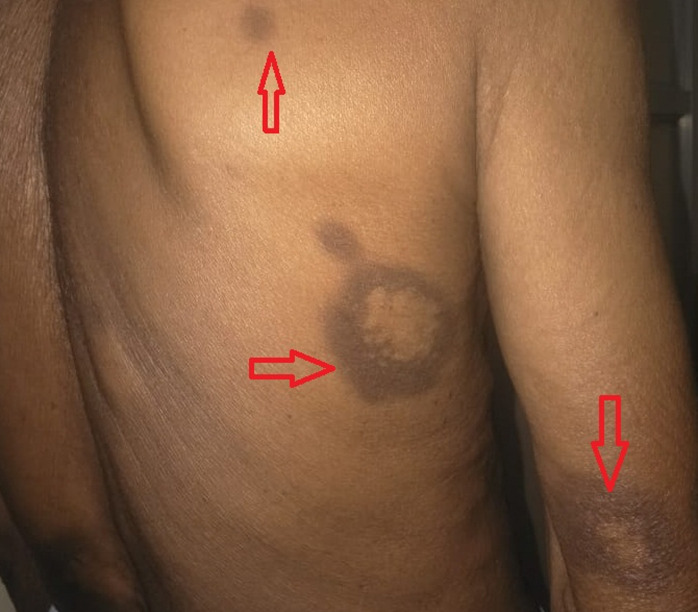 Figure 1
Peer Reviews
No public reviews on file for this paper yet. If you reviewed it on a platform where reviews are public (OpenReview, ICLR, NeurIPS, ICML), you can paste yours below so the community can read it here.
Videos
No videos yet. Explain this paper in a talk, walkthrough, or lecture? Add one.
Taxonomy
TopicsDrug-Induced Adverse Reactions · Blood disorders and treatments · Chemotherapy-related skin toxicity
Image in medicine
Fluoroquinolones are commonly used as antimicrobial agents in patients presenting with respiratory diseases with levofloxacin, ofloxacin, and moxifloxacin, and have a significant role in the management of pulmonary tuberculosis and atypical pneumonia. However, the use of fluoroquinolones is also associated with the development of adverse drug reactions such as tendon rupture, Qtc interval prolongation, and generalised drug eruptions. Here, we present a 70-year-old male patient who presented with generalised drug eruption rash over the body 3 days after starting levofloxacin therapy for atypical pneumonia. The patient was treated as per the dermatologist's advice with oral corticosteroids and antihistamines. After 7 days, significant improvement was noted in skin eruptions. This clinical image aims to highlight a rare adverse effect of a commonly used antimicrobial agent.
multiple lesions of generalised drug eruption in a patient treated with levofloxacin