Morphological and molecular identification of the cat flea Ctenocephalides felis from Bangladesh
Md Shamsudduha, Md Mahfuzur Rahman, Jannatun Naher, Azizul Islam Barkat, Sumaiya Akter, Mohammad Shamimul Alam

TL;DR
This study confirms the presence of cat fleas (Ctenocephalides felis) in Bangladesh using both physical and genetic analysis.
Contribution
The study provides the first morphological and molecular confirmation of C. felis in Bangladesh.
Findings
Morphological features matched C. felis, including the metatibial chaetotaxy formula (2-2-2-2-1-3).
DNA sequencing showed high sequence identity (99.12-99.78%) with known C. felis sequences from NCBI.
Phylogenetic analysis revealed genetic relationships among C. felis populations from different regions.
Abstract
The present study was designed to conduct molecular and morphological identification of cat fleas (Ctenocephalides felis) from Bangladesh along with nucleotide polymorphism and phylogenetic analysis. Samples were collected from two hosts (cat and human). The species was identified through morphological studies first, and then DNA was extracted for subsequent molecular analysis. A part of the mitochondrial 16S rRNA gene was amplified by polymerase chain reaction using extracted DNA as a template. The amplified region was sequenced using the Sanger dideoxy method. The sequence was subjected to NCBI BLASTn search. BioEdit and MEGA 11 software were used for multiple sequence alignment (MSA) and generating a phylogenetic tree. Morphological features such as shape, size, and appendages showed similarity with C. felis. The metatibial formula of chaetotaxy (2-2-2-2-1-3) was confirmed for…
Genes, proteins, chemicals, diseases, species, mutations and cell lines named across the full text — each resolved to its canonical identifier and authoritative record.
Click any figure to enlarge with its caption.
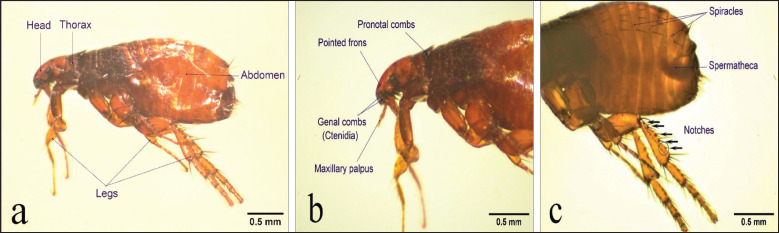 Figure 1
 Figure 2
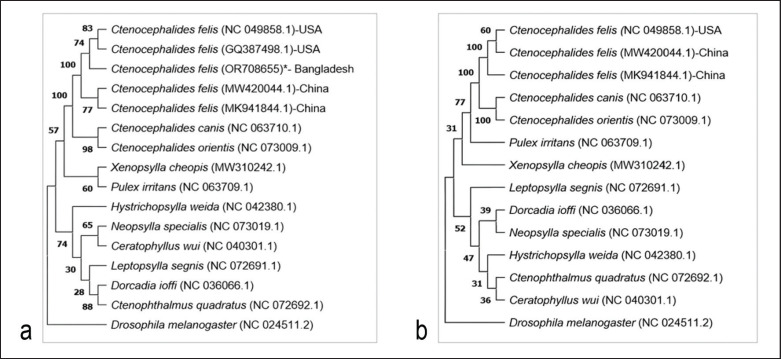 Figure 3
| Description | Max score | Total score | Query cover (%) | E value | Identical (%) | Accession |
|---|---|---|---|---|---|---|
| 828 | 828 | 100% | 0.0 | 99.78% | ||
| 813 | 813 | 100% | 0.0 | 99.12% | ||
| 813 | 813 | 100% | 0.0 | 99.12% | ||
| 706 | 706 | 90% | 0.0 | 98.03% | ||
| 767 | 767 | 100% | 0.0 | 97.34% | ||
| 745 | 745 | 100% | 0.0 | 96.46% |
| Name (Accession number) | Country | Sites | ||||
|---|---|---|---|---|---|---|
| 51 | 239 | 241 | 242 | 395 | ||
| Bangladesh | A | C | – | – | A | |
| China | G | T | T | A | A | |
| China | G | T | T | A | A | |
| USA | A | T | – | – | A | |
| USA | A | T | – | – | – | |
| Gap (–) represents base deletion. | ||||||
| Name (Accession number) | Total number of | Percentage of GC (GC%) | |||
|---|---|---|---|---|---|
| Adenine (A) | Thymine (T) | Guanine (G) | Cytosine (C) | ||
| 186 | 164 | 63 | 38 | 22.4% | |
| 186 | 165 | 63 | 37 | 22.2% | |
| 186 | 166 | 64 | 37 | 22.3% | |
| 186 | 166 | 64 | 37 | 22.3% | |
| 188 | 161 | 64 | 38 | 22.6% | |
| 190 | 158 | 66 | 38 | 23.0% | |
| 177 | 165 | 68 | 38 | 23.7% | |
Peer Reviews
No public reviews on file for this paper yet. If you reviewed it on a platform where reviews are public (OpenReview, ICLR, NeurIPS, ICML), you can paste yours below so the community can read it here.
Videos
No videos yet. Explain this paper in a talk, walkthrough, or lecture? Add one.
Taxonomy
TopicsYersinia bacterium, plague, ectoparasites research · Healthcare and Venom Research · Vector-borne infectious diseases
Introduction
Cat flea Ctenocephalides felis (Bouché 1835) is a member of the Pulicidae family under the Order Siphonaptera. They are important ectoparasites with veterinary medical significance considered to be the most common species of flea on earth [1]. These are hematophagous ectoparasites that transmit a variety of zoonotic vector-borne pathogens such as Rickettsia felis, Bartonella clarridgeiae, B. henselae, and Yersinia pestis which are the etiologic agents of flea-borne spotted fever, cat scratch disease, and plague, respectively [2–6]. It also acts as a secondary host of a cestode parasite, Dipylidium caninum, and its bite develops Flea Allergic Dermatitis (FAD) in cats, dogs, and humans [7–9]. Though the cat flea infests mainly domesticated cats and dogs worldwide, it is also found on other domesticated and feral animals such as domesticated sheep, donkeys, goats, water buffalo, roof rats, Rüppell’s fox, and so on, and its adaptability to various habitat conditions has made it geographically widespread [1,10–12]. Cat fleas may occasionally infest humans, resulting in discomfort and skin irritation [9,12,13].
In Bangladesh, R.* felis* infections vectored by fleas are diagnosed throughout the country [14]. Cat fleas play a potential role in transmitting R. felis (a bacteria) to humans globally, particularly in Bangladesh [15]. Although several morphological and molecular studies on cat fleas are conducted worldwide [16–18], only morphology has been studied in Bangladesh [19]. Dog flea C.* canis* and the cat flea C. felis have often been misidentified based on morphology [20]. Therefore, for this tiny organism, DNA-based molecular methods could provide reliability in species identification [21,22]. Very few morphological studies [19] and the absence of significant molecular analysis for identifying cat fleas in Bangladesh urged further studies to combine molecular techniques with morphology. In the present study, we utilized the 16S rRNA gene of mitochondrial DNA for the identification of the species from Bangladesh.
Materials and Methods
Ethical approval
No animal experiment has been done in this experiment. However, the fleas were collected from the animals without harming or giving minimum disturbances, following the animal welfare standards.
Sample collection and morphology analysis
Several specimens (about 10) of cat fleas were collected from each of the two hosts, a human and a cat. All specimens of cat fleas were collected from two locations on the Dhaka University campus, Dhaka, Bangladesh (23°43’52’’N, 90°23’29’’E and 23°43’28.31’’N, 90°24’03.82’’E). They were identified as C. felis based on external morphology. Due to morphological similarities, two samples were chosen for further study. Each was carried in a separate Eppendorf tube to the Genetics and Molecular Biology lab for morphometric and molecular study. Both specimens were photographed with a stereomicroscope (Leica EZ4). For morphological studies, the existing literature was consulted [16,17,19]. After confirmation of the identification of the species according to the morphological studies, one of the samples was sacrificed for the molecular studies.
DNA extraction, PCR amplification, sequencing, and bioinformatics information
The CTAB DNA extraction method was used for the isolation of DNA from the sample. A previously reported primer pair suitable for insects was used in PCR amplification for the mitochondrial 16S rRNA gene [23]. The forward and the reverse primers were (5’-CGC CTG TTT AAC AAA AAC AT-3’) and (5’-TTT AAT CCA ACA TCG AGG-3’), respectively. The purified PCR product was sequenced by the Sanger dideoxy method. After receiving the sequencing file, it was visualized and edited using the software FinchTV. Noisy areas of the sequence, as seen in the chromatogram, were removed from both ends to base the subsequent analyses on a quality sequence. The edited sequence was used for species identification and the comparison among related sequences with the aid of the Basic Local Alignment Search Tool (BLASTn) of the National Center for Biotechnology Information (NCBI). Multiple sequence alignment (MSA) of the species from different geographical areas was performed with the aid of ClustalW in BioEdit software [24]. DNA sequences were analyzed using both BioEdit [24] and MEGA 11 software [25] to find polymorphic sites.
Molecular phylogenetic trees were constructed using MEGA 11 software [25]. Two neighbor-joining phylogenetic trees were made and analyzed, one utilizing the 16S rRNA region and the other using the CO1 region of mitochondrial DNA. Various species belonging to the Siphonaptera order were selected for phylogenetic analysis. Both phylogenetic trees were constructed with the same species to facilitate a comparative analysis of their phylogenetic relationships. The partial mitochondrial 16S rRNA sequence from our research specimen was incorporated into the construction of the 16S rRNA tree. Fruit fly (Drosophila melanogaster) was used as an outer group for both the tree. The bootstrap value was 100 for this study.
Results and Discussion
Morphological identification
The flea was initially identified as C.* felis *based on its morphology before conducting molecular analysis.
Generic morphological features
The specimen is a small, 2.9 mm wingless insect with a shiny surface and a dark or reddish-brown coloration (Fig. 1a). At the posterior or ventral edges of the head, there are rows of dark spines, ctenidia, or comb that faced backward. The pronotal and genal ctenidium on the head both have eight or nine horizontally aligned spines (Fig. 1b).
The sternum consists of one or two ventral spines; the tergum of the ninth abdominal segment is changed to form the clasper, which is absent in females but present in males [19]. The third pair of legs is far longer than the other two pairs utilized for jumping (Fig. 1a). Each leg has a coxa, femur, tibia, and tarsus, as well as pygidium and antepygidial bristles on the posterior end. The female has spermatheca as a holding organ, and the forehead has maxillary palpus ventrally (Fig. 1c) [19].
Species-specific morphological features
The species C.* felis* is distinguished by its notably angled frons and more pointed-looking head (Fig. 1b). Length is usually more than double the height of the head. The first spine of the genal ctenidia exceeds at least half of the second in length [16]. *Ctenocephalides felis *often has two setae in its lateral metanotal area (LMA) [16]. It has small tergal spiracles as shown in Figure 1c. It contains fewer bristles in comparison with other species in this genus [16]. All six legs’ tibiae have five to six notches. One thick bristle between the post-median and apical long bristles [19]. The metatibial formula of chaetotaxy is 2-2-2-2-1-3. Female (the present specimen) spermatheca (a holding organ) contains a short hilla (Fig. 1c) [19].
Female C. felis. (a) The left side of the whole body. (b) Head and thorax region, showing pointed frons; 1st genal ctenidial length exceeds half of the 2nd one; pronotal combs; and maxillary palpus. (c) Leg’s tibia bearing 5 notches; female spermatheca (a holding organ); tergal spiracles.
A partial view of the MSA of 16S rRNA region of C. felis from different countries. The scale on top represents site numbers.
Molecular identification
After the successful extraction of DNA, a partial region of the mitochondrial 16S rRNA gene was amplified using the polymerase chain reaction (PCR) technique. The amplification was accomplished using the primers specific for the mitochondrial 16S rRNA gene. The resulting PCR products were visualized through agarose gel electrophoresis. The size of the amplified region was 472 base pairs (bp). Based on quality, a 451 bp DNA region was selected for further analysis (Accession no. OR708655). Mitochondrial markers are used in the identification and phylogenetic studies of different species, including insects [26]. 16S rRNA gene is one of the mitochondrial markers that is commonly used in the identification of different animal species [26,27].
More than 99% sequence similarity has been found in the case of 16S rRNA gene fragment of the present specimen when aligned with C.* felis* of the previous study [28]. NCBI BLAST nucleotide search shows 99.78% similarity with accession number NC_049858.1 and 99.12% similarity with accession number MW420044.1 and MK941844.1 where query coverage was 100% (Table 1). Other species of the Ctenocephalides genus such as C.* canis and C. orientis *show 97.34% (NC_063710.1) and 96.46% (NC_073009.1) similarity, respectively (Table 1). The sequence of our sample has been submitted to GenBank of the National Center for Biotechnology Information (NCBI). The GenBank accession number of our sample sequence is OR708655. The result of MSA, as outputs of ClustalW and BioEdit [24], has been presented in Figure 2.
Analysis of polymorphic sites
Aligning the sequence of the Bangladeshi sample with that of other countries provided information about polymorphic sites. Single nucleotide polymorphism (SNP), insertion, or deletion (indel) of nucleotide bases at the specific site of 16S rRNA gene of C.* felis* from different countries are shown in Table 2.
Ctenocephalides felis of China with accession numbers MW420044.1 and MK941844.1 contain Guanine (G) at site 51 whereas all others contain Adenine(A) at the same site (Table 2). The Bangladeshi specimen of the present study is distinct from all others at site 239 where there is Cytosine (C) instead of Thymine (T) (Table 2). C.* felis* of China (MW420044.1, MK941844.1) has a specific “TA” insertion at sites 241–242 whereas all others possess deletion on this site. GQ387498.1 has a deletion of a base at site 395 while others contain Adenine (A) as shown in Table 2.
A comparison of the nucleotides in related species of C.* felis* has been presented in Table 3. The sample specimen of the present study contains 41.24% Adenine (A), 36.36% Thymine (T), 13.97% Guanine (G), and 8.43% Cytosine (C) in the selected 16S rRNA region. The percentage of A is the highest, and C is the lowest. The AT/GC ratio of the sample specimen was found to be 3.47.
Phylogenetic analysis
Neighbor-joining phylogenetic trees were constructed based on the sequences of the 16S rRNA (Fig. 3a) and CO1 genes (Fig. 3b) to understand the relationships between the target flea species and other fleas belonging to the Siphonaptera order. A total of 16 partial sequences from the mitochondrial 16S rRNA region (Fig. 3a) and 14 partial sequences from the CO1 region (Fig. 3b) of the same 11 species were taken for phylogenetic relation analysis. Drosophila melanogaster (Accession number: NC_024511.2) was used as an outgroup that falls outside the group of interest.
*Phylogenetic relationship among different species from the order Siphonaptera using mitochondrial 16S rRNA gene (a) and mitochondrial CO1 gene (b). Marked sequence depicts the present study. Numbers representing bootstrap values.
In the mitochondrial 16S rRNA gene-based phylogenetic tree, C.* felis *of Bangladesh (OR708655) shows a closer relationship with that of the USA (NC_049858.1, GQ387498.1) when compared to the sequences from China (MK941844.1, MW420044.1) (Fig. 3a). Thus, it indicates that the USA origin seems to be more closely related to Bangladeshi origin compared to China.
In the case of both 16S rRNA and CO1, the species C. felis of different origins construct a cluster in the phylogenetic tree (Fig. 3a). One of the two C.* felis* specimens of China (MW420044.1) shows more relatedness with the USA (NC_049858.1) as shown in the phylogenetic tree based on the mitochondrial CO1 region (Fig. 3b). The relationship of USA, China and Bangladesh origin cannot be ascertained due to a lack of CO1 sequence data from Bangladesh. C. canis (NC_063710.1) and C.* orientis* (NC_073009.1) cluster together and are separated from C.* felis* in both mitochondrial 16S rRNA (Fig. 3a) and CO1 gene (Fig. 3b) based phylogenetic tree.
Xenopsylla cheopis (MW310242.1) and Pulex irritans (NC_063709.1) are in the same clade in the 16S rRNA tree (Fig. 3a) but separated in the CO1 tree (Fig. 3b). The cluster of Neopsylla specialis (NC_073019.1) and Ceratophyllus wui (NC_040301.1) is connected to the cluster of *Leptopsylla segnis *(NC_072691.1), Dorcadia ioffi (NC_036066.1), and Ctenophthalmus quadratus (NC_072692.1); Hystrichopsylla weida (NC_042380.1) is in a separate branch (Fig. 3a). On the other hand, in the CO1 tree, the cluster of D. ioffi (NC_036066.1) and *N. specialis *(NC_073019.1) is connected with cluster of C. quadratus (NC_072692.1), C. wui (NC_040301.1), and *H. weida *(NC_042380.1); *L. segnis *(NC_072691.1) remains in a separate branch (Fig. 3b).
Conclusion
The integration of both molecular and morphological approaches provides a comprehensive and reliable method for the accurate identification of this important ectoparasite. C.* felis* of different geographical locations showed distinctiveness in the sequence of the 16S rRNA gene, which may help in strain identification as well. To the best of our knowledge, our sequence of C. felis from Bangladesh is the first to be submitted to NCBI GenBank. Besides, the study can aid in further studies on the biology, ecology, and control of cat fleas as well as contribute to our understanding of their potential role in disease transmission.
The reference list from the paper itself. Each links out to its DOI / PubMed record.
- 1Moore CO AndréMR Šlapeta J Breitschwerdt EB Vector biology of the cat flea Ctenocephalides felis Trends Parasitol 202440432437 https://doi.org/10.1016/j.pt.2024.02.0063845888310.1016/j.pt.2024.02.006PMC 11168582 · doi ↗ · pubmed ↗
- 2Calvani NED Bell L Carney A De La Fuente C Stragliotto T Tunstall M The molecular identity of fleas (Siphonaptera) carrying Rickettsia felis, Bartonella clarridgeiae and Bartonella rochalimae from dogs and cats in Northern Laos Heliyon 20206747 https://doi.org/10.1016/j.heliyon.2020.e 0438510.1016/j.heliyon.2020.e 04385 PMC 736403932695906 · doi ↗ · pubmed ↗
- 3Beliavskaia A Tan KK Sinha A Husin NA Lim FS Loong SK Metagenomics of culture isolates and insect tissue illuminate the evolution of Wolbachia, Rickettsia and Bartonella symbionts in Ctenocephalides spp. fleas Microb Genom 202397001045 https://doi.org/10.1099/mgen.0.00104510.1099/mgen.0.001045 PMC 1043880037399133 · doi ↗ · pubmed ↗
- 4Hamzaoui B El Zurita A Cutillas C Parola P Fleas and flea-borne diseases of North Africa Acta Trop 2020211105627 https://doi.org/10.1016/j.actatropica.2020.1056273265205410.1016/j.actatropica.2020.105627 · doi ↗ · pubmed ↗
- 5Ehlers J Krüger A Rakotondranary SJ Ratovonamana RY Poppert S Ganzhorn JU Molecular detection of Rickettsia spp., Borrelia spp., Bartonella spp. and Yersinia pestis in ectoparasites of endemic and domestic animals in southwest Madagascar Acta Trop 2020205105339 https://doi.org/10.1016/j.actatropica.2020.1053393193535410.1016/j.actatropica.2020.105339 · doi ↗ · pubmed ↗
- 6Dewitte A Bouvenot T Pierre F Ricard I Pradel E Barois N A refined model of how Yersinia pestis produces a transmissible infection in its flea vector P Lo S Pathog 2020164128 https://doi.org/10.1371/journal.ppat.100844010.1371/journal.ppat.1008440 PMC 718572632294143 · doi ↗ · pubmed ↗
- 7Chin HC Ahmad NW Lim LH Jeffery J Hadi AA Othman H Infestation with the cat flea, Ctenocephalides felis felis (Siphonaptera: Pulicidae) among students in Kuala Lumpur, Malaysia Southeast Asian J Trop Med Public Health 20104161331421329307 · pubmed ↗
- 8Beugnet F Labuschagne M Fourie J Jacques G Farkas R Cozma V Occurrence of Dipylidium caninum in fleas from client-owned cats and dogs in Europe using a new PCR detection assay Vet Parasitol 20142051–23006 http://doi.org/10.1016/j.vetpar.2014.06.0082498643210.1016/j.vetpar.2014.06.008 · doi ↗ · pubmed ↗