Evaluation of gonadotropin-releasing hormone agonist and antagonist protocols on pregnancy outcomes in POSEIDON groups 3 and 4: A randomized controlled trial
Zahra Aminimajomerd, Maryam Eftekhar, Nooshin Hatamizadeh, Shahrzad Moeinaddini

TL;DR
This study compared two fertility treatment protocols for women with low ovarian reserve and found similar pregnancy outcomes, but one was more cost-effective.
Contribution
The study provides evidence that GnRH-antagonist protocols are more cost-effective than long GnRH-agonist protocols for women with low ovarian reserve.
Findings
GnRH-antagonist and long GnRH-agonist protocols had similar clinical pregnancy and live birth rates.
The antagonist protocol required shorter stimulation and lower gonadotropin doses.
The antagonist protocol was found to be more cost-effective.
Abstract
Women with low ovarian reserve are the capable part of people who refer to infertility centers, this study compares 2 treatment protocols in cases with low ovarian reserve. This study aimed to compare the efficacy of gonadotropin-releasing hormone (GnRH) agonist and GnRH-antagonist protocols in women with diminished ovarian reserve (DOR) in POSEIDON groups 3–4 undergoing in assisted reproductive technology (ART). This randomized clinical trial enrolled 158 infertile women with diminished ovarian reserve undergoing ART at the Research and Clinical Center for Infertility, Yazd, Iran from January to October 2024. Women were randomly assigned to either a GnRH-antagonist (n = 84) or a long GnRH-agonist (n = 74). Primary outcomes included clinical pregnancy and secondary outcomes were chemical pregnancy, early abortion rate, ongoing pregnancy, and implantation rate. No significant…
Genes, proteins, chemicals, diseases, species, mutations and cell lines named across the full text — each resolved to its canonical identifier and authoritative record.
Click any figure to enlarge with its caption.
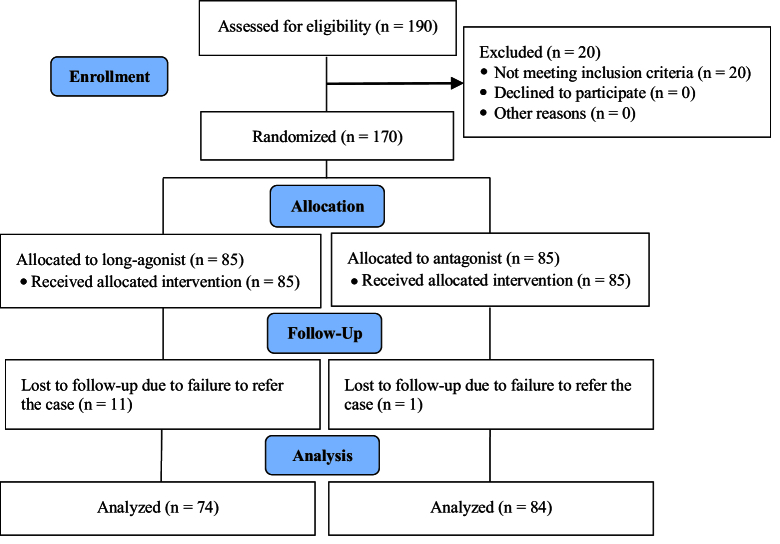 Figure 1
Peer Reviews
No public reviews on file for this paper yet. If you reviewed it on a platform where reviews are public (OpenReview, ICLR, NeurIPS, ICML), you can paste yours below so the community can read it here.
Videos
No videos yet. Explain this paper in a talk, walkthrough, or lecture? Add one.
Taxonomy
TopicsOvarian function and disorders · Assisted Reproductive Technology and Twin Pregnancy · Reproductive Biology and Fertility