Association Between ACL Continuity on Magnetic Resonance Imaging at 5 Years After an Acute ACL Rupture and 11-Year Outcomes: A Secondary Analysis From the KANON Trial
Stephanie R. Filbay, Frank Roemer, Ewa M. Roos, Aleksandra Turkiewicz, Richard Frobell, L. Stefan Lohmander, Martin Englund

TL;DR
This study found that patients with ACL continuity on MRI at 5 years after injury had worse knee outcomes at 11 years compared to those who had ACL reconstruction.
Contribution
The study is the first to link ACL continuity on MRI at 5 years with long-term clinical outcomes at 11 years after an ACL rupture.
Findings
ACL continuity at 5 years was associated with worse KOOS4 scores at 11 years compared to early or delayed ACLR.
Patients with ACL continuity had similar or worse outcomes compared to those with ACL discontinuity.
Rates of radiographic osteoarthritis varied across treatment groups, with early ACLR showing the highest patellofemoral osteoarthritis.
Abstract
Emerging evidence suggests that anterior cruciate ligament (ACL) ruptures can restore ACL fiber continuity. The relationship between ACL continuity on magnetic resonance imaging (MRI) (sign of ACL healing) and outcomes >5 years after an acute ACL rupture has not been investigated. This study aimed to (1) describe clinical outcomes and radiographic osteoarthritis (ROA) at 11 years based on ACL continuity status at 5 years and (2) investigate the relationship between 5-year ACL continuity status and 11-year Knee Injury and Osteoarthritis Outcome Score (KOOS4) scores. Secondary analysis of KANON randomized controlled trial; Level of evidence, 3. Overall, 105 of 121 (87%) active adults with acute ACL ruptures randomized to undergo initial exercise therapy and optional delayed ACL reconstruction (ACLR) or early ACLR and postoperative exercise therapy completed 11-year follow-up. MRI scans…
Genes, proteins, chemicals, diseases, species, mutations and cell lines named across the full text — each resolved to its canonical identifier and authoritative record.
Click any figure to enlarge with its caption.
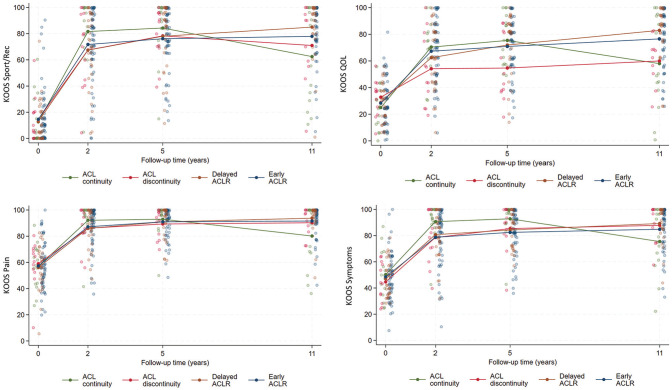 Figure 1
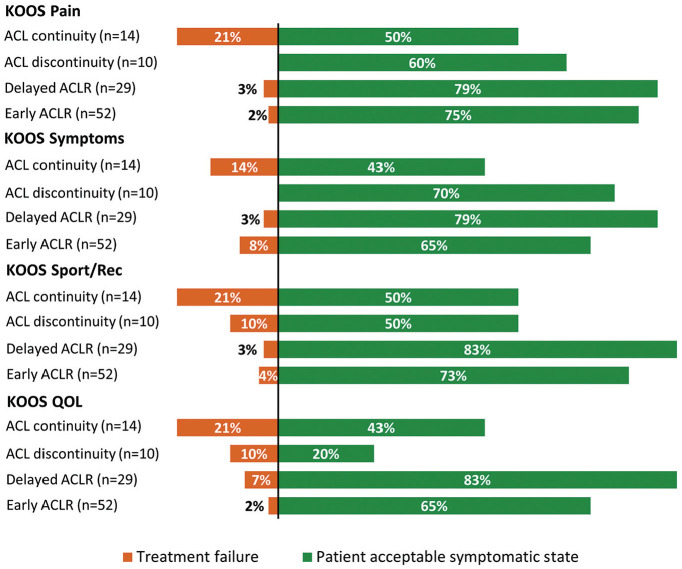 Figure 2
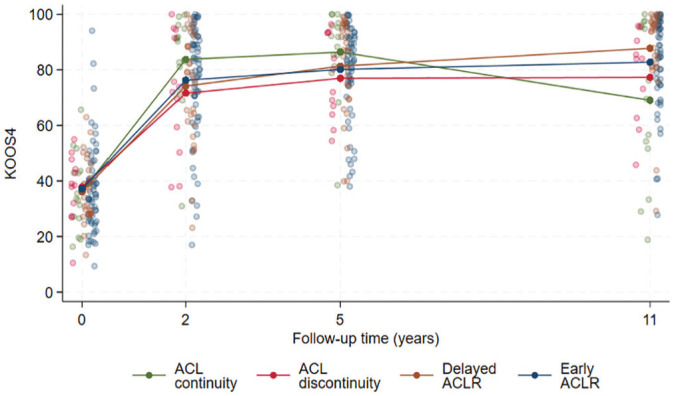 Figure 3
 Figure 4
 Figure 5
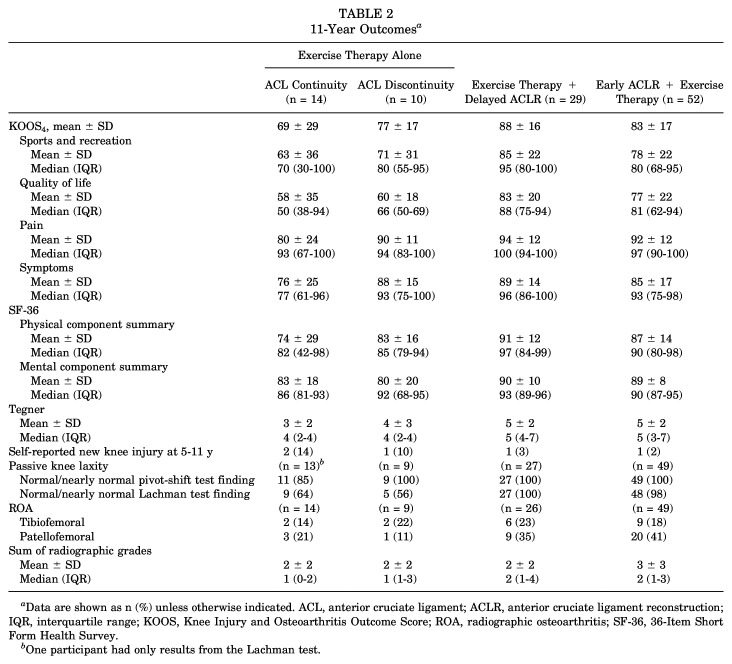 Figure 6
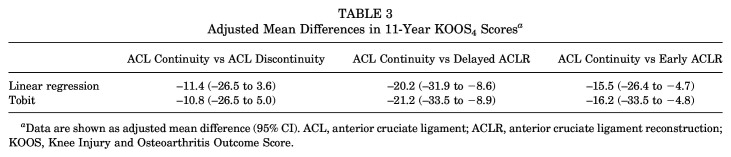 Figure 7
Peer Reviews
No public reviews on file for this paper yet. If you reviewed it on a platform where reviews are public (OpenReview, ICLR, NeurIPS, ICML), you can paste yours below so the community can read it here.
Videos
No videos yet. Explain this paper in a talk, walkthrough, or lecture? Add one.
Taxonomy
TopicsKnee injuries and reconstruction techniques · Total Knee Arthroplasty Outcomes · Sports injuries and prevention