Prevalence, spermatozoa, hormonal, and genetic evaluation of rare mosaic klinefelter syndrome patients in southern China
Derong Li, Yuqing Lai, Yujuan Liao, Jinjie Pan, Yudi Luo, Yunning Liang, Bowen Luo, Lingling Zhu, Guosheng Deng, Xiang Li, Keng Feng, Feifei Lei, Liuping Lan

TL;DR
This study examines the prevalence and characteristics of rare mosaic Klinefelter syndrome in southern China, finding that it affects 0.172% of infertile men and shows varied sperm and hormone profiles.
Contribution
The study provides new insights into the genetic and reproductive characteristics of mosaic Klinefelter syndrome in a southern Chinese population.
Findings
Mosaic Klinefelter syndrome accounts for 0.172% of infertile male patients in southern China.
The most common karyotype in mosaic KS is 47,XXY/46,XY, found in 78.57% of cases.
Patients with mosaic KS show varied sperm conditions and can achieve biological fatherhood through assisted reproductive techniques.
Abstract
Klinefelter syndrome (KS) is the most common genetic cause of male infertility in humans. Mosaic KS is a subtype of KS. Due to its low prevalence, the lack of typical clinical signs, and the limited professional awareness of the syndrome, many cases of mosaic KS remain undiagnosed. To investigate the prevalence of rare mosaic KS, karyotype characteristics, reproductive hormone levels, and sperm quality in southern China, and to enrich our knowledge of patients with mosaic KS. The chromosome results of 8,110 cases of infertile male patients attending the Reproductive Center of Yulin Maternal and Child Health Hospital from January 2018 to July 2024 were retrospectively analyzed. Semen, sex hormone tests, and Y chromosome microdeletions were analyzed in fourteen selected patients with a diagnosis of mosaic KS. Among the 8,110 male infertility patients, a total of 0.703% (57/8,110) were…
Genes, proteins, chemicals, diseases, species, mutations and cell lines named across the full text — each resolved to its canonical identifier and authoritative record.
Click any figure to enlarge with its caption.
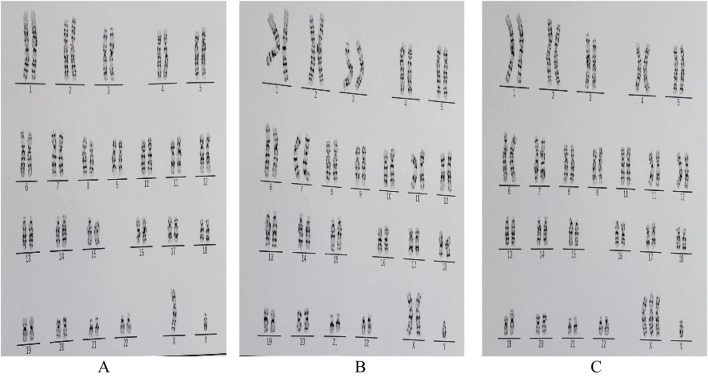 Figure 1
Peer Reviews
No public reviews on file for this paper yet. If you reviewed it on a platform where reviews are public (OpenReview, ICLR, NeurIPS, ICML), you can paste yours below so the community can read it here.
Videos
No videos yet. Explain this paper in a talk, walkthrough, or lecture? Add one.
Taxonomy
TopicsGenetic and Clinical Aspects of Sex Determination and Chromosomal Abnormalities · Herpesvirus Infections and Treatments · Sperm and Testicular Function